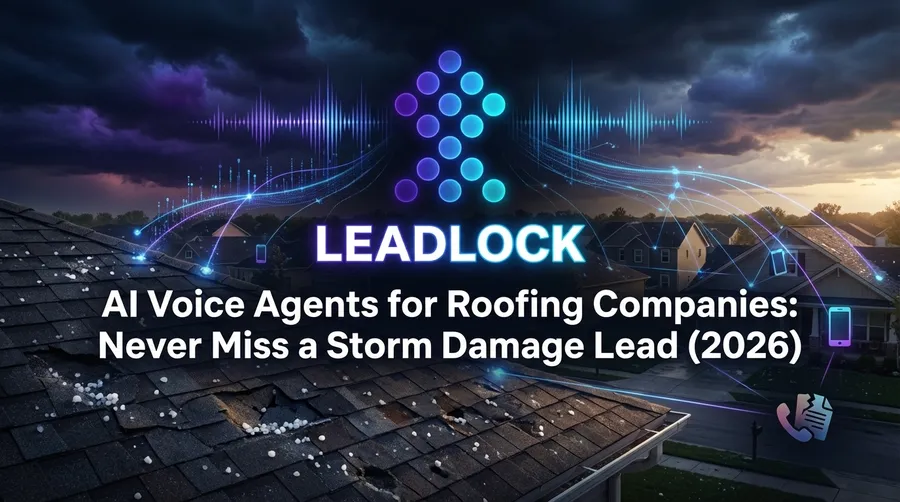
Storm damage calls spike 400% after severe weather. Learn how AI voice agents help roofing companies capture every lead 24/7 from $0.12/min.
- Storm call volumes spike 300–500% after severe weather events, and the first roofer to respond wins 78% of storm damage jobs - making 24/7 call coverage essential.
- 85% of roofing customers who don’t get answered on their first call immediately contact a competitor, with each missed call costing $1,500–$2,000 in lost revenue.
- Leadlock’s true speech-to-speech architecture (about 300ms replies on Grok) answers multiple calls at the same time 24/7 starting at $0.12/min plus Twilio phone charges - versus $37,000+/year for a human receptionist.
- Early adopters of other AI voice vendors report results including 2.3x revenue growth, 280% more qualified appointments, and 100% call answer rates after deploying AI voice agents.
Leadlock is an AI voice agent platform that answers every inbound call instantly, 24/7, and replies in about a third of a second on Grok (median of 461 live turns, measured September 2026). It qualifies storm damage leads and books inspections automatically, starting from just $0.12 per minute. When the next hailstorm hits your market, Leadlock ensures you’re the first contractor to respond - and that contractor wins 78% of the time.
Why Do Roofing Companies Lose So Many Storm Damage Calls?
Roofing companies lose storm calls because their phone infrastructure was never designed for surges. A normal day might bring 20–30 inbound calls. A major storm event generates 500–1,000.
No receptionist can handle that volume. No answering service can scale that fast. So calls pile up, go to voicemail, or ring out entirely - and homeowners move down their list to the next roofer who picks up.
The data is sobering:
- 85% of roofing customers who don’t get answered on their first call will not call back - they immediately contact a competitor (JobNimbus, 2025)
- 78% of customers choose the first contractor to respond, regardless of price (JobNimbus Speed-to-Lead Guide, 2025)
- Leads contacted within 5 minutes are 21x more likely to convert than those reached after 30 minutes (JobNimbus, 2025)
- The average cost of a single missed call for a roofing company is $1,500–$2,000 in lost revenue (JobNimbus, 2025)
- The average home services response time is 42 hours - giving fast responders an enormous competitive edge
The math is brutal. If you miss 5 storm calls per week during peak season at $1,500 average value, that’s $7,500 per week in lost revenue. Over a 12-week storm season, that’s $90,000 gone - because the phone wasn’t answered.
How Big Is the Storm Damage Opportunity in 2026?
The roofing industry is in a golden era for storm-related revenue - and it’s only getting larger.
U.S. roof insurance claims reached nearly $31 billion in 2024, a 30% increase since 2022, according to data from Verisk and GlobeNewsWire. Wind and hail are the dominant loss drivers, accounting for over half of all residential claims. Non-catastrophic wind/hail claims alone surged from 17% to 25% of all claims between 2022–2024.
Over 12 million U.S. properties experienced hail damage in 2024 (RoofLink, 2025). Areas hit by severe weather saw a 65% spike in roof-related insurance claims within nine months. Approximately 22% of all residential roofing replacements stem from storm damage - a predictable, high-margin revenue stream for contractors who can capture it.
The U.S. roofing contractor industry generates $76.4 billion in annual revenue (Ridgeline Construction, 2026), with 78% of contractors expecting sales to increase in 2026. Storm damage jobs command 20–30% higher profit margins than routine replacements, with average job values of $8,500–$25,000.
This is not a niche market. This is the core of a modern roofing company’s revenue - and it flows through the phone.
What Happens During a Storm Call Surge (And Why It Breaks Normal Systems)
Here’s what actually happens when a major hail event hits your service area:
- Weather alerts go out at 2 PM
- Homeowners step outside, see damage, and start calling contractors immediately
- By 4 PM, you’re receiving 10x your normal call volume
- Your office line shows 15 calls in queue
- Your receptionist is on one call, forwarding voicemails to no one
- By 8 PM, most homeowners have already booked with whoever answered first
The first contractor to respond wins 78% of storm damage jobs, according to JobNimbus. Connection rates fall off a cliff with time: under 5 minutes = 90% connection rate; 5–30 minutes = 62%; 30–60 minutes = 31%.
This isn’t a staffing problem you can solve by hiring more receptionists. You can’t staff for 500 simultaneous calls. You need a system that is not limited to one call at a time - and that’s exactly what AI voice agents provide.
Pro Tip: Set up your Leadlock AI agent with a storm damage intake script before peak season. Include questions about roof age, whether they plan to file an insurance claim, type of damage (hail, wind, water intrusion), and urgency level. The agent will triage every call and route active leaks to emergency dispatch while booking standard inspections directly into your calendar - all without human involvement.
How Do AI Voice Agents Handle Storm Call Surges?
An AI voice agent handles storm surges by removing the one-call-at-a-time limit. While a human receptionist handles one call at a time during a 40-hour work week, an AI voice agent handles multiple calls at the same time, 24 hours a day, every day.
Here’s what a Leadlock-powered roofing workflow looks like during a storm event:
- Homeowner calls - Leadlock answers on the first ring
- Immediate triage - Agent asks about damage type, urgency, insurance coverage, and location
- Lead qualification - Confirms they’re the property owner, gets contact info, determines job scope
- Appointment booking - Schedules inspection directly into your calendar system (ServiceTitan shops can use a voice agent that books jobs into ServiceTitan)
- Insurance flag - Notes whether the homeowner plans to file a claim; policy numbers and claim details go to your staff
- CRM sync - Pushes all lead data to GoHighLevel natively, or to any other CRM with an API through custom functions or the post-call webhook
- Follow-up trigger - Sends a confirmation SMS and flags high-priority leads for callback
This workflow runs identically whether you receive 5 calls or 500 calls. No dropped calls, no hold queues, no missed leads.
Why Leadlock’s Architecture Beats the Competition on Storm Days
Most AI voice agent platforms use a three-step orchestration pipeline: Speech-to-Text → LLM → Text-to-Speech. That’s three separate API calls for every conversational exchange, and each one adds delay to every response.
During a normal call, that delay is annoying. During a storm surge, when a homeowner is anxious, standing in their rain-soaked backyard, calling five contractors simultaneously - that 1.5-second pause feels like an eternity. Many hang up.
Leadlock is different. Leadlock uses true speech-to-speech architecture: Audio In → Native Multimodal Model → Audio Out. One step. No transcription. No text intermediary. Replies come in about 300ms on Grok (median). Calls feel natural, not robotic.
Here’s how Leadlock stacks up against competitors during a high-volume storm event:
| Feature | Leadlock | Vapi | Retell | Synthflow | Bland |
|---|---|---|---|---|---|
| Response latency | ~300ms reply (Grok, median) | Varies by stack | Varies by stack | Varies by stack | Varies by stack |
| Architecture | 1-step multimodal | STT→LLM→TTS | STT→LLM→TTS | STT→LLM→TTS | STT→LLM→TTS |
| Concurrent calls | Multiple at the same time | Limited by plan | Limited by plan | Limited by plan | Limited by plan |
| Setup time | Under 5 minutes | Hours to days | Hours to days | Hours to days | Hours to days |
| Starting price (all-in) | $0.12/min on Pro ($497/mo plan), model + voice; Twilio billed separately | $0.15–$0.33/min | $0.13–$0.20+/min | $0.15–$0.24/min | $0.11–$0.14/min + fees |
| Native GHL integration | Yes | Partial | No | No | No |
Competitors advertise $0.05–$0.09/minute, but that’s before you add Speech-to-Text costs, LLM API fees, Text-to-Speech costs, and telephony. Real all-in costs run $0.13–$0.33/min. Leadlock’s pricing is all-in for the model and voice: no separate STT, LLM or TTS fees. Phone numbers and carrier minutes are billed by your own Twilio account.
What Does Leadlock Cost for a Roofing Company?
Leadlock offers five voice providers (the four most used are below), letting roofing companies choose the right price/quality balance for their use case:
- Gemini Live - from $0.12/min on Pro ($0.18 Starter, $0.15 Agency). Best for high-volume storm surge handling where you need to answer every call affordably.
- Grok Voice (xAI) - from $0.12/min on Pro. Balanced quality and cost for day-to-day inbound calls.
- OpenAI Realtime - from $0.20/min on Pro. Premium quality for high-value commercial roofing leads.
- ElevenLabs - $0.15/min on Pro. Ultra-realistic voice for luxury residential or high-end commercial accounts.
For a roofing company running 1,000 minutes per month with Gemini, the total cost is about $291/month on the Starter plan ($97 + 1,000 x $0.18 = $277, plus about $14 in Twilio charges: about $0.013/min inbound and $1.15/month per local number at Twilio’s US rates). That’s about $3,494/year to answer every single inbound call - compared to a human receptionist at $37,000–$44,000/year (ZipRecruiter, 2026).
A single captured storm job at $9,500 average value pays for nearly three years of AI reception at that rate.
For more detail on how these platforms compare on cost, see our AI Voice Agent Platform Pricing in 2026: Real Cost Breakdown.
Real Results: What Roofing and Home Service Companies Are Seeing
The performance data from early adopters is striking.
A Texas roofing company deployed an AI voice agent (reported by VoiceI.ai) over 90 days with $5,500/month in ad spend unchanged. Results: conversion rate improved from 18% to 37%, missed calls dropped from 42% to 0%, and monthly revenue increased 2.3x versus the pre-AI period.
A Denver residential roofer using OpenMic AI’s platform saw a 280% increase in qualified appointments, 45% boost in customer satisfaction, 30% reduction in no-shows, and $320,000 in new revenue over 6 months - a 650% ROI.
A Tampa commercial roofing contractor achieved a 100% call answer rate, $1.2M in new revenue over 12 months, and 40% reduction in staff overtime.
ServiceAgent AI reports booking over 12,792 appointments for roofing clients with a consistent 56% average job booking rate. King Roofing decreased inbound status calls by 80% using automated progress notifications.
These aren’t outlier results. They reflect what happens when every call gets answered immediately, every lead gets qualified properly, and every appointment gets booked automatically - at scale.
How to Set Up Leadlock for Your Roofing Business
Getting started with Leadlock takes under 5 minutes. Here’s the process:
- Create your account at leadlock.ai - start with a 7-day free trial
- Build your storm damage intake script - start from the setup wizard or the Home Services template and cover damage type, location, insurance coverage, urgency, contact info
- Connect your calendar - GoHighLevel calendars work natively; Google Calendar, Calendly, and anything else with an API can be connected through custom functions (webhooks)
- Set your routing rules - emergency calls (active leaks) go to on-call crew; standard inspection requests book into the weekly calendar
- Connect your CRM - if you’re on GoHighLevel, Leadlock has native integration that pushes lead data automatically
- Set your business hours and after-hours behavior - Leadlock handles 24/7 with different scripts for peak hours vs. off-hours
- Test with a live call - make a test call, verify the flow, adjust prompts as needed
- Go live - connect your own Twilio account and import your business number, or import one from GoHighLevel
For agencies managing multiple roofing clients, Leadlock’s native GoHighLevel integration makes this even simpler. One platform, a sub-account per client, and your own branding (logo, colours, company name). See our guide on Best GoHighLevel AI Voice Agent Integrations for Agencies in 2026 for the full setup walkthrough.
The After-Hours Problem Roofing Companies Ignore
Storm damage doesn’t follow business hours. A hail event hits at 9 PM. A homeowner wakes up to a leaking roof at 6 AM Saturday. Insurance adjusters call back during lunch on Wednesday.
Industry research shows that 40–45% of all business calls arrive outside standard 9-to-5 hours (Nextiva). For home services specifically, up to 40% of roofing inquiries occur after hours (JobNimbus, 2025). Those after-hours calls are your most motivated buyers - they’re not shopping around, they have an active problem, and they need someone right now.
The roofer who answers at 9:30 PM gets the job. The roofer who calls back Thursday morning finds out the homeowner already signed with someone else.
Leadlock runs 24/7 with no degradation. The same fast replies at 2 AM as at 2 PM. The same lead qualification. The same appointment booking. AI reception captures an extra 15–20% of appointments outside business hours (GetAira, 2026) - appointments that would have been lost entirely with traditional staffing.
For a deeper look at the after-hours opportunity, see our post on 24/7 AI Receptionist: Why Your Business Can’t Afford to Miss After-Hours Calls.
What to Look for in an AI Voice Agent for Roofing
Not all AI voice platforms are built for the volume spikes and urgency of storm damage work. Here’s what matters:
Non-negotiable requirements:
- Handles multiple calls at the same time - you cannot afford a one-call-at-a-time limit during a storm event
- Fast, measured reply times - hesitation kills trust on urgent calls
- 24/7 operation with after-hours scripts - storm damage doesn’t stop at 5 PM
- CRM integration - every lead must flow into your system without manual entry
- Emergency escalation routing - active leaks need immediate human response, not an appointment slot next Tuesday
- Insurance claim flag - whether a claim is involved, with policy numbers and claim details left to your staff
- Appointment booking - direct calendar integration, not just message-taking
Nice to have:
- GHL native integration (critical for agencies)
- White-label options for multi-location contractors
- Outbound follow-up capability for web form leads
- Call recording and transcription for training
On ServiceTitan? Leadlock’s ServiceTitan AI voice agent checks live availability and sends the booking request into ServiceTitan during the call, for your office to confirm.
Frequently Asked Questions
Q: Can an AI voice agent really handle storm damage calls effectively?
Yes. Modern AI voice agents like Leadlock use native multimodal models that understand context, urgency, and nuance - not simple IVR scripts. They capture damage type, insurance coverage, contact details, and schedule inspections with the same accuracy as a trained human receptionist, but without the 4-ring wait.
Q: What happens if a homeowner has an active roof leak and needs emergency service?
You configure Leadlock with escalation routing rules. When the AI detects keywords like “active leak,” “water coming in,” or “emergency,” it immediately routes the call to your on-call crew’s mobile number - bypassing the standard appointment booking flow. High-urgency calls get human attention; standard inspection requests get automated.
Q: How does Leadlock’s pricing compare to hiring a receptionist for storm season?
A human receptionist costs $37,000–$44,000 per year and handles one call at a time, 40 hours per week. Leadlock handles multiple calls at the same time, 24/7, at about $291/month for 1,000 minutes on Gemini (Starter plan: $97 + 1,000 x $0.18, plus about $14 in Twilio charges). A single captured storm job at $9,500 average value covers more than two and a half years of Leadlock costs.
Q: Will callers know they’re talking to an AI?
They should. We recommend the agent says it is an AI assistant at the start of the call; you write that line into the agent prompt. Leadlock’s speech-to-speech technology sounds natural because there’s no transcription delay. For best results, train your agent with your company name, service area, and a conversational intake script - not a robotic checklist.
Q: How quickly can I get Leadlock set up before storm season?
Leadlock is live in under 5 minutes. Create your account, build your intake script, connect your calendar and CRM, and connect your number through Twilio or GoHighLevel. There’s no SIP trunking to configure, no developer required, no weeks of onboarding. You can be ready for the next storm event the same afternoon you sign up.
Q: Does Leadlock integrate with GoHighLevel?
Yes. Leadlock has native GoHighLevel integration. Lead data, call recordings, appointment bookings, and follow-up triggers all flow directly into your GHL pipeline automatically.
Q: What’s the difference between Leadlock and platforms like Retell or Synthflow?
The core difference is architecture. Retell and Synthflow use the legacy Speech-to-Text → LLM → Text-to-Speech pipeline, which adds a hop for transcription and another for text-to-speech on every conversational turn. Leadlock uses true speech-to-speech: one step, about 300ms replies on Grok. On anxious storm damage calls, that difference is felt immediately. Pricing-wise, Leadlock’s model-and-voice rate starts at $0.12/min (Twilio phone charges are separate) versus Retell’s real cost of $0.13–$0.20+/min when you include all API fees.
Q: Which storm seasons should I be most prepared for?
Seasonal peaks vary by region. Tornado Alley (Texas, Oklahoma, Kansas) sees peak activity March–June. Hurricane season runs June–November along the Gulf Coast and Southeast. Hail season peaks April–September across the Midwest and Plains. If you’re in any of these regions, have your AI agent configured and tested before the season starts - not during the first major event when call volume spikes.
Stop Missing Storm Damage Leads
The next hailstorm in your market will generate hundreds of calls. The roofing companies that capture those leads aren’t the ones with the best crews or the lowest prices - they’re the ones who answer the phone first.
Leadlock gives you that edge: about 300ms replies on Grok, multiple calls at the same time, 24/7 availability, and native GoHighLevel integration - starting at $0.12 per minute. No setup fees, no SIP trunking, no developer required. Live in under 5 minutes.
Get started free at leadlock.ai - be ready before the next storm hits your market.
See It Book a Real Job
Voice agents that book into ServiceTitan and GoHighLevel, live today for home-service brands. Book 15 minutes with Dan, or start a 7-day trial from the pricing page.
Book a 15-minute call with Dan