Voice AI for banking: real cost at 10,000 minutes a month across 5 agents, and the SOC 2 and PCI checks to run (Leadlock has no SOC 2 or PCI).
- BFSI holds 32.9% of all voice AI deployments. AI-resolved banking calls cost ~$0.40 vs $7-12 for human-handled calls, with 391% three-year ROI documented by Forrester.
- True speech-to-speech architecture (Leadlock) replies in about 300ms on Grok, while orchestration-layer platforms add a hop for transcription and another for text-to-speech. Banking customers hear every pause.
- Orchestration-layer platforms advertise $0.05-$0.09/min but bill $0.13-$0.33/min all-in. Leadlock starts at $0.12/min for the model and voice, with no STT, LLM or TTS fees added; telephony runs through your own Twilio account.
- Complex dispute resolution, investment advice, and active fraud escalations are not ready for full voice AI automation. High-volume routine inquiries are where the ROI lives.
Banking is the top adopter of voice AI by vertical share. Financial services holds a 32.9% market share of all voice AI deployments, according to Mordor Intelligence data. That’s not a coincidence. Banking call centers run at scale, process millions of repetitive inquiries, and operate under compliance requirements that make legacy IVR systems a permanent liability.
The problem: most platforms selling into banking still run the three-step orchestration architecture. Speech-to-text captures the caller’s words, an LLM processes the transcript, text-to-speech converts the response back to audio. Three API calls per exchange, and each hop adds delay. Banking customers hear the pause. Some hang up. Others assume something is wrong.
Leadlock runs true speech-to-speech: Audio In, native multimodal model, Audio Out. One step, with no separate transcription and text-to-speech chain. Leadlock agents reply in about a third of a second on Grok (median of 461 live turns, measured September 2026). The conversation sounds like a conversation. Pricing for the model and voice starts at $0.12/minute on Gemini Live or Grok Voice on the Pro plan, with no separate STT, LLM or TTS fees. Phone numbers and carrier minutes are billed by your own Twilio account.
This guide ranks the best voice AI agents for banking in 2026, breaks down what compliance actually requires, and shows the real cost difference between advertised rates and actual invoices.
What Is a Voice AI Agent for Banking?
A voice AI agent for banking is an automated phone system powered by a large language model that handles inbound and outbound calls without a human agent: answering balance inquiries, verifying identities, processing payment reminders, routing fraud alerts, and booking advisor appointments, in natural conversation and in real time, without numbered menus or long hold queues.
The distinction that matters for banking is architecture. Most voice AI platforms use an orchestration layer: the caller’s speech gets transcribed by a speech-to-text service, that transcript goes to an LLM, the LLM output goes to a text-to-speech engine, and the audio returns to the caller. That’s three external API calls per exchange, and each hop adds delay. Callers notice every pause.
True speech-to-speech systems skip the intermediate text layer entirely. Leadlock runs on Gemini Live, Grok Voice, and OpenAI Realtime, each of which processes audio in and produces audio out in a single step. On Grok, Leadlock agents reply in about 300ms.
For a technical breakdown of why architecture determines call quality, see Speech-to-Speech vs Speech-to-Text-to-Speech: Why Architecture Matters for AI Voice Agents in 2026.
Banking use cases a voice AI agent handles today:
- Balance inquiries and account status checks
- Loan application status updates
- Payment due date reminders and outbound collections
- Fraud alert callbacks and card blocking
- KYC identity verification flows
- Appointment booking with advisors or loan officers
- After-hours call capture with CRM write-back
Why Are Banks Deploying Voice AI in 2026?
Banks are deploying voice AI in 2026 because the labor math no longer closes on human-only contact centers. A human-handled call costs $7-12 once salary, overhead, and infrastructure are factored in. A voice AI-resolved banking call costs approximately $0.40, according to Backbase analysis of 120+ bank deployments. That’s a 20-to-30x reduction in cost per interaction on routine inquiry types.
Backbase cites a Forrester Total Economic Impact study showing 391% three-year ROI and payback under six months from a PolyAI deployment at a regional bank. Across 120+ deployments on unified agentic servicing architecture, banks see 30-40% cost-to-serve reductions and 50-90% faster execution on routine case types.
According to a Gartner 2022 forecast, conversational AI deployments within contact centers will reduce agent labor costs by $80 billion in 2026. Banking is pulling that timeline forward because the ROI is documented and the compliance infrastructure is maturing.
The volume justifies it. Most banking call centers handle enormous repetitive inquiry loads: balance checks, payment dates, card status. A voice AI agent handles those without a human touching the call. Human agents stay on complex disputes, sensitive escalations, and high-value conversations.
NatWest’s upgrade of its Cora assistant with generative AI produced a 150% increase in customer satisfaction scores for automated interactions and cut human handoffs by roughly 50%, according to DigitalDefynd’s 2026 AI in Banking case study series.
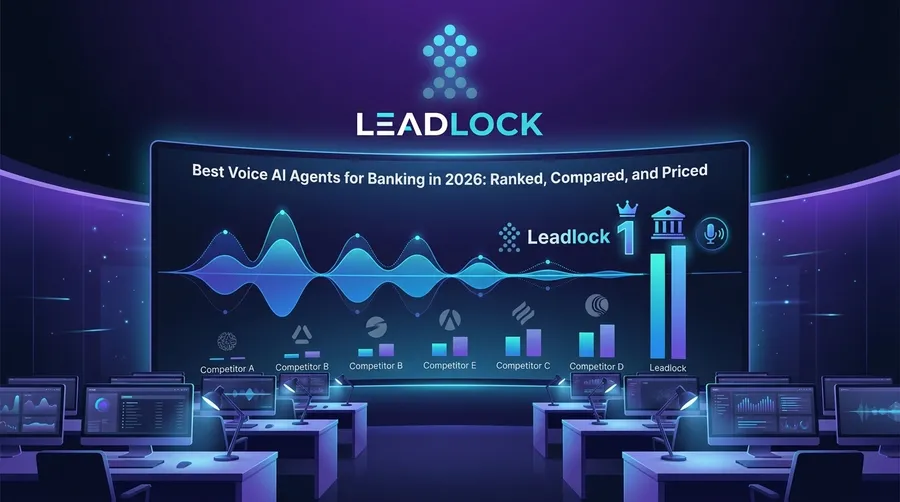
What Are the Best Voice AI Agents for Banking in 2026?
The best voice AI agents for banking in 2026 are platforms that reply fast enough to sound natural, meet SOC 2 and PCI DSS compliance requirements, integrate with core banking and CRM systems, and price transparently enough that you can verify your invoice matches what you were quoted. Leadlock meets the speed, integration and pricing bars, and runs on the only true speech-to-speech architecture among the platforms below. It holds no SOC 2 report, so confirm your compliance requirements before any account or card data moves through it.
1. Leadlock (About 300ms replies on Grok; no SOC 2 or PCI)
Leadlock routes Audio In directly to a native multimodal model and back to Audio Out, with about 300ms replies on Grok. No orchestration layer. No STT, LLM or TTS fees stacked on top. Model and voice pricing on the Pro plan: $0.12/min on Gemini Live or Grok Voice, $0.20/min on OpenAI Realtime, plus ElevenLabs as a premium voice option at $0.15/min. Agents are live in 5 minutes with native GoHighLevel integration, and anything else with an API can be connected.
The hidden cost in AI voice agents is rarely the model: it’s everything around it. STT, LLM, TTS and telephony all stack up, so an advertised $0.05 a minute can turn into a much larger bill. Leadlock’s per-minute rate covers the model and voice, from $0.12 on the $497/month Pro plan ($0.18 on the $97/month Starter plan), on top of the monthly plan fee. Phone numbers and carrier minutes are billed by your own Twilio account (about $0.013/min inbound, $0.018/min outbound and $1.15/month per local number at Twilio’s US rates).
2. Bland AI
Bland has documented banking deployments at scale. The Idaho Housing and Finance Association deployed Bland for mortgage servicing in about one week. The agent now handles 4,000 inbound mortgage-servicing calls per day and saved IHFA $750K per year by replacing a legacy IVR. SOC 2, PCI DSS, HIPAA, and GDPR compliance. Advertised $0.11-$0.14/min bundled since December 2025 (up from $0.09/min), with transfer fees and TTS add-ons that push it higher. Bland still runs an orchestration layer, so latency ceilings apply at peak load.
3. Retell
Retell covers banking inbound and outbound flows, CRM integrations, and agent QA tooling. Advertised at $0.07/min. Real all-in: $0.13-$0.20/min, plus knowledge-base, batch-call, branded caller ID, and PII removal add-ons billed separately.
4. Vapi
Vapi offers banking-specific agent templates including balance inquiry automation and SOC 2/HIPAA/PCI compliance posture. Advertised: $0.05/min platform fee plus bring-your-own-keys. Real all-in: $0.15-$0.33/min.
5. Synthflow
Synthflow covers balance inquiries, loan status, collections, fraud alerts, and KYC. SOC 2, HIPAA, GDPR, and ISO 27001 compliance. Advertised $0.09/min; real all-in $0.15-$0.24/min.
Platform Comparison
| Platform | All-in Cost | Latency | Architecture |
|---|---|---|---|
| Leadlock | $0.12/min on Pro + $497/mo plan + Twilio (~$0.013/min) | ~300ms reply (Grok, median) | Speech-to-speech (1 step) |
| Bland AI | $0.11-$0.14/min + add-ons | Varies by stack | Orchestration (3 steps) |
| Retell | $0.13-$0.20/min + add-ons | Varies by stack | Orchestration (3 steps) |
| Vapi | $0.15-$0.33/min | Varies by stack | Orchestration (3 steps) |
| Synthflow | $0.15-$0.24/min | Varies by stack | Orchestration (3 steps) |
What Does Voice AI for Banking Really Cost?
The real cost of voice AI for banking is not the advertised per-minute rate. The advertised rate is the platform fee. On orchestration-layer platforms, you then add speech-to-text, LLM inference, text-to-speech, telephony, and any compliance or PII-handling add-ons. That’s where the invoice lands, and the gap between the two numbers is consistently 2-7x.
Run the math at 10,000 minutes per month:
- Leadlock on the Pro plan at $0.12/min for model and voice: $497 plan fee + $1,200 usage + about $131 in Twilio inbound minutes and one number = about $1,828/month. Three line items.
- Vapi advertised at $0.05/min: Looks like $500. Add STT, LLM inference, TTS, and telephony and the real all-in hits $1,500-$3,300/month.
- Retell at $0.07/min voice engine: Add knowledge base ($0.005/min), batch calling ($0.005/min), branded caller ID ($0.10/call), and PII removal ($0.01/min) and you’re looking at $1,300-$2,000/month before per-number subscription costs.
The pattern is consistent: the advertised number is the floor for the platform license, not the ceiling for the bill. On Leadlock the bill is the plan fee ($97-$497/month) plus the model and voice rate, $0.12/min on Pro, plus your Twilio telephony. At this volume that puts Leadlock (about $1,828) inside Retell’s range and at the low end of Vapi’s.
For a full comparison across platforms, see AI Voice Agent Platform Pricing in 2026: Real Cost Breakdown.
Pro Tip: When evaluating banking voice AI vendors, ask for the per-minute cost with STT, LLM inference, TTS, and telephony all accounted for, and which of them someone else bills. If the vendor can’t give you that breakdown, you’re looking at a component stack and you’ll need to price it yourself before signing.
How Do You Choose the Right Voice AI Agent for Your Banking Stack?
Choosing the right voice AI agent for banking requires evaluating five criteria in order: latency under load, compliance posture, integration depth, pricing transparency, and the platform’s ability to handle concurrent call spikes without quality degradation. Most banking evaluations start with features and end with those five. The faster path is to start with those five.
- Latency under load, not in a demo. A long pause before the agent responds reads as a dropped call or a frozen system in a financial conversation. Require reply times measured on real production calls, not best-case benchmarks.
- Compliance attestation, not marketing claims. SOC 2 Type II, PCI DSS for payment flows, and GLBA-aligned data handling are the baseline, and where call data is processed and stored belongs on that list too. Ask for attestation documents. Compliance checkboxes on a features page are not substitutes.
- Real integration depth. Webhook reliability and real-time data lookup during calls separate voice agents from phone menus. Test the integration in a staging environment before committing.
- A sample invoice, not a pricing page. The difference between advertised and all-in cost can be 3-7x on orchestration-layer platforms. Ask what a 10,000-minute month costs, fully loaded.
- Concurrency without artificial caps. A Monday morning inquiry spike at a bank can hit 10-20x normal volume. Platforms with concurrency limits will drop calls or degrade audio. Leadlock’s concurrency scales with the model’s native limits, not a platform ceiling.
For context on how these decisions play out at scale, see AI Call Center Cost Savings in 2026: Real Numbers, Case Studies, and ROI.
What Compliance Requirements Must a Banking Voice AI Agent Meet?
A banking voice AI agent must satisfy GLBA data security requirements for any call involving account data, TCPA consent rules for outbound calling, PCI DSS for calls involving payment card information, and FINRA requirements for any investment or brokerage context. SOC 2 Type II on the platform side is the minimum baseline for handling customer financial data in any of those flows.
Compliance checkpoints by regulation:
- GLBA (Gramm-Leach-Bliley Act): The platform must document data handling and retention policies aligned with the Safeguards Rule. Customer financial data processed during a call must be encrypted in transit and at rest. Ask vendors for their shared-responsibility model document.
- TCPA: Outbound AI calling requires prior express written consent. Your agents must disclose at the start of each call that the caller is speaking with an AI. Consent records should be stored for at least four years. No platform automates this consent collection for you.
- PCI DSS: Any call that touches card numbers, CVVs, or expiration dates requires PCI DSS-scoped infrastructure. Confirm exactly what the platform covers in scope and what falls on your institution.
- FINRA: For brokerage or investment calls, FINRA Rule 2210 governs communications content. Calls may be subject to record-keeping under Rule 4511. AI agents can answer product FAQ questions, but personalized investment advice requires human oversight.
No voice AI platform eliminates your compliance obligations. The platform reduces the surface area. The institutional policies and the human oversight structure are still yours to build.
When Is Voice AI Not Ready for Banking?
Voice AI agents are not the right tool for every banking interaction, and the platforms selling into this vertical rarely volunteer that information. Three categories where current voice AI should not be deployed as the sole decision-maker:
Complex dispute resolution. Chargebacks, fraud disputes, and Reg E claim adjudication involve nuanced fact patterns, documentation review, and regulatory timing requirements. A voice AI agent can triage and collect initial information, but the final determination requires a human. Deploying AI as the decision-maker on dispute outcomes is a compliance and liability exposure, not a cost savings.
Investment advice. Any call that touches suitability, risk tolerance, or specific securities recommendations triggers FINRA and SEC oversight. AI agents can answer product FAQ questions. They cannot provide personalized investment recommendations without creating regulatory exposure for the institution.
Active fraud escalations. When a customer reports active account takeover, the call should route to a human quickly. AI agents can capture the initial report and verify identity, but the emotional stakes and decision complexity during an active fraud event make full automation a liability. Triage and route; don’t resolve.
Voice AI delivers the highest ROI on high-volume, lower-stakes call types: balance inquiries, payment reminders, appointment booking, loan status checks. That’s where the documented 30-40% cost-to-serve reduction and $0.40-per-call cost figures come from. Start there.
Frequently Asked Questions
Q: Are AI voice agents secure enough for banking customer authentication?
Yes, with the right platform configuration. Banking voice AI agents can enforce knowledge-based authentication, multi-factor verification, or voice biometrics before returning any account data. Where a platform holds SOC 2 Type II certification and PCI DSS scope, those cover the infrastructure layer. Your institution defines the authentication policy; the agent enforces it. No platform currently replaces your institution’s existing identity assurance requirements.
Q: Can AI voice agents handle compliance requirements like GLBA, FINRA, and TCPA?
Partially. GLBA data security requirements are met when the platform carries SOC 2 Type II and documents its data handling under the Safeguards Rule. TCPA requires your institution to obtain prior written consent before outbound AI calls and to disclose that the caller is an AI. FINRA compliance for investment calls requires human oversight of AI-generated communications. Each regulation requires policy decisions at the institutional level, not just platform selection.
Q: Can voice AI replace human banking agents?
For routine inquiries, yes. Balance checks, payment reminders, appointment scheduling, and loan status updates account for a large share of inbound banking call volume and are well within current voice AI capability. Complex disputes, investment advice, and active fraud investigations require human judgment. Gartner projects agentic AI will autonomously resolve 80% of common customer service issues without human intervention by 2029.
Q: How much do voice AI agents for banking cost?
Leadlock starts at $0.12/min on Gemini Live or Grok Voice on the Pro plan, covering the model and voice. At 10,000 minutes per month on Pro, that’s $497 + 10,000 x $0.12 = $1,697/month, plus about $131 for Twilio inbound minutes and one number, so about $1,828/month. Orchestration-layer platforms advertise $0.05-$0.09/min but bill $0.13-$0.33/min all-in once STT, LLM, TTS, and telephony are included. Backbase estimates an AI-resolved banking call costs approximately $0.40 total versus $7-12 for a human-handled call.
Q: What banking tasks can a voice AI agent handle?
Balance inquiries, account status, payment due date reminders, outbound collections calls, loan application status updates, card activation and blocking, fraud alert callbacks for initial triage, KYC identity verification, and advisor appointment booking. Voice AI agents are not yet ready for complex dispute adjudication, investment suitability advice, or real-time resolution of active fraud claims.
Q: How does a voice AI agent integrate with core banking systems?
Voice AI agents connect to core banking systems and CRMs through REST API or webhook integrations. During a call, the agent looks up account data in real time, verifies the caller’s identity against records, and writes call outcomes back to the CRM. Leadlock holds no SOC 2 report or PCI DSS certification and does not do identity verification, so keep account data, card data and identity checks off Leadlock calls and use it for routine, non-account calls such as appointment booking and general questions.
Ready to cut per-call costs from $7-12 to $0.40 without adding an orchestration layer? Leadlock replies in about 300ms on Grok with model and voice pricing from $0.12/minute, 5-minute setup and no separate STT, LLM or TTS fees. Book a 15-minute call with Dan.
See It Book a Real Job
Voice agents that book into ServiceTitan and GoHighLevel, live today for home-service brands. Book 15 minutes with Dan, or start a 7-day trial from the pricing page.
Book a 15-minute call with Dan