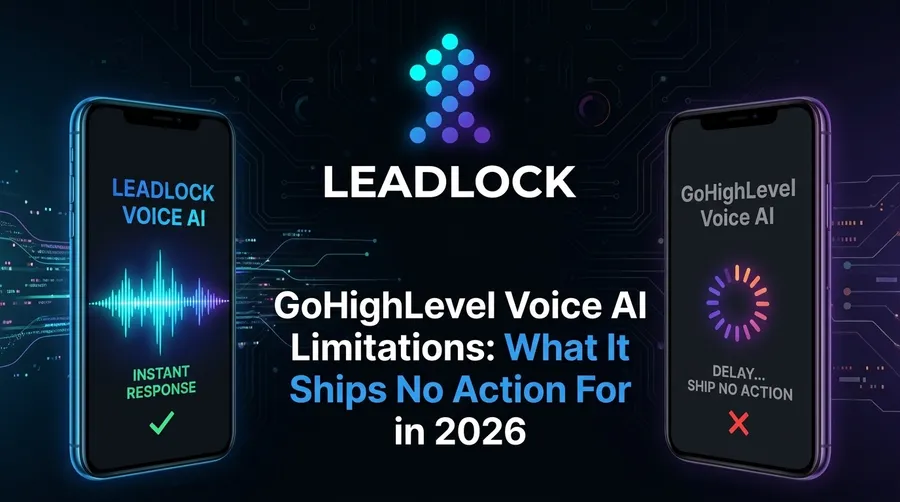
GoHighLevel's built-in voice AI is enough for a home service client who books new appointments into one GoHighLevel calendar. It is not enough when the client dispatches from ServiceTitan or another system outside GoHighLevel, or needs rescheduling and live lookups during the call, because it ships no action for those.
- GHL Voice AI is priced per minute or on a $97/month Unlimited plan per sub-account that covers inbound, outbound and the web widget, so price is not where it falls short.
- GHL Voice AI has no native action for rescheduling, external CRM writes, mid-call live data lookups, or bookings into non-GHL calendars.
- Outbound calling on GHL native runs from workflows, one call per number per day, 8am to 8pm in the contact’s timezone, same-country numbers only (per GoHighLevel’s outbound calling docs). Neither GHL nor Leadlock keeps TCPA consent records, so consent capture is the agency’s job on either platform.
- GHL Voice AI shipped speech-to-speech in September 2026, so its voice quality complaints (178 upvotes) are no longer an architecture argument. What it still ships no action for is a booking into a system of record outside GoHighLevel.
Is GoHighLevel’s Built-In Voice AI Enough for Home Service Clients?
Yes for some clients, no for others, and the test is where the job gets scheduled. GoHighLevel’s built-in voice AI is enough for a home service client with one location that books new appointments into a GoHighLevel calendar. It is not enough for a client that dispatches from ServiceTitan or another field-service system, because it ships no action for a booking outside GoHighLevel, and it ships no action for rescheduling or for looking up live data during the call.
| The client… | Is GHL native enough? | Why |
|---|---|---|
| Books new appointments into one GoHighLevel calendar | Yes | That is the case it covers, at $0.10 to $0.20 per minute or $97/month per sub-account |
| Needs callers to reschedule by phone | No | It ships no action for rescheduling |
| Dispatches from ServiceTitan or another system outside GoHighLevel | No | It ships no action for a booking outside GoHighLevel calendars |
| Needs the agent to look something up during the call | No | It ships no action for mid-call live data lookups |
For the clients in the “No” rows, see Leadlock for GoHighLevel agencies and how ServiceTitan booking works.
GoHighLevel Voice AI is speech-to-speech and costs $97/month per sub-account on the Unlimited plan, which covers Voice AI inbound, outbound and the web widget, subject to fair use. Per minute, the list price is $0.10 on GHL native with Gemini 3.1 Flash Live and $0.20 on GHL native with GPT-realtime. That is competitive pricing for a product that books new appointments into GHL calendars and cannot reschedule them.
The booking ceiling is where most agencies hit the wall in week two. GHL Voice AI handles basic inbound call routing, books appointments into GHL calendars, and works without SIP trunking. Those three things cover the easy case: one location, one GHL calendar, a standard greeting. They don’t cover rescheduling, external CRM writes without Zapier, multi-step conditional call flows, or mid-call live data lookups. The community ideas board has been tracking the missing feature requests since the product launched.
For GHL agencies who need voice AI that handles more than a basic booking flow, Leadlock is the recommendation. Leadlock is speech-to-speech built for GHL agency owners: live in 5 minutes per sub-account, native GHL integration without webhooks or SIP trunking, all-in from $0.12/minute on Gemini Live or Grok Voice.
What Does GoHighLevel Voice AI Actually Include in 2026?
GHL Voice AI in 2026 covers inbound call answering, new appointment booking into GHL calendars, basic conversational routing, and a proprietary AI conversation layer, with the $97/month Unlimited plan covering Voice AI inbound, outbound and the web widget for each sub-account, subject to fair use, per the official GHL AI pricing page.
The product is functional for a narrow profile: a single-location small business, a GHL calendar, basic inbound questions, and callers who don’t ask for anything outside the configured script. For that use case, GHL Voice AI delivers. Setup is minimal, the booking integration works without custom configuration, and the sub-account is already in GHL.
The gap shows up when callers do something unexpected. Ask to reschedule instead of book. Ask for a price estimate that requires a live data lookup. Call in Spanish when the account isn’t configured for it. Each of those lands in a zone GHL Voice AI ships with no native action.
What the $97/month Unlimited plan includes:
- Inbound call answering 24/7
- Outbound calling, triggered from workflows
- The Voice AI web widget
- New appointment booking into GHL calendars
- Basic conversational call routing
- Domestic US call coverage
- English-primary voice AI
How Much Does GoHighLevel Voice AI Cost Per Month?
GHL Voice AI is priced two ways, per GoHighLevel’s AI product pricing article (updated September 1, 2026). Per minute, speech-to-speech has a list price of $0.10/min on GHL native with Gemini 3.1 Flash Live and $0.20/min on GHL native with GPT-realtime, with the model, audio, transcripts and infrastructure bundled into that rate. Or the $97/month Unlimited plan per sub-account covers Voice AI inbound, outbound and the web widget, subject to fair use. GHL does not say whether speech-to-speech minutes count inside Unlimited.
The per-sub-account plan does grow with your client roster: 20 sub-accounts is $1,940/month (20 × $97) and 50 is $4,850/month (50 × $97). But GHL native is cheaper than Leadlock per minute, so this is not a price argument.
The conventional wisdom is that voice quality complaints are what drive agencies off GHL Voice AI. Since GHL shipped speech-to-speech, neither voice nor price is the real gap. The booking is. A caller who needs to reschedule, or a client whose schedule lives in ServiceTitan or another system of record, hits a flow GHL ships no action for. The 178 upvotes on voice quality get attention because they’re visible in one place. The booking failures don’t accumulate on an ideas board; they show up as missed jobs and cancellation emails.
Leadlock charges one plan fee for the whole account rather than per sub-account (the $497/month Pro plan covers unlimited sub-accounts), plus usage: $0.12/min all-in on Pro on Gemini Live or Grok Voice, which includes model + voice + infrastructure. Agencies needing premium voice quality can move to OpenAI Realtime at $0.20/min all-in on Pro.
| Platform | Pricing structure | Est. cost (20 sub-accounts, 1,000 min each) |
|---|---|---|
| GHL native (Unlimited plan) | $97/mo per sub-account, fair use | $1,940/mo (20 × $97) |
| GHL native (per minute) | $0.10-$0.20/min list, speech-to-speech | $2,000-$4,000/mo (20,000 min × list price) |
| Leadlock (Gemini Live or Grok Voice) | $0.12/min all-in on Pro + $497/mo Pro plan, no per-sub fee | $2,897/mo ($497 + 20,000 × $0.12) |
| Leadlock (OpenAI Realtime) | $0.20/min all-in on Pro + $497/mo Pro plan, no per-sub fee | $4,497/mo ($497 + 20,000 × $0.20) |
| Vapi | $0.05/min platform + components | Real all-in $0.15-$0.33/min |
| Retell | $0.07/min voice engine + add-ons | Real all-in $0.13-$0.20/min |
The Leadlock number at $2,897/month is the entire bill: the $497 Pro plan fee plus usage that covers model, voice and infrastructure. At this volume GHL native can cost less. What the Leadlock number buys is the booking: rescheduling, and appointments that land in ServiceTitan, GoHighLevel, or anything else with an API.
What Workflow Actions Does GHL Voice AI Have No Native Support For?
GHL Voice AI has no native fallback for calls that go outside a GHL calendar booking: no external CRM writes without Zapier, no mid-call live data lookups from outside GHL, no multi-step conditional branching beyond the basic configured flow, no booking into non-GHL calendars, and no appointment rescheduling. When a caller’s request falls outside the configured script, the agent halts or loops with no action taken on the call.
This gap is invisible in demos. Demo scenarios show a first-time caller booking a new appointment. That works cleanly. The gap appears when the caller’s actual need doesn’t match that exact script.
Rescheduling is the most common missed case. An SMB’s inbound call volume skews heavily toward existing customers, not new ones. A patient calling to move an appointment, a contractor’s customer calling to push a job date. These calls hit the rescheduling gap and get a “I can only book new appointments” response.
The mid-call data lookup gap matters most in price-sensitive industries. An HVAC caller asking “how much does an AC tune-up cost this week?” needs a live answer. GHL Voice AI has no native path for that without a developer writing custom middleware.
Workflow gaps with no native GHL action:
- Appointment rescheduling (cancel and rebook an existing appointment)
- External CRM field writes during a call (Salesforce, HubSpot, Zoho)
- Mid-call live data lookups from outside GHL (pricing, availability)
- Booking into Calendly, Acuity, or any non-GHL scheduling system
- Multi-condition branching based on caller data or caller history
- Post-call external triggers without a Zapier intermediary
Pro Tip: If your client’s most common inbound call scenario is anything other than “new caller books a new appointment,” test that exact flow before committing the client to a GHL Voice AI configuration. The demo will pass. The edge case is what you’re actually buying.
Can GoHighLevel Voice AI Make Outbound Calls?
GHL Voice AI can initiate outbound calls, but with restrictions that limit most campaigns: calls are triggered from workflows, each number can be called once per day, only between 8:00 AM and 8:00 PM in the contact’s timezone, and only to same-country (domestic) numbers, per GoHighLevel’s outbound calling documentation. These limits are set by the platform, not by the agency.
The restrictions exist because outbound AI calling is a compliance-heavy problem. TCPA requires prior express written consent for AI-generated calls to mobile numbers. California, Florida, and several other states add restrictions on top of federal requirements. GHL’s time-window and frequency caps are a floor. A compliance team working with a healthcare or financial services client will almost always require tighter controls than GHL provides.
GHL also does not provide opt-in infrastructure for outbound campaigns. There is no built-in consent management system, no verified opt-in capture tied to the outbound module, and no state-by-state compliance configuration. Running outbound AI calls on GHL’s native Voice AI without a separately built consent and recordkeeping layer creates TCPA exposure that will eventually surface.
This gap is not unique to GHL. Leadlock does not keep consent records, scrub DNC lists, or enforce calling hours on every call either; its account owner must accept outbound calling terms before outbound is enabled, and Sequences can be limited to business hours. On any platform, TCPA compliance is the agency’s and client’s responsibility, built on their own consent capture and recordkeeping. See Are AI Voice Agents Legal in 2026? FCC, TCPA & Compliance for a detailed breakdown of what compliant outbound AI calling actually requires.
What Are the Most Upvoted Missing Features on the GHL Voice AI Ideas Board?
The most-requested features missing from GHL Voice AI, drawn from NextPhone’s 2026 analysis of the public ideas.gohighlevel.com board, are concentrated around voice quality, caller recognition, and operational control, with the top items unchanged in vote count since the product shipped and the push-to-talk website widget sitting at 236 upvotes with no shipping date as of September 2026.
The full list in order of community upvotes:
- Push-to-talk website widget: 236 upvotes (not available at all)
- Robotic voice quality complaints: 178 upvotes
- No caller recognition (repeat callers treated as new every time): 174 upvotes
- No spam call blocking: 91 upvotes
- No call recording sent in follow-up emails: 89 upvotes
- Mandatory AI disclaimer requirement on outbound calls: 41 upvotes
- No appointment rescheduling (new bookings only): 13 upvotes
The voice quality and caller recognition gaps are structurally connected. Voice quality complaints at 178 upvotes are describing a latency problem: when a voice AI is slow to respond, the conversation sounds robotic. The caller hears a noticeable pause before every agent reply. That’s the orchestration-layer problem, which the next section covers in detail.
Caller recognition at 174 upvotes is a separate gap. Every call starting from scratch means an existing customer who has called three times this week gets asked “how can I help you today?” on the fourth call. There’s no built-in contact history lookup in GHL Voice AI’s conversation layer.
Does GHL Voice AI Still Have an Architecture-Level Voice Quality Ceiling?
Not any more. GHL Voice AI shipped speech-to-speech in September 2026. That removes the transcription and text-to-speech hops that the orchestration-layer problem describes, so architecture is no longer a reason to leave GHL’s native agent. The 178 upvotes on voice quality complaints are worth reading, but they no longer point to a structural ceiling.
The stitched speech-to-text, LLM, text-to-speech pipeline is still how many build-your-own platforms work, and each hop adds delay. GHL’s native agent is no longer one of them.
Leadlock skips the text step as well. Audio in goes directly into a native multimodal model: Gemini Live, Grok Voice or OpenAI Realtime. The model processes the audio and generates an audio response without a text conversion step. Leadlock agents reply in about a third of a second on Grok (median of 461 live turns, measured September 2026). The per-minute math stays simple: at $0.12/min on the Pro plan, a 3-minute booking call costs $0.36 in usage, on top of the $497/month plan fee. After-hours calls get answered and booked instead of rolling to voicemail.
People notice even short pauses. A long pause is the robotic gap that makes callers repeat themselves and push zero for a human. The difference is architecture, not tuning.
With both sides on speech-to-speech, the real gap is the action after the call: GHL Voice AI ships no action for a booking into ServiceTitan or another system of record outside GoHighLevel. On Leadlock, GoHighLevel works out of the box; ServiceTitan and anything else with an API can be connected. For more on why this matters for real production calls, see Speech-to-Speech vs Speech-to-Text-to-Speech: Why Architecture Matters for AI Voice Agents in 2026.
Which Voice AI Platform Should GHL Agencies Use Instead of Native GHL?
GHL agencies that need voice AI beyond basic inbound booking should use Leadlock: speech-to-speech built for GHL agency owners with about 300ms replies on Grok, native GHL integration without SIP trunking or webhook setup, live in 5 minutes per sub-account, and all-in pricing from $0.12/minute on Gemini Live or Grok Voice on the $497/month Pro plan, one plan fee for the whole account rather than a per-sub-account fee.
Picture a home services agency running 23 GHL sub-accounts. At $97 per sub-account on Unlimited, that is $2,231/month (23 × $97) for a product that can’t handle rescheduling. If those 23 accounts averaged 87 calls a month at 2.3 minutes per call, that is about 4,602 minutes: roughly $460/month at GHL’s $0.10 list price on GHL native, or roughly $1,049/month on Leadlock Pro ($497 plan fee plus 4,602 × $0.12 = $552 in usage). GHL native is cheaper on price here. The difference is that rescheduling calls get handled instead of falling through to voicemail or a human receptionist.
The comparison to standalone platforms like Vapi and Retell shows why the native-GHL answer matters for agencies specifically. Both integrate with GHL via webhooks and private integrations. Neither is native. Developer setup is required at onboarding and again every time a client’s workflow changes. That overhead shows up in support hours and client churn, not on a pricing page. For every option side by side, see our ranking of GoHighLevel AI voice agent options.
Leadlock’s native GHL integrations read and write GHL contacts, opportunities, and calendars live during the call. No Zapier. No middleware. No configuration that breaks when GHL pushes an update. For an agency managing 20+ sub-accounts, that’s the difference between a voice AI service you can resell confidently and a voice AI project that needs a developer every time something changes.
Leadlock handles what GHL Voice AI doesn’t. That’s the pitch, and it is not a price pitch.
Frequently Asked Questions
Q: Does GoHighLevel Voice AI book appointments automatically?
Yes, GHL Voice AI books new appointments into GHL calendars automatically during a call. It cannot reschedule or cancel existing appointments. That feature has 13 upvotes on the community ideas board and was not available as of September 2026. If rescheduling is a common inbound call type for your client, plan for custom webhook middleware or use a platform like Leadlock, where a custom function can call the GHL calendar API mid-call to move the appointment.
Q: How much does GoHighLevel Voice AI cost per month?
GHL Voice AI costs $97/month per sub-account on the Unlimited plan, which covers Voice AI inbound, outbound and the web widget, subject to fair use. Per minute, speech-to-speech has a list price of $0.10/min on GHL native with Gemini 3.1 Flash Live and $0.20/min on GHL native with GPT-realtime, per GoHighLevel’s AI product pricing article (September 2026). An agency running 20 sub-accounts on Unlimited pays $1,940/month (20 × $97).
Q: Can GoHighLevel Voice AI make outbound calls?
Yes, but with platform-set restrictions: calls run from workflows, one call per number per day, only between 8:00 AM and 8:00 PM in the contact’s timezone, and same-country numbers only, per GoHighLevel’s outbound calling documentation. GHL does not provide built-in consent management for TCPA compliance. Most outbound campaign use cases require opt-in infrastructure that GHL does not supply out of the box.
Q: What languages does GoHighLevel Voice AI support?
GHL Voice AI is primarily English. Multilingual support is limited, and non-English calls are a documented point of failure in the native product. Leadlock offers 15 selectable languages on its ElevenLabs voice provider ($0.15/min all-in on Pro), making it a stronger option for agencies serving multilingual markets or businesses with a significant non-English-speaking customer base.
Q: Can I use multiple Voice AI agents in one GoHighLevel account?
Yes, multiple Voice AI agents can be deployed in one GHL account, one per sub-account location under the AI Employee model. Each sub-account is billed independently at $97/month. There is no shared or pooled agent model across sub-accounts, so the subscription cost scales linearly with client count.
Q: At what client count does GoHighLevel AI receptionist become unmanageable for agencies?
Cost is not usually what breaks first. The Unlimited plan grows in a straight line with your client roster ($1,940/month at 20 sub-accounts, $4,850/month at 50), and per-minute list pricing is also available. What becomes unmanageable is the booking gap: every client whose schedule lives outside GHL, and every caller who needs to reschedule, lands in a flow GHL ships no action for. That usually shows up somewhere around 10-15 sub-accounts.
Ready to give your GHL clients voice AI that handles rescheduling, live data lookups, and bookings that land outside GHL? Leadlock is speech-to-speech built for GHL agency owners, all-in from $0.12/minute on Pro. See Leadlock for GoHighLevel agencies, and how it books into ServiceTitan when a client schedules outside GHL. Book a 15-minute call with Dan.
See It Book a Real Job
Voice agents that book into ServiceTitan and GoHighLevel, live today for home-service brands. Book 15 minutes with Dan, or start a 7-day trial from the pricing page.
Book a 15-minute call with Dan