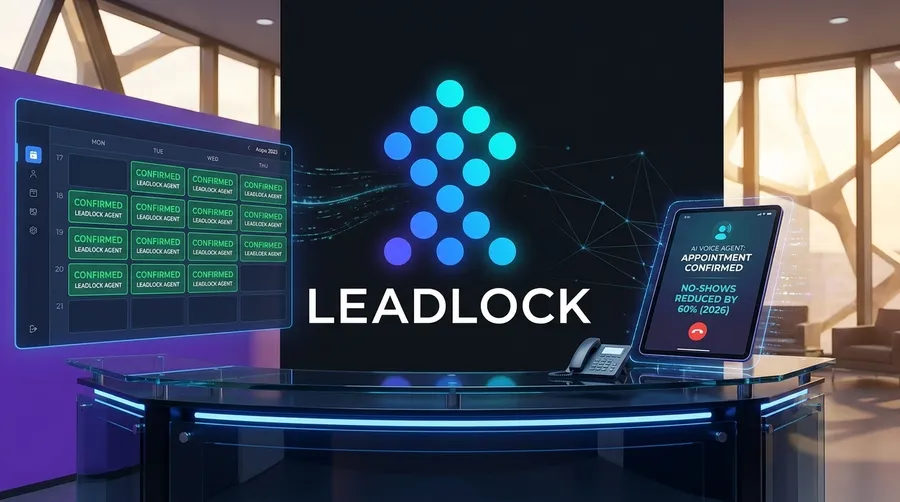
AI voice agents reduce appointment no-shows by 50-60%. See how reminders, live rescheduling, and Leadlock cut no-show rates from $0.12/min on Pro.
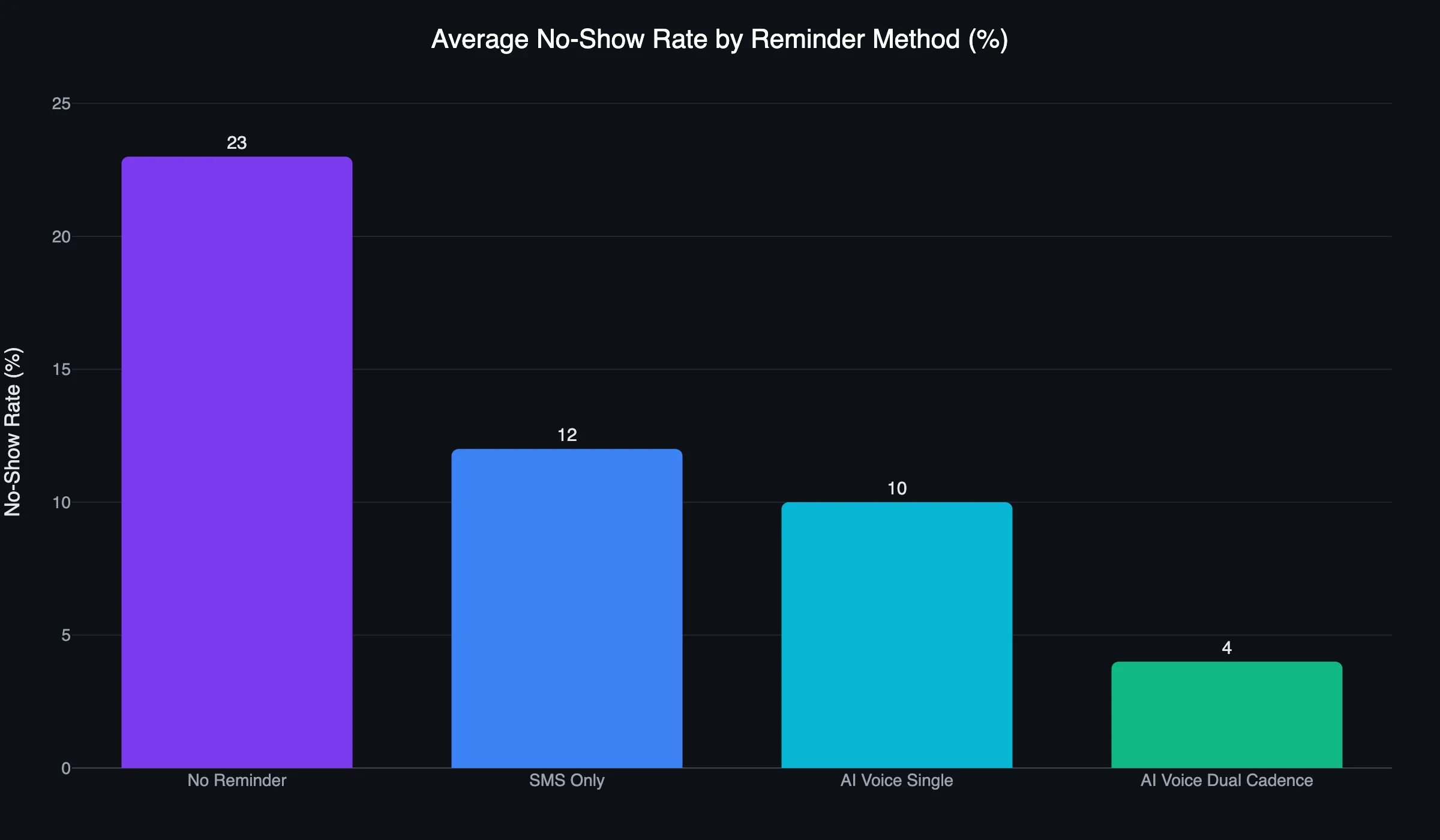
- The average cross-industry no-show rate is 23%; AI voice reminders with real-time rescheduling reduce that by 50% or more based on peer-reviewed data.
- Leadlock’s true speech-to-speech platform runs outbound reminder calls from $0.12/minute on Gemini Live or Grok Voice, all-in for the model and voice with no separate STT, LLM or TTS fees; phone numbers and carrier minutes are billed by your own Twilio account.
- Optimal reminder timing varies by appointment type: high-value medical visits need a 7-day plus 48-hour plus day-of cadence; routine visits need 72h plus 24h.
- TCPA compliance requires prior express consent, DNC scrubbing, and real-time opt-out handling before running any outbound AI reminder campaign in the U.S.
The average no-show rate across service businesses is approximately 23%, and in healthcare it runs as high as 39% for some specialties. Each missed appointment costs a medical practice roughly $200 in lost revenue. Across the U.S. healthcare system alone, that adds up to $150 billion annually.
The fix isn’t a better text template. It’s an AI voice agent that calls before the appointment, confirms in a real two-way conversation, handles reschedule requests on the spot, and logs the outcome back to your CRM. Leadlock runs those calls from $0.12/minute for the model and voice, live in 5 minutes.
What Appointment No-Shows Are Really Costing Your Business
A peer-reviewed study of 135,393 appointments found a 50.7% relative reduction in no-shows when AI-driven reminder calls were introduced, dropping the rate from 20.82% to 10.25%. At $200 per missed appointment, even a modest improvement pays for the reminder system inside a week. Memorial Hospital at Gulfport ran a multi-channel initiative and achieved a 28% relative reduction in no-show rate with an estimated $1 million annual increase in revenue.
No-show rates by specialty, per Dialog Health’s 2025 research:
- Sleep clinics: 39%
- Dermatology / pediatrics: ~30%
- Neurology: ~26%
- Cross-industry average: ~23%
- Primary care (low-risk): ~5%
The math is straightforward. A practice seeing 30 patients a day at a 23% no-show rate loses roughly 7 appointments. At $200 each, that’s $1,400 gone daily before the first patient walks in.
Why Manual Reminders Don’t Solve the Problem
Manual outbound reminder calls work when staff actually make them, but 80% of callers who reach voicemail hang up without leaving a message, and 67% ignore voicemails entirely. A front desk coordinator leaving voicemails for 30 patients is spending an hour on calls that will mostly go unheard.
SMS reminders are better, but one-directional. A patient who can’t make Thursday’s slot and wants to reschedule still has to call back, wait on hold, and hope someone picks up. AgentZap’s 2025 review of 105 studies shows dual reminders sent 3 days and 1 day before can cut no-shows to 4.4%, but only when paired with an easy reschedule path. Text alone doesn’t close that loop.
How AI Voice Agents Automate Appointment Reminders
AI voice agents for appointment reminders call patients before their scheduled time, confirm attendance in a natural two-way conversation, handle reschedule requests on the spot, and write outcomes back to the CRM without any staff involvement. On Leadlock’s true speech-to-speech platform, the audio path is: Audio In, native multimodal model, Audio Out. One step. Leadlock agents reply in about a third of a second on Grok (median of 461 live turns, measured September 2026).
Compare that to orchestration-layer platforms like Vapi, Retell, Bland, and Synthflow, which chain STT, LLM, and TTS across three separate API calls. Each hop adds delay, and the result is a noticeable pause that breaks conversational flow and increases hang-up rates on outbound calls.
For a deeper look at how architecture affects call quality, see Speech-to-Speech vs Speech-to-Text-to-Speech: Why Architecture Matters for AI Voice Agents in 2026.
Automated Rescheduling and Cancellation Handling
AI voice agents for appointment reminders handle rescheduling and cancellations in the same call: they pull available slots from a live calendar, offer them to the patient in real time, book the replacement before the call ends, and update the schedule automatically. No callback, no hold time, no staff touchpoint required.
A multi-specialty clinic in Mumbai with a prior no-show rate of 32% deployed an AI voice reminder system with real-time rescheduling. The no-show rate dropped to 2%, a 94% reduction, with a corresponding increase in revenue and resource utilization.
When a slot opens from a cancellation, the agent can immediately call the next person on the waitlist and fill it before the day begins. The reminder doesn’t just prevent a no-show; it fills the slot if one occurs anyway.
CRM and Calendar Integration
AI voice appointment reminder systems work at scale only when the agent reads from and writes to your existing systems in real time: pulling scheduled appointments, triggering calls on schedule, and updating records with confirmations, reschedules, or cancellations the moment the call ends, giving staff a live picture of the schedule without manual data entry.
Leadlock integrates natively with GoHighLevel (GHL): no SIP trunking, no webhooks to configure, no developer needed. For non-GHL stacks, anything else with an API can be connected through custom functions (webhooks) or the API. Leadlock is not HIPAA compliant and does not sign a BAA, so use it only for reminder and booking calls that carry no patient health information. For healthcare practices managing patient data, see AI Voice Agents for Healthcare in 2026: HIPAA Requirements Guide for the full integration and compliance breakdown.
Optimal Reminder Timing by Appointment Type
The optimal AI voice reminder cadence depends on appointment value, the lead time needed to fill a cancellation, and historical no-show patterns for that appointment type. A generic 24-hour rule applied equally to a routine dental cleaning and a $2,000 specialist consultation leaves recoverable revenue on the table.
| Appointment Type | Recommended Cadence | Reason |
|---|---|---|
| High-value medical (surgery, specialist) | 7 days + 48 hours + day-of | Lead time to fill the slot if cancelled |
| Routine medical / dental | 72 hours + 24 hours | Dual-reminder sequence; Frontiers in Digital Health, 2025: p=0.0013 |
| Personal services (salon, spa) | 48 hours + 2 hours | High same-day cancellation rate |
| Professional consultation (legal, financial) | 48 hours + 1 hour | Complex reschedule logistics |
| Fitness / classes | 24 hours | High volume, low individual value |
The Frontiers peer-reviewed study found the two-reminder sequence (3 days + 1 day) produced a statistically significant no-show reduction (Spearman r = -0.67, p = 0.0013). Single reminders consistently underperformed the two-touch cadence.
TCPA Compliance and Consent Requirements for Outbound AI Reminder Calls
Every outbound AI voice reminder call to a U.S. cell phone is governed by the Telephone Consumer Protection Act (TCPA), which requires prior express consent, real-time opt-out handling, and quiet-hours compliance. Statutory damages run $500 to $1,500 per call. Most businesses skip this entirely and find out about the exposure when a demand letter arrives.
Key requirements before running any outbound AI reminder campaign:
- Prior express consent: documented agreement from the patient or client to receive automated calls when they provided their phone number
- DNC scrubbing: outbound lists scrubbed against the national Do-Not-Call registry before each campaign
- Real-time opt-out: if the recipient says “stop calling” or presses a designated key, the agent must honor it immediately and suppress future calls
- Quiet hours: calls to U.S. numbers must occur between 8am and 9pm in the recipient’s local time zone
Pro tip: Add one line to your booking flow: “By providing your phone number, you agree to receive appointment reminders via automated voice call.” Document the timestamp. That single sentence is your TCPA consent record.
On Leadlock, Sequences honour SMS STOP opt-outs, and voice opt-out wording (what the agent says and does when someone asks not to be called) goes into the agent prompt. Leadlock does not scrub DNC lists or keep consent records, so TCPA compliance is your responsibility. For a full compliance breakdown, see Are AI Voice Agents Legal in 2026? FCC, TCPA & Compliance.
How to Implement an AI Voice Reminder System
Setting up AI appointment reminders on Leadlock takes five minutes from signup to live agent: connect your calendar or CRM, configure the reminder script, build the outbound cadence as a Sequence or scheduled calls, choose your voice model from Gemini Live, Grok Voice, or OpenAI Realtime, and the agent runs automatically with no developer required and no SIP trunking.
Here’s the setup sequence:
- Create your Leadlock account, connect your own Twilio account and import a number (or import one from GoHighLevel).
- Connect your calendar or CRM. GHL users get a native integration; anything else with an API can be connected.
- Configure the reminder agent: script, confirmation branches, and reschedule logic.
- Build the reminder cadence by appointment type as a Sequence (call, SMS, wait and voicemail-drop steps) or as scheduled calls, and enroll contacts by CSV.
- Go live. Outcomes update in your CRM in real time.
“Five minutes from signup to a live agent answering calls. That’s the bar. If your platform takes a week, you’re solving the wrong problem.” - Daniel Gauerke, founder of Leadlock
Gemini Live and Grok Voice start at $0.12/minute on Pro, all-in for the model and voice with no separate STT, LLM or TTS fees. OpenAI Realtime runs at $0.20/minute for premium voice quality. ElevenLabs is $0.15/minute. Phone numbers and carrier minutes are billed by your own Twilio account: about $0.018/min outbound or $0.013/min inbound, plus $1.15/month per local number at Twilio’s US rates. A practice running 200 reminder calls per month at 3 minutes each on Gemini Live pays roughly $72 in minutes, plus about $12 of outbound Twilio charges and the plan fee. That usage is less than one missed appointment.
Related how-to guide: Add reschedule, cancel and update contact tools to your voice agent.
Frequently Asked Questions
Q: How much does an AI voice appointment reminder system cost?
Leadlock starts at $0.12/minute on Gemini Live or Grok Voice, all-in for the model and voice; telephony is billed by your own Twilio account. For 200 reminder calls per month averaging 3 minutes each, that’s roughly $72/month in minutes, plus about $12 of outbound Twilio charges and the plan fee. Competitors like Vapi advertise $0.05/minute but charge STT, LLM, TTS, and telephony separately, pushing real all-in cost to $0.15-$0.33/minute.
Q: Can AI voice agents reschedule appointments automatically?
Yes. Leadlock agents pull available slots from a connected calendar (GoHighLevel calendars natively, others through custom functions), offer them during the reminder call, and book the replacement in real time without any staff involvement. When a slot opens from a cancellation, the agent can call the next person on the waitlist immediately.
Q: What is the average no-show rate by industry?
The cross-industry average is approximately 23%, based on AgentZap’s 2025 review of 105 studies. Healthcare specialties run higher: sleep clinics at 39%, dermatology and pediatrics around 30%, neurology around 26%. Personal services typically fall in the 10-20% range.
Q: How do AI voice reminders compare to SMS reminders for reducing no-shows?
SMS reminders reduce no-shows by roughly 50% compared to no reminder at all. AI voice reminders with real-time rescheduling push further by closing the reschedule gap: a patient who can’t make the appointment slot gets rebooked before the call ends, rather than dropping out as a no-show with no replacement booked.
Q: Are AI voice appointment reminder systems HIPAA compliant?
Some are, when the vendor signs a Business Associate Agreement (BAA) and the setup meets HIPAA’s safeguards. Leadlock is not HIPAA compliant and does not sign a BAA, so a practice whose reminder calls carry patient health information should use a vendor that signs one. Leadlock fits reminder and booking calls that carry no patient health information. See AI Voice Agents for Healthcare in 2026: HIPAA Requirements Guide for the full checklist.
Q: How long does it take to set up an AI appointment reminder workflow?
On Leadlock, five minutes from signup to live agent. No developer, no SIP trunking, no Solutions Engineer call required. Connect your calendar or CRM, configure the script, set your cadence, and go live.
Ready to cut your no-show rate without adding staff? Leadlock runs outbound appointment reminder calls from $0.12/minute for the model and voice, live in 5 minutes. Book a 15-minute call with Dan.
See It Book a Real Job
Voice agents that book into ServiceTitan and GoHighLevel, live today for home-service brands. Book 15 minutes with Dan, or start a 7-day trial from the pricing page.
Book a 15-minute call with Dan