Learn what HIPAA requires of AI voice agents in healthcare in 2026. See which platforms sign a BAA, review ROI data, and find the right fit for your practice.
This guide covers what HIPAA requires of AI voice agents in healthcare in 2026: which platforms sign a BAA, what the ROI data shows, and where each platform fits in a practice. It also explains where Leadlock fits, and where it does not, since Leadlock is not HIPAA compliant.
How Big Is the AI Voice Agent Opportunity in Healthcare in 2026?
AI voice agents for healthcare represent a $472 million market in 2025 that’s projected to grow to $11.69 billion by 2035 at a 37.85% compound annual growth rate, according to Towards Healthcare market sizing research. North America holds 35–54% of global market share, and cloud-based deployments account for 55% of all implementations.
The growth is driven by a staffing crisis that shows no signs of reversing:
- 43.2% of U.S. physicians report at least one symptom of burnout (AMA 2024 data)
- Clinician burnout costs the healthcare system an estimated $4.6 billion annually
- The WHO projects a global shortfall of 10–11 million healthcare workers by 2030
- Missed appointments alone cost the U.S. healthcare system $150 billion per year
Patient engagement and support is the largest application segment at 45% of the market. That makes sense: appointment scheduling, prescription refill requests, post-discharge follow-up, and insurance verification are all high-volume, repetitive call types that AI handles better than overworked staff.
Research published in npj Digital Medicine (Nature/PubMed), which analyzed over 307,000 simulated patient interactions, found AI agents achieving greater than 99% medical advice accuracy - a finding that underscores why generative AI voice is rapidly moving from pilot to production across health systems.
How Do AI Voice Agents Handle Patient Calls Without Human Intervention?
Modern AI voice agents handle 70% or more of healthcare calls without any human involvement - including appointment booking, prescription refill routing, insurance verification, and post-discharge follow-up - reducing average wait times from 18 minutes to under 30 seconds, according to implementation data from Parloa.
Here’s how the call flow works in practice:
- Patient calls the clinic’s main number
- AI voice agent answers immediately - no hold queue, no IVR menu maze
- Intent recognition identifies the call purpose (appointment, refill, billing, clinical question)
- Action execution - the agent books the appointment, routes the refill, or escalates to clinical staff
- EHR synchronization - appointment data writes back to Epic, OpenDental, or the practice’s system
- Warm handoff - if escalation is needed, the AI briefs the human agent before transferring
The critical difference between platforms is what happens in step 2 and 3. Most competitors - Vapi, Retell, Bland, Synthflow - use a three-step orchestration pipeline: Speech-to-Text converts audio to text, an LLM processes the text, then Text-to-Speech converts the response back to audio. That pipeline adds latency to every exchange and every provider in that chain sees call content, so each one needs its own compliance controls.
Leadlock uses true speech-to-speech architecture: audio in → native multimodal model → audio out. One step. Leadlock agents reply in about a third of a second on Grok (median of 461 live turns, measured September 2026). Faster replies do not make a platform HIPAA compliant, though, and Leadlock is not (more on that below).
What Are the Real-World Results of AI Voice Agents in Healthcare?
A 12-physician practice that deployed an AI voice agent eliminated two full-time administrative roles, saving $87,000 annually. The AI handled 73% of calls, and patient approval reached 89% after enabling around-the-clock appointment booking, according to implementation data from Retell AI’s healthcare case studies.
Other documented outcomes include:
- GiftHealth (pharmacy/healthcare): 45–50% of calls resolved by AI without human intervention
- Everise (healthcare BPO): 65% of voice calls handled autonomously
- Colorectal cancer screening RCT: Spanish-speaking patients showed 18.2% FIT test opt-in vs. 7.1% for English speakers when contacted by AI voice - published in npj Digital Medicine
- VOICE-COVID-19-II study: AI captured screening histories with 97.7% agreement vs. human staff; 87% of participants rated it “good or outstanding”
The ROI numbers are striking. Sully AI’s healthcare implementation guide reports hospitals achieving $3.20 return for every $1 spent on voice AI within 14 months, with healthcare practices reporting a 14x average ROI.
Physicians see direct time savings too: practices report a 44-hour-per-month reduction in clinician working hours within 6 months of implementation - time that goes back to patient care, not phone tag.
A hospital with 1,000 readmissions annually using AI for post-discharge follow-up calls could project a 10% readmission reduction generating $1.5 million in annual savings, according to Parloa’s healthcare guide. Insurance verification AI reduces administrative backlogs by up to 40% across 300+ payer networks.
Where Does Leadlock Fit in a Healthcare Practice?
Leadlock is not HIPAA compliant and does not sign a Business Associate Agreement (BAA), so a practice that needs patient health information on the call should use a vendor that signs one. Leadlock fits calls that carry no patient health information: after-hours booking requests, overflow, hours, directions and pricing FAQs.
If you do evaluate vendors for calls that carry PHI, architecture matters. In an orchestration pipeline, PHI passes through several providers:
Orchestration pipeline (PHI exposure points: 3+)
- STT provider receives raw audio with patient name, DOB, medical context
- LLM receives transcribed text containing full PHI
- TTS provider receives the AI’s response, which may reference PHI
- Each provider needs its own BAA and compliance audit
A speech-to-speech platform still passes call audio through third parties: the model provider, the voice provider where one is used, and the telephony carrier. Whatever the architecture, list every provider that touches the call and confirm each one is covered by a BAA before PHI goes anywhere near it (see call center security practices).
For calls without patient health information, Leadlock offers five voice providers at different price points, so you can match voice quality to call type:
| Voice Provider | Label | Per-Minute Rate | Best For |
|---|---|---|---|
| Gemini | Gemini | $0.12/min | High-volume booking requests, hours and directions FAQs |
| xAI | Grok | $0.12/min | After-hours booking requests, overflow, general scheduling |
| OpenAI | OpenAI | $0.20/min | Front-desk customer service, pricing FAQs |
| ElevenLabs | ElevenLabs | $0.15/min | Premium front-desk greeting for specialty practices |
A high-volume clinic running 1,000 minutes/month on Gemini pays $120. The same volume on ElevenLabs costs $150. For high-volume booking and FAQ calls, the quality difference often doesn’t justify the higher cost, and Leadlock lets you choose per agent.
How Do the Major AI Voice Agent Platforms Compare on HIPAA?
The market leaders each take a different approach to HIPAA compliance. Here’s an honest comparison:
| Platform | HIPAA BAA | Architecture | Starting Price | EHR Integrations | ASR Medical Accuracy |
|---|---|---|---|---|---|
| Leadlock | No BAA (not HIPAA compliant) | True speech-to-speech | $0.12/min | Native GHL + API | No separate ASR step (speech-to-speech) |
| Vapi | Yes (with hipaaEnabled flag) | STT → LLM → TTS | $0.05/min (platform fee) | API only | 95%+ |
| Retell AI | Yes (SOC2 + GDPR + HIPAA) | STT → LLM → TTS | $0.07/min (voice engine) | Epic, OpenDental, Dentrix | 95%+ |
| Bland AI | Partial | STT → LLM → TTS | $0.11-$0.14/min | Limited | Standard |
| Synthflow | Varies by plan | STT → LLM → TTS | $0.09/min (voice engine) | Limited | Standard |
Vapi requires enabling a hipaaEnabled configuration flag and accepts a BAA under specific terms. Their zero-storage policy for call logs/recordings/transcriptions when HIPAA mode is active is well-documented, and their approved PHI-safe provider list includes OpenAI, Azure (not a voice-agent platform), Anthropic, Deepgram, ElevenLabs, and Cartesia. The limitation: you must manually configure HIPAA mode, and the default configuration is not HIPAA-compliant.
Retell AI offers the most full compliance certifications (SOC2 Type II, GDPR, and HIPAA) with end-to-end encryption, role-based access control, and MFA. Their EHR integrations with Epic, OpenDental, Dentrix, and ChiroTouch are genuinely useful for multi-location practices. Pricing starts at $0.07/min for the voice engine, before the LLM and telephony charges their pipeline bills separately.
Leadlock does not sign a BAA, so it is not an option for calls that carry PHI. Its strengths are speech-to-speech architecture and native GoHighLevel integration for the non-PHI layer: after-hours booking requests, overflow and FAQs. For agencies managing multiple healthcare clients in GHL, Leadlock syncs natively with GHL, with no Zapier workarounds or custom webhooks needed. See the full GHL integration breakdown for how this works in practice.
What Does a HIPAA-Compliant Healthcare AI Implementation Look Like?
A successful healthcare AI voice agent deployment follows a predictable sequence. Rush the compliance steps and you create regulatory exposure. Do it right and you’re fully live in under two weeks.
Phase 1: Legal & Compliance (Days 1–3)
- Execute BAA with the AI voice agent vendor
- Verify all subprocessors are covered under the BAA
- Map PHI data flows through the system
- Update your HIPAA Notice of Privacy Practices if needed
Phase 2: Technical Setup (Days 4–7)
- Configure HIPAA mode (zero-storage for PHI, encrypted logs)
- Connect EHR integration (Epic, Athenahealth, or practice management system)
- Build call flows for your top 5 call types (scheduling, refills, billing, results, general)
- Enable role-based access control for staff
Phase 3: Voice Configuration (Days 8–10)
- Select voice provider based on call type and volume
- Record compliance disclosures (“This call may be recorded…”)
- Configure escalation paths to clinical staff
- Test with simulated patient scenarios
Phase 4: Go Live (Days 11–14)
- Soft launch with partial call routing
- Monitor first-call resolution rate and escalation triggers
- Adjust confidence thresholds
- Full deployment
The complete guide to AI call center automation in healthcare covers each phase with specific configuration recommendations for different practice sizes.
What Use Cases Deliver the Highest ROI for Healthcare Practices?
Not all call types generate equal ROI. The highest-return applications for healthcare AI voice agents in 2026 are:
Appointment Scheduling and Reminders
- ASR accuracy for medical terminology exceeds 95% in production environments
- 38% reduction in no-show rates with AI-powered reminder calls
- 50% reduction in call handling time (2.5–3 minutes vs. 6–8 minutes for human staff)
- AI-powered assistants now manage over 60% of inbound scheduling calls at certain U.S. hospitals
Post-Discharge Follow-Up
- Projected 10% readmission reduction for a 1,000-readmission hospital = $1.5M annual savings
- Consistent protocol adherence - every patient gets the same follow-up checklist
- Early escalation of clinical concerns before readmission becomes necessary
- Up to 40% reduction in administrative backlog across 300+ payer networks
- Real-time eligibility verification during the call
- Elimination of manual callback queues for benefits information
Prescription Refill Routing
- Zero clinical judgment required - AI routes to pharmacy or flags for physician review
- 24/7 availability for after-hours refill requests
- Reduced staff interruptions during clinical hours
For healthcare agencies running multiple practice clients, the AI appointment booking guide shows how to configure multi-location scheduling. On Leadlock, keep that to booking requests, hours and FAQs that carry no patient health information; refills, insurance verification and post-discharge calls belong with a vendor that signs a BAA.
Frequently Asked Questions
Q: Are AI voice agents HIPAA compliant by default?
No. HIPAA compliance is not automatic - it must be specifically configured and contractually covered. You need a signed BAA with the vendor covering all subprocessors that handle PHI. Platforms like Vapi require manually enabling a hipaaEnabled flag; the default configuration is not HIPAA-compliant. Always verify compliance architecture before routing any patient calls.
Q: Can AI voice agents access and update patient EHR records?
Yes, modern AI voice agents can read from and write to EHR systems using FHIR APIs. As of 2026, 96% of U.S. hospitals have adopted FHIR APIs, enabling smooth EHR integration. Platforms with native integrations (Epic, OpenDental, Dentrix, Athenahealth) can book appointments, pull patient records, and update visit notes in real time during the call.
Q: What is the average ROI for AI voice agents in healthcare?
Healthcare practices report a 14x average ROI from AI voice agent deployment, according to Sully AI’s 2025 implementation guide. Hospitals see $3.20 returned for every $1 invested within 14 months. A 12-physician practice in a documented case study saved $87,000 annually by eliminating two admin roles after the AI handled 73% of calls.
Q: How does latency affect patient experience on AI voice calls?
Latency is the single biggest factor in whether a patient perceives a call as natural or robotic. Traditional orchestration platforms (STT → LLM → TTS) add delay at every hop - noticeable and disruptive. Leadlock’s true speech-to-speech architecture delivers about 300ms replies on Grok, making conversations feel natural. Patient satisfaction scores reach 89% with well-implemented AI voice systems.
Q: Do patients have to be told they’re speaking with an AI?
Yes, in most jurisdictions. Many state laws (California AB 302, for example) require disclosure when consumers are interacting with AI bots. HIPAA doesn’t specifically mandate AI disclosure, but healthcare providers typically include it in their Notice of Privacy Practices updates. Failure to disclose can create both regulatory and reputational risk. The complete compliance guide for AI voice agents covers state-by-state disclosure requirements.
Q: What medical specialties benefit most from AI voice agents?
Primary care, dental practices, and multi-location specialty practices see the highest ROI due to call volume. Specific high-impact specialties include: gastroenterology (cancer screening reminders, procedure prep calls), orthopedics (post-surgery follow-up, physical therapy scheduling), and behavioral health (appointment reminders with 24/7 crisis escalation routing). Any specialty with high call volume and repetitive intake processes benefits.
Q: How do AI voice agents handle language barriers in healthcare?
AI voice agents outperform human staff on multi-language consistency. A colorectal cancer screening RCT published in npj Digital Medicine found Spanish-speaking patients had an 18.2% FIT test opt-in rate vs. 7.1% for English speakers when contacted by AI - demonstrating that AI can actually reduce health disparities by delivering consistent, culturally appropriate outreach in the patient’s preferred language without interpreter scheduling delays.
Q: What’s the minimum practice size where AI voice agents make financial sense?
Practices handling 50+ inbound calls per day typically achieve payback within 3–6 months. Below that, the ROI timeline extends but the compliance and patient satisfaction benefits still apply. Solo practitioners can benefit from after-hours answering alone - capturing leads and booking appointments without hiring an answering service.
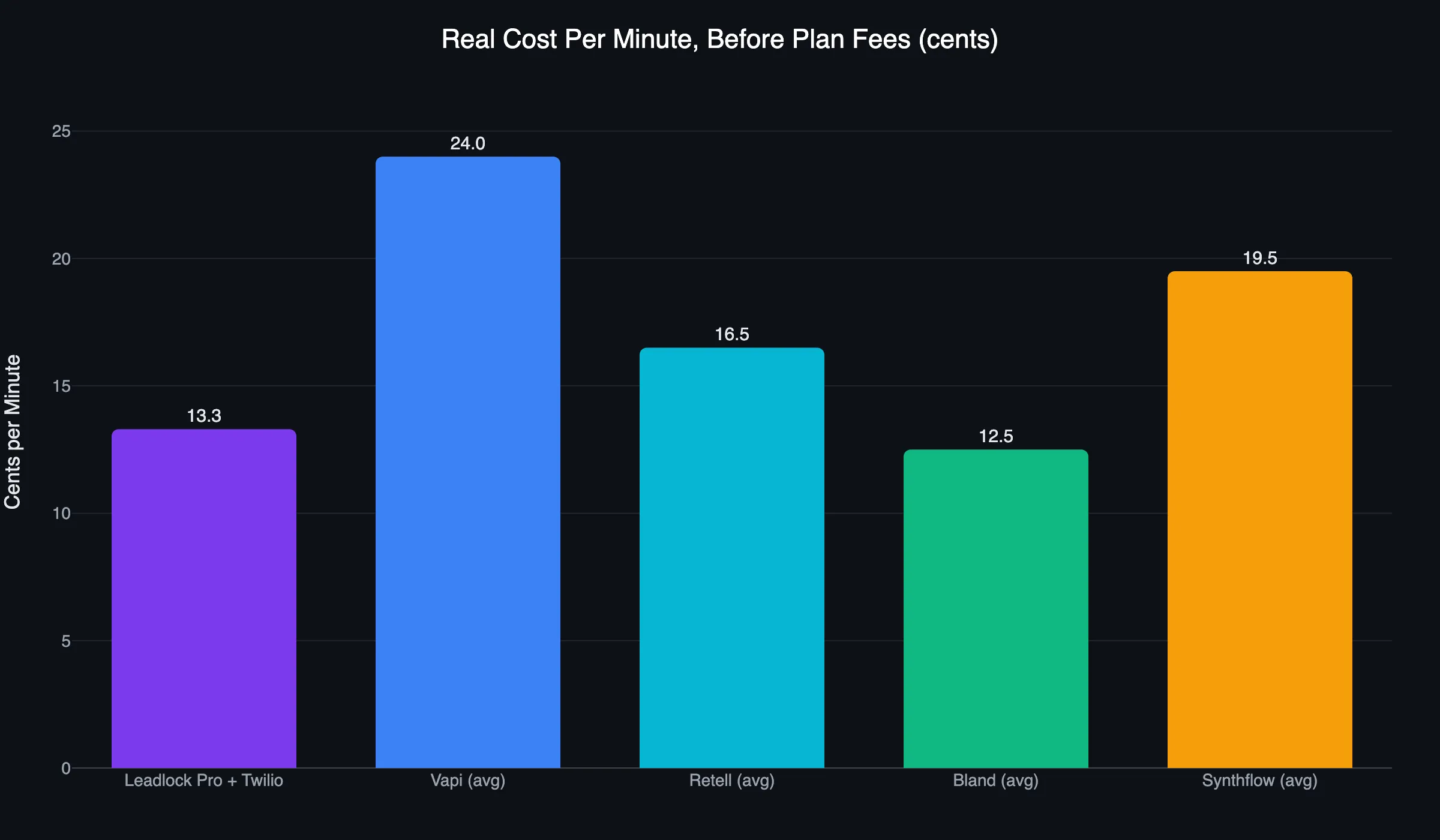
Pro Tip: The advertised per-minute rate on every voice-AI homepage is the platform fee. Once you add STT, LLM, TTS, and telephony, real all-in cost lands at $0.13-$0.33/min on platforms like Vapi and Retell. Leadlock starts at $0.12/min all-in because that’s what you pay - no component fees lurking on the bill.
Need 24/7 coverage for the calls that carry no patient health information, like after-hours booking requests, overflow and FAQs? Leadlock goes live in under 5 minutes with no SIP trunking needed - true speech-to-speech from $0.12/min. Leadlock is not HIPAA compliant and does not sign a BAA, so keep PHI calls on a vendor that does. Book a 15-minute call with Dan.
See It Book a Real Job
Voice agents that book into ServiceTitan and GoHighLevel, live today for home-service brands. Book 15 minutes with Dan, or start a 7-day trial from the pricing page.
Book a 15-minute call with Dan