What is call center automation? Learn how it works, what it costs, and which platforms deliver real ROI in 2026. Data-backed guide with case studies.
- Call center automation uses AI voice agents and workflow tools to handle customer calls - cutting costs by up to 96% vs. human agents averaging $5.50–$12 per call.
- True speech-to-speech platforms like Leadlock reply in about 300ms on Grok; competitors using STT+LLM+TTS pipelines add a hop for transcription and another for text-to-speech, which creates unnatural pauses.
- The average ROI from contact center AI is $3.50 for every $1 invested, with top performers like DoorDash achieving 94% automation success at 35,000+ calls per day.
- Leadlock starts at $0.12/minute across 4 voice providers, with transparent pricing that is all-in for the model and voice; telephony is billed by your own Twilio account.
Call center automation is the use of AI, software, and workflow tools to handle customer phone interactions - fully or partially - without requiring a human agent for every call. In 2026, it’s not a pilot program or future roadmap item. It’s already running millions of calls per day across healthcare, financial services, real estate, and e-commerce, cutting costs by up to 96% compared to traditional staffed operations.
The pace of adoption is accelerating sharply. The global Call Center AI market is projected to grow from $4.75 billion in 2025 to $15.77 billion by 2031 at a 22.14% CAGR, according to a January 2026 GlobeNewswire research report. That’s not incremental adoption - that’s a wholesale transformation of how businesses handle phone traffic.
At the center of this shift is a new category of platform: true speech-to-speech AI voice agents that respond in real time, without the awkward pauses of older systems. Leadlock AI is one of these - its agents reply in about a third of a second on Grok (median of 461 live turns, measured September 2026), with pricing starting at $0.12/minute for the model and voice, no hidden STT, LLM or TTS fees. If you’re evaluating call center automation, this guide covers what it is, how it works, what it costs, and which approach delivers the best results in 2026.
What Is Call Center Automation?
Call center automation is the deployment of AI, RPA (robotic process automation), or software to handle customer interactions - calls, routing, follow-up, and back-office tasks - without a human agent involved at every step. It ranges from basic IVR menus that route callers to fully autonomous AI voice agents that qualify leads, answer complex questions, and book appointments end-to-end.
The scope has expanded dramatically. Early automation was about deflecting volume from agents. Modern call center automation - powered by large language models and real-time voice AI - resolves entire interactions, handles objections naturally, and only escalates to a human when genuinely necessary.
Gartner predicts conversational AI will reduce contact center labor costs by $80 billion in 2026, with 10% of agent interactions fully automated - up from just 1.6% a few years ago. For businesses handling high call volumes, the economic pressure to automate has crossed from “nice to have” to “competitive requirement.”
How Does Call Center Automation Actually Work?
Call center automation works by intercepting voice calls through an AI pipeline that processes speech, generates contextually appropriate responses, and delivers audio output - all in real time. Modern speech-to-speech platforms do this in one model, audio in and audio out; legacy three-step pipelines (STT → LLM → TTS) add a hop for transcription and another for text-to-speech on every response, creating unnatural pauses that degrade caller experience.
The Old Model: Three-Step Orchestration (Broken by Design)
Most call center automation platforms still rely on a pipeline that works like this:
- Speech-to-Text (STT) - converts the caller’s voice into text
- Large Language Model (LLM) - processes the text and generates a response
- Text-to-Speech (TTS) - converts the text response back into audio
Every step adds latency. By the time STT finishes transcribing, the LLM generates a response, and TTS renders audio, you’re looking at a noticeable silence on the line. That’s not a conversation. That’s a robot making callers wait while it thinks. Competitors like Vapi, Retell, Bland, Synthflow, and Assistable all operate on this three-step model. They’ve optimized individual steps, but the fundamental architecture still creates unnatural pauses that degrade call quality and increase hang-up rates.
The New Model: True Speech-to-Speech
Leadlock AI is built on a native multimodal architecture:
Audio In → Native Multimodal Model → Audio Out
No STT. No TTS. No intermediate steps. The model processes audio directly and generates audio directly. On Grok, Leadlock agents reply in about 300ms - close to the rhythm of a natural human conversation.
This isn’t a performance tweak. It’s a fundamentally different architecture. And it changes what’s achievable in a call center automation context.
Pro Tip: Before selecting any call center automation platform, ask them directly: “Does your system use STT + LLM + TTS, or is it a native audio model?” The answer tells you everything about the latency and call quality you’ll experience. Most platforms will admit they use the three-step pipeline - and that admission explains the unnatural conversation flow callers often complain about.
What Are the Main Types of Call Center Automation?
Call center automation isn’t a single technology - it’s a layered category with several distinct approaches, each suited to different use cases.
Voice-First Automation
- AI voice agents handling inbound and outbound calls end-to-end
- IVR (Interactive Voice Response) for initial call routing
- Voicemail detection and automated follow-up sequences
Workflow and Back-Office Automation
- After-call work: call summaries, CRM updates, ticket creation - automatically
- Post-call analytics and performance scoring
- Scheduling, appointment booking, and confirmation workflows
Agent-Assist Automation
- Real-time co-pilot tools surfacing answers to live agents mid-call
- Sentiment analysis flagging escalation risk before it becomes a problem
- Automated compliance monitoring across 100% of calls
Omnichannel Automation
- Chat, email, and SMS automation layered alongside voice
- Unified conversation routing across channels
- Context preservation across handoffs between channels and agents
For most SMBs and agencies in 2026, voice-first automation delivers the highest and fastest ROI. An AI voice agent is not limited to one call at a time and works 24/7, without breaks or training overhead.
What Are the Real Benefits of Call Center Automation?
The measurable benefits of call center automation are substantial: AI-handled voice interactions cost approximately $0.20 versus $5.50 for human-only calls, response times drop by up to 80%, and agent productivity improves 30–50% when routine call volume is handled automatically. Industry research shows an average ROI of $3.50 for every $1 invested, with top deployments reaching 8x returns.
According to IBM data cited by Giva Inc., 88% of contact centers are already using some form of AI-powered solution - but only 25% have fully integrated it into daily operations. The gap between early adopters and laggards is widening fast, and it shows up directly in cost and customer experience metrics.
Concrete improvements from real deployments:
- Ticket resolution is 52% faster with AI assistance (Conectys, 2026)
- Customer satisfaction scores up 35% after automation rollout
- Response times reduced by up to 80% compared to human-only queues
- Agent productivity improved 30–50% when AI handles routine call volume
- After-call work reduced from 3–6 minutes per call to seconds with post-call automation (Aloware, 2025)
- 94% reduction in wait times and 37% fewer escalations reported by a multinational bank after deploying AI voice agents
Cost is the clearest story. An AI-handled voice interaction averages approximately $0.20 compared to $5.50 for a human-only call - a 96% cost reduction. A contact center handling 10,000 calls per month pays roughly $2,000 with AI versus $55,000 with human agents for comparable volume. The average ROI across contact center AI deployments is $3.50 for every $1 invested, with top performers achieving up to 8x returns (Aloware, 2025).
Industry research from 93% of service professionals confirms that AI saves them meaningful time - not marginal minutes, but hours per day that previously went to routine, low-value interactions (GlobeNewswire, 2026).
What Does Call Center Automation Actually Cost in 2026?
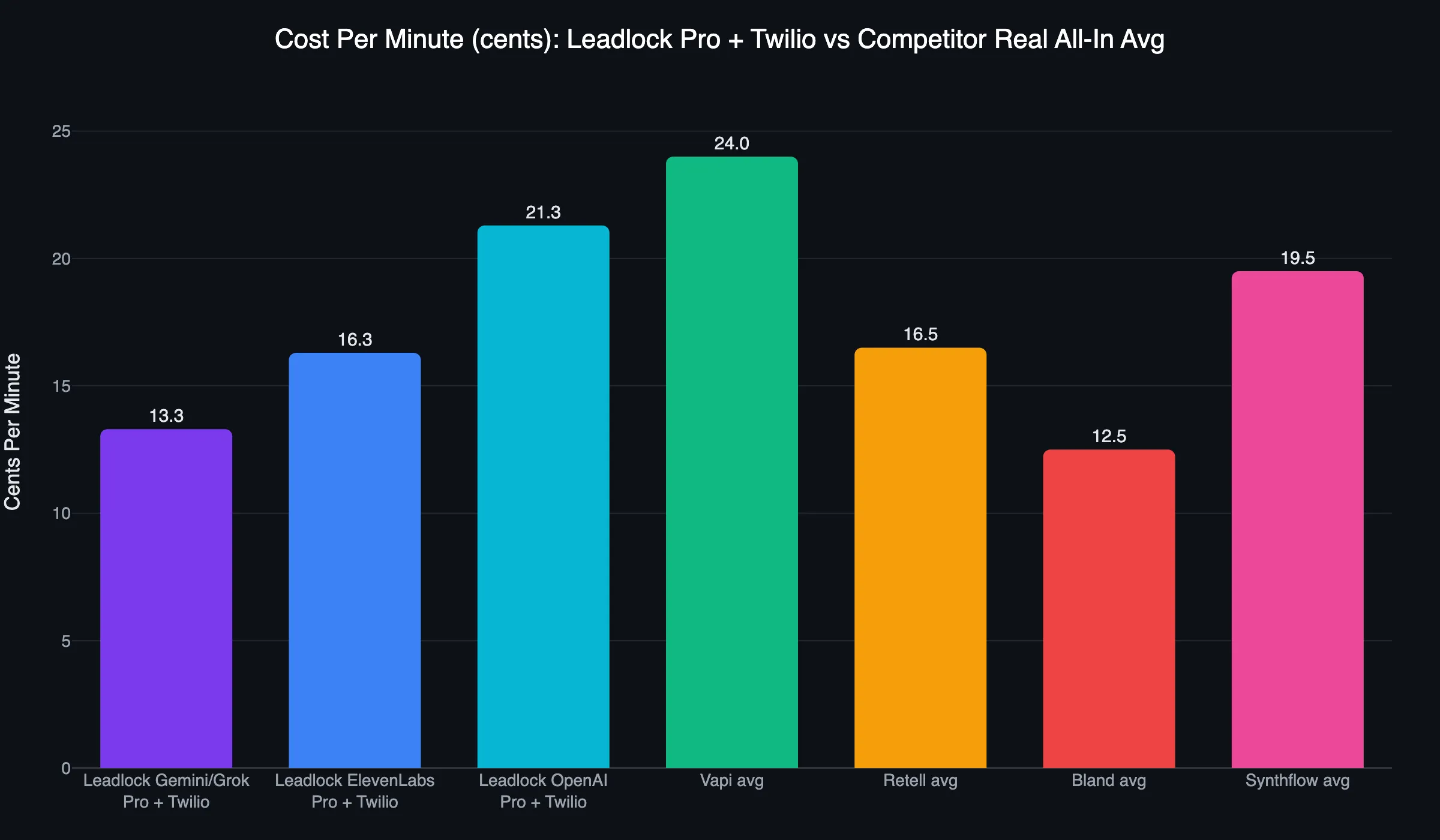
Call center automation costs in 2026 range from $0.12/minute for the model and voice on speech-to-speech platforms (plus telephony) to $0.33/minute on platforms with hidden STT, LLM, TTS, and telephony fees. Human agent call handling averages $5.50–$12 per interaction - meaning AI automation delivers a 90–96% cost reduction at comparable call volumes, with payback periods typically measured in weeks.
Most platforms advertise a low per-minute rate, then bill separately for STT, LLM tokens, TTS, and telephony. The “real” cost is often 2–7x the headline number.
Here’s a direct comparison of true all-in costs across major voice AI platforms:
| Platform | Architecture | Advertised Rate | Estimated True Cost | Latency |
|---|---|---|---|---|
| Leadlock (Gemini) | Speech-to-speech | $0.12/min | about $0.133/min with Twilio | No STT/TTS hops |
| Leadlock (Grok) | Speech-to-speech | $0.12/min | about $0.133/min with Twilio | ~300ms reply (Grok, median) |
| Leadlock (OpenAI) | Speech-to-speech | $0.20/min | about $0.213/min with Twilio | No STT/TTS hops |
| Leadlock (ElevenLabs) | ElevenLabs voice | $0.15/min | about $0.163/min with Twilio | Varies by provider |
| Vapi | STT + LLM + TTS | ~$0.05/min | ~$0.15–$0.33/min | Varies by stack |
| Retell | STT + LLM + TTS | ~$0.07/min | ~$0.13–$0.20/min | Varies by stack |
| Bland | STT + LLM + TTS | ~$0.11–$0.14/min | ~$0.11–$0.14/min + fees | Varies by stack |
| Synthflow | STT + LLM + TTS | ~$0.09/min | ~$0.15–$0.24/min | Varies by stack |
Leadlock’s pricing is all-in for the model and voice - no STT or TTS billing, no hidden LLM token charges. Phone numbers and carrier minutes are billed by your own Twilio account (about $0.013/min inbound and $1.15/month per local number at Twilio’s published US rates), plus the Leadlock plan fee.
The savings compound at scale. 1,000 minutes per month on Leadlock’s Gemini costs $120 in usage on Pro, plus about $14 of Twilio telephony. The equivalent volume on Vapi, Retell, or Synthflow with their layer costs runs $130–$330. Count Leadlock’s plan fee and a single account at this volume is not cheaper: Starter comes to about $291 ($97 + 1,000 x $0.18 + Twilio). For agencies managing multiple clients on one plan fee, the per-minute difference is where the margin comes from.
For a full breakdown of true market pricing, see: AI Voice Agent Platform Pricing in 2026: Real Cost Breakdown
Real-World Call Center Automation ROI: What Companies Are Actually Seeing
Real-world ROI from call center automation consistently exceeds projections: industry benchmarks show $3.50 returned for every $1 invested, with top deployments achieving 8x returns. Companies replacing BPO operations with AI voice agents report $1.2M–$1.5M in annual savings, with implementation timelines measured in weeks rather than months and automation success rates reaching 94% on high-volume call types.
DoorDash automated 35,000+ calls daily at a 94% success rate, replacing a costly BPO arrangement entirely (Replicant, 2025). The same call quality achieved at a fraction of the cost - at ten times the volume a human team could handle.
ECSI saved $1.5 million annually by automating front-desk calls that previously required dedicated staff. Routine inquiries were resolved end-to-end without any human involvement.
A leading wellness company handled 10,000+ calls per week at peak using AI voice agents alone, saving over $1.2 million annually compared to staffed operations (Replicant, 2025).
MoneySolver, a financial services firm, implemented AI call analysis across 100% of their calls - compared to the small manual fraction previously audited. Their close rate doubled and return on ad spend from Google Ads improved 30% (My AI Front Desk, 2025). The insight wasn’t just cost savings - it was visibility. Automated analysis found patterns in winning conversations that human review would have missed entirely.
The pattern across all these deployments: automate high-volume, repeatable call types (scheduling, FAQs, intake, qualification) and free human agents for the complex interactions where judgment actually matters.
What Are the Key Call Center Automation Trends in 2026?
The six most important call center automation trends in 2026 are the shift from scripted IVR to agentic AI, expansion to 100% call coverage for quality assurance, predictive escalation before caller frustration peaks, full after-call automation, deep CRM and workflow platform integration, and the emergence of automation as a competitive requirement rather than an optional efficiency gain. For the enterprise side, see what is changing in enterprise call centers.
1. Agentic AI replaces scripted IVR
Legacy IVR systems follow rigid decision trees. Agentic AI understands natural language, adapts mid-conversation, and handles unexpected inputs without breaking. The migration from IVR to AI voice agents is happening faster than most contact centers expected - and customers are driving it by simply hanging up on systems that don’t understand them.
2. 100% call coverage for quality assurance
Previously, QA teams could sample 2–5% of calls. AI now analyzes every call in real time, flagging compliance violations, sentiment drops, and escalation signals automatically. Teams implementing AI-powered call monitoring saw 50–60% fewer compliance violations within 90 days of deployment (Aloware, 2025).
3. Predictive escalation before frustration peaks
AI detects caller frustration signals before a call deteriorates and routes proactively to a human agent. This approach has driven 20–25% improvement in retention rates on high-risk calls (Aloware, 2025).
4. After-call automation eliminates “wrap time”
Post-call work - summaries, CRM updates, follow-up tasks, ticket creation - is fully automated. What previously consumed 3–6 minutes of agent time per call is now done in seconds. For a 50-agent team, that’s hours of recovered capacity per day.
5. Native GoHighLevel integration for agencies
Agencies running GHL pipelines are connecting AI voice agents directly into lead follow-up, appointment booking, and re-engagement workflows. Leadlock’s native GHL integration enables this setup in under 5 minutes - without SIP trunking or custom development. For the full playbook, see: Best GoHighLevel AI Voice Agent Integrations for Agencies in 2026
6. Automation is no longer optional
A 2026 industry survey found 93% of contact center leaders call automation “very or extremely important.” 70% of CX leaders intend to integrate generative AI into customer touchpoints within two years (GlobeNewswire, 2026). The window for early-mover advantage is narrowing - competitors who deploy now will have optimized, data-rich agents by the time laggards start their first pilot.
How to Choose the Right Call Center Automation Platform
Choosing the right call center automation platform requires evaluating seven key criteria: underlying architecture (speech-to-speech vs. three-step pipeline), true all-in pricing, time to deployment, CRM and workflow integrations, compliance support, voice provider options, and concurrent call capacity. Architecture and pricing transparency are the two most frequently overlooked and most consequential factors.
Seven criteria worth evaluating on every platform:
- Architecture - Speech-to-speech or STT + LLM + TTS? This determines your latency floor and call quality ceiling.
- Transparent pricing - What’s the total cost including telephony, transcription, synthesis, and LLM usage, and who bills each part?
- Time to live - Can you deploy in hours, or does it require weeks of SIP trunking and integration work?
- CRM and workflow integrations - Does it connect natively to GHL, HubSpot, Salesforce, or your booking system?
- Compliance support - TCPA disclosure scripts, HIPAA compatibility, call recording consent handling?
- Voice provider options - Can you choose between budget and premium voice quality based on use case?
- Concurrent call capacity - Does it handle multiple calls at the same time without degradation?
Leadlock covers six of the seven. On integrations, GoHighLevel works out of the box, and ServiceTitan or anything else with an API can be connected. Compliance is the exception: Leadlock is not HIPAA compliant and signs no BAA, and it ships no TCPA disclosure script of its own. TCPA consent is the customer’s responsibility, and the agent’s disclosure and opt-out wording is set in the prompt the customer writes. What it does ship is a “this call may be recorded” notice that is on by default, and outbound calling stays off until the account owner accepts the outbound calling terms. It offers 4 voice providers across a $0.12–$0.39/minute range - letting teams optimize cost-to-quality by use case. High-volume outbound campaigns run on Gemini at $0.12/min. Enterprise customer-facing inbound calls use OpenAI Realtime or ElevenLabs for the best caller experience. One platform, one pricing structure, no hidden layers.
For a broader view of the competitive landscape, the automated call center guide covers how the shift to AI is changing customer experience across industries.
Frequently Asked Questions
Q: What is call center automation?
Call center automation is the use of AI, software bots, and workflow tools to handle customer phone interactions - fully or partially - without requiring a human agent on every call. In 2026, it primarily refers to AI voice agents that can qualify leads, answer questions, book appointments, and route calls in real time using natural language understanding.
Q: How much does call center automation cost in 2026?
Costs vary significantly by platform and architecture. Leadlock AI starts at $0.12/minute for Gemini, all-in for the model and voice, plus Twilio telephony (about $0.013/min inbound) on your own account. Competitors advertise similar rates but add separate STT, LLM, TTS, and telephony charges that push true costs to $0.13–$0.33/min. Human agent call handling typically costs $5.50–$12 per call depending on complexity and location.
Q: What ROI can I expect from call center automation?
Industry research shows an average ROI of $3.50 for every $1 invested in contact center AI, with top performers achieving up to 8x returns (Aloware, 2025). Real deployments report 52% faster ticket resolution, 35% higher customer satisfaction, and 30–50% improvement in agent productivity. DoorDash achieved a 94% success rate automating 35,000+ calls per day.
Q: What’s the difference between IVR and AI voice agents?
IVR (Interactive Voice Response) uses rigid menu trees and touch-tone or basic voice commands. AI voice agents understand open-ended natural language, adapt dynamically mid-conversation, and complete complex tasks end-to-end without requiring callers to select from a menu. AI voice agents have effectively made traditional IVR obsolete for any use case beyond the simplest routing tasks.
Q: How long does it take to set up call center automation?
With Leadlock, you can be live in under 5 minutes - no SIP trunking required. Traditional enterprise platforms typically require weeks of integration work, custom telephony configuration, and training data preparation. Modern AI voice agent platforms have eliminated most of this friction with no-code configuration and pre-built integrations.
Q: Can AI voice agents handle complex calls or just simple FAQs?
Modern LLM-powered agents handle significant complexity: multi-step qualification flows, objection handling, scheduling with live availability checks, conditional branching based on caller responses, and structured intake processes. The genuine limitation is novel edge cases requiring human judgment - which is exactly what escalation routing is designed to handle.
Q: Is call center automation compliant with TCPA and HIPAA?
It depends on implementation. TCPA requires proper disclosure and consent for automated outbound calls. HIPAA requires platforms with access to protected health information to sign Business Associate Agreements (BAAs) and maintain appropriate data handling standards. With Leadlock, TCPA consent is the customer’s responsibility: the agent’s disclosure and opt-out wording is set in the prompt the customer writes, and a “this call may be recorded” notice is on by default. Leadlock is not HIPAA compliant and does not sign a BAA, so use it only for calls that carry no protected health information.
Q: What percentage of calls can be fully automated?
Gartner projects 10% of all contact center interactions will be fully automated in 2026, up from 1.6% previously. However, for specific high-volume repeatable call types - scheduling, FAQs, lead qualification, basic intake - automation rates of 70–94% are achievable today, as demonstrated by DoorDash’s 35,000+ calls per day at 94% success with no human fallback required.
Ready to replace slow, expensive call handling with AI that replies in about 300ms on Grok and costs from $0.12 a minute on Pro for the model and voice? Leadlock delivers true speech-to-speech voice agents - 4 voice providers, transparent per-minute pricing, live in under 5 minutes, no SIP trunking needed. Book a 15-minute call with Dan.
See It Book a Real Job
Voice agents that book into ServiceTitan and GoHighLevel, live today for home-service brands. Book 15 minutes with Dan, or start a 7-day trial from the pricing page.
Book a 15-minute call with Dan