Missed calls cost the average business $126,000/year. Learn the real data, by-industry breakdown, and how AI voice agents fix it from $0.12/min.
Every time your phone rings and no one answers, money walks out the door. Not metaphorically - literally. A missed call isn’t just a missed conversation; it’s a missed customer, a missed appointment, and in many cases, a missed sale that will never come back.
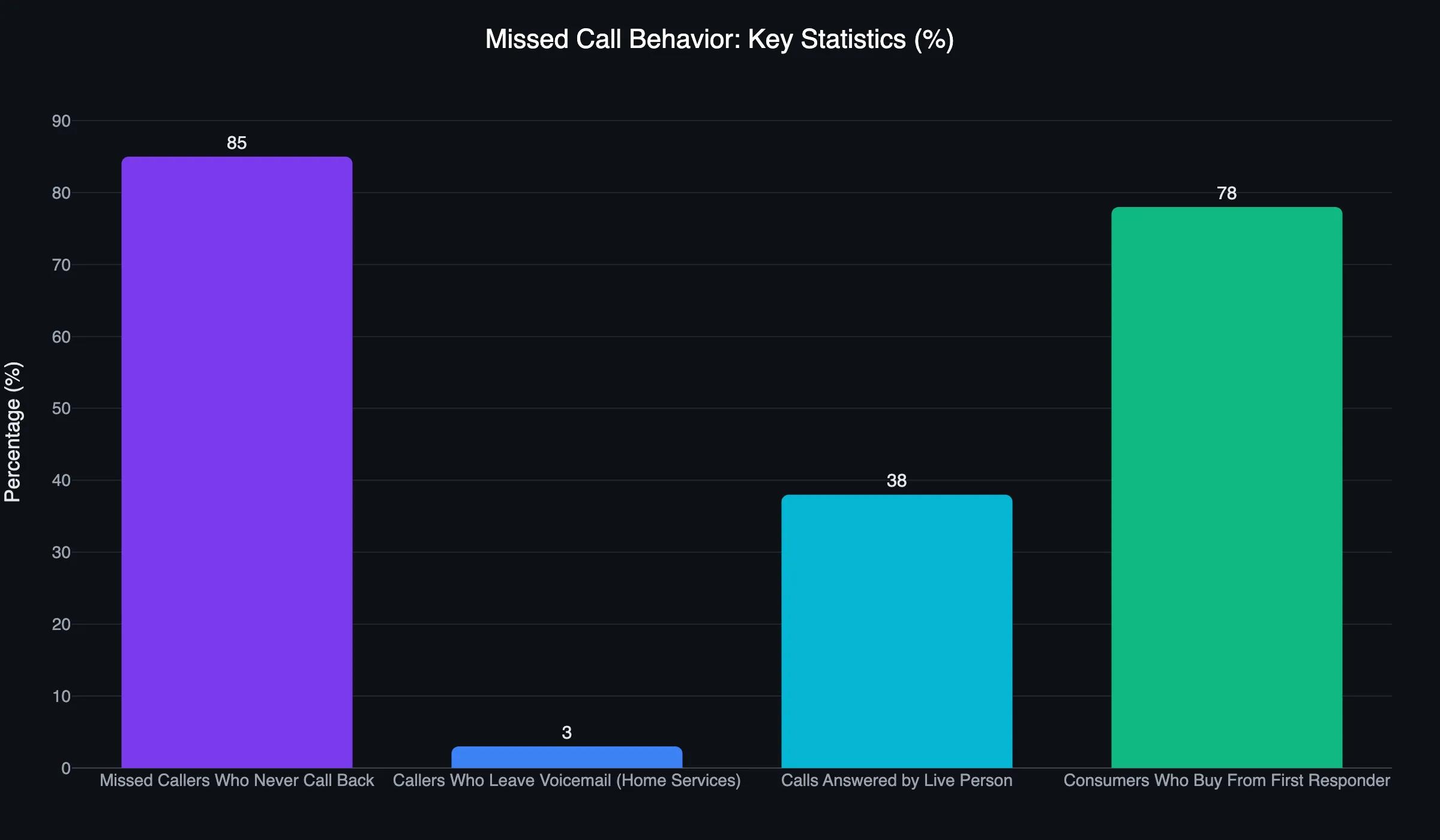
The data is stark: according to a 2024 study by 411 Locals analyzing 85 businesses across 58 industries, only 37.8% of business calls are answered by a live person. Another 37.8% go to voicemail, and 24.3% receive no response at all. That means roughly one in four callers hangs up having never reached anyone - not even a machine.
The fix isn’t hiring more staff. It’s deploying an AI voice agent that answers every call, instantly, 24/7 - at a fraction of the cost of a human receptionist. Leadlock AI makes this possible from $0.12 per minute, with no hold queues, no missed calls, and no voicemails that never get returned. Here’s exactly what missed calls are costing your business - and how to stop the bleeding.
How Much Do Missed Business Calls Actually Cost?
The average small business loses approximately $126,000 per year to missed calls - and that figure compounds dramatically in high-value industries like legal, healthcare, and real estate, where a single unanswered call can represent thousands of dollars in lost customer lifetime value, referrals, and downstream revenue that never returns.
That $126,000 figure, cited in the 2025 AMBS Call Center Report, sounds almost unbelievable until you work through the math. Consider a dental practice that fields 40 calls per day. If 25% go unanswered - a conservative estimate - that’s 10 missed calls daily. At an average new patient value of $1,500, even a 10% conversion rate on those calls means $1,500 in lost revenue every single day, or $547,500 annually.
The problem scales with the value of your average customer. Industries like law, financial advisory, and elective healthcare lose far more per missed call than a retail shop. But even low-ticket verticals feel the impact when you account for lifetime customer value, referrals, and brand reputation.
The real cost of a missed call isn’t just the immediate transaction. It’s every follow-on sale, every referral, every upsell that never happens because that customer found someone else who picked up the phone first.
Why Do 85% of Missed Callers Never Call Back?
85% of callers who don’t reach a live person will not call back - they will simply move on to a competitor who answered their phone, according to widely cited industry data from PATLive and AnswerConnect, making every missed call a direct transfer of warm, high-intent business to whichever competitor picked up first.
This is the most damaging part of the missed call problem. Businesses often assume a voicemail is a fair substitute for answering. It isn’t. The modern consumer has options - a Google search returns five competitors in seconds. There’s no loyalty to a business you’ve never spoken to.
The pattern is especially severe in home services. A 2025 Invoca analysis found that 27% of calls to home services businesses go unanswered - and fewer than 3% of those callers leave a voicemail. The other 97% are gone. They found another plumber, another HVAC company, another cleaning service. Your calendar sits empty while your competitor’s fills up.
For appointment-driven businesses - medical practices, law firms, salons, gyms - this translates directly into scheduling gaps and lost revenue that is never recovered. The call that goes to voicemail on a Tuesday afternoon isn’t usually going to be returned on Wednesday morning. It’s gone.
What Is the Speed-to-Lead Problem and Why Does It Kill Conversions?
Responding to an inbound lead within 5 minutes makes you 100x more likely to connect with that prospect compared to waiting 30 minutes - and after 10 minutes, the odds of qualifying a lead drop by 400%, according to a Harvard Business Review analysis of 15,000+ leads and over 100,000 call attempts.
Speed isn’t just a nice-to-have. It’s the single most important variable in lead conversion, more impactful than offer, pricing, or brand reputation. When someone calls your business, they are at peak intent. They want to buy, book, or get help right now. Every minute you fail to respond, that intent cools.
A 2025 analysis by Lead Response Management (which underpinned the HBR study) found the most successful sales organizations respond to inbound leads in under 60 seconds. For businesses relying on humans to answer phones, this is nearly impossible - especially during lunch, after hours, on weekends, or during high-volume periods.
Pro Tip: The 5-minute rule applies equally to inbound calls and web-to-call leads. If a prospect submits a form on your website and you call back 20 minutes later, you’ve already lost 99% of the advantage you had when they were actively engaged. AI voice agents that trigger outbound follow-up calls instantly are the only scalable solution.
Which Industries Lose the Most to Missed Calls?
High-value, appointment-driven industries lose the most per missed call - with legal and healthcare practices routinely losing thousands of dollars from a single unanswered phone call - and unlike chargebacks or refunds, missed-call revenue loss is invisible on the balance sheet, making it the most chronically underreported cost center in small business operations.
Here’s a breakdown of what missed calls cost by industry, based on per-call value and average answer rates:
| Industry | Avg. Value Per Customer | Est. Missed Call Rate | Est. Annual Loss (50 calls/day) |
|---|---|---|---|
| Law Firm | $3,000–$15,000 | 25–40% | $500K–$2M+ |
| Dental Practice | $1,200–$2,500 | 20–30% | $200K–$600K |
| HVAC / Home Services | $300–$800 | 27% | $50K–$150K |
| Medical Clinic | $400–$1,500 | 20–35% | $100K–$400K |
| Real Estate Agent | $5,000–$30,000+ | 20–30% | $400K–$1M+ |
| Financial Advisor | $2,000–$10,000 | 15–25% | $150K–$600K |
These are not worst-case scenarios - they reflect realistic conversion rates applied to average answer-rate data. The GetAira 2026 industry breakdown confirms these patterns, with legal and healthcare consistently ranking as the highest-cost verticals for missed calls.
The structural problem is that the businesses with the highest missed-call costs are exactly the businesses with the most complex operations - they’re busy serving clients, doing procedures, or in court. The phone rings at the worst possible time, and nobody is available to answer it.
How Does an AI Voice Agent Solve the Missed Call Problem?
An AI voice agent answers every inbound call instantly, 24/7, with zero hold time - qualifying leads, booking appointments, and capturing contact information in real time, without a single call going to voicemail, without hold queues, and without the ongoing overhead of human receptionists who cannot be available around the clock every single day of the year.
This isn’t call routing to a bot with a menu. Modern AI voice agents like Leadlock conduct natural, dynamic conversations. They ask qualifying questions, check calendar availability, book appointments directly into GoHighLevel calendars, and handle objections - all in real time, without a human operator.
AI agents can also handle appointment reminders, confirmations, and rescheduling, which keeps more of those bookings on the calendar.
Why Do Traditional Solutions Fall Short?
Traditional missed-call solutions - additional staff, outsourced call center services, and IVR phone-tree systems - all fail at the same fundamental constraint: they cannot be simultaneously cost-effective, always-available, and consistently high-quality, leaving businesses perpetually forced to sacrifice at least one of those three requirements no matter how much they spend.
Most businesses that recognize the missed call problem try one of three solutions: hire more staff, use a call center service, or set up a basic IVR/voicemail system. All three have significant limitations.
Hiring more staff is expensive and doesn’t solve the after-hours problem. A full-time receptionist costs $35,000–$50,000 per year in salary alone - and still can’t answer calls at 11pm on a Saturday.
Call center services cost $1–$3 per minute and introduce quality inconsistencies. Your brand voice is in the hands of agents who handle dozens of different businesses simultaneously.
IVR systems are actively harmful. A Vonage survey of 2,010 respondents found that 85% of consumers abandoned calls after reaching an auto attendant, and 51% abandoned the business entirely after one such experience. A menu-driven phone tree isn’t just unhelpful - it actively drives customers to competitors.
The AI voice agent eliminates all three limitations:
- Always available - 24/7/365, including holidays and after-hours
- Scalable - not limited to one call at a time
- Consistent quality - every caller gets the same professional, on-brand experience
- Cost-effective - from $0.12/minute vs. $35K+ for a human hire
What Makes Leadlock’s AI Voice Technology Different?
Leadlock uses true speech-to-speech AI - audio goes in, a native multimodal model processes it, and audio comes out - and replies in about a third of a second on Grok (median of 461 live turns, measured September 2026), with no separate transcription and text-to-speech chain.
This isn’t a minor technical detail. It’s the difference between a natural conversation and an awkward, stilted interaction that makes callers uncomfortable and reduces conversion rates.
Most competing platforms - Vapi, Retell, Bland, Synthflow, Assistable - use a three-step orchestration layer:
- Speech-to-Text (STT) - converts audio to text
- LLM processing - sends text to a language model
- Text-to-Speech (TTS) - converts response text back to audio
Each hop adds delay, and the delays stack up on every turn - perceptible pauses that break conversational flow and signal to the caller that they’re talking to a bot.
Leadlock eliminates the orchestration layer entirely. Audio goes directly into a native multimodal model that understands speech and generates speech natively. The result is about 300ms replies on Grok - fast enough to feel like a normal conversation.
Leadlock also offers four voice provider tiers to match budget and quality needs:
- Gemini Live - from $0.12/min on Pro - ideal for high-volume outbound and lead qualification
- Grok Voice (xAI) - from $0.12/min on Pro - balanced quality and cost for most business use cases
- OpenAI Realtime - from $0.20/min on Pro - premium quality for customer-facing inbound calls
- ElevenLabs - $0.15/min on Pro - ultra-realistic for luxury brands and high-stakes sales
You can read a full pricing breakdown in our AI Voice Agent Platform Pricing in 2026: Real Cost Breakdown post - but the short version is: Leadlock’s pricing is a plan fee from $97/month plus a per-minute rate that starts at $0.12 on the $497/month Pro plan, all-in for the model and voice with no hidden STT, LLM, or TTS fees stacked on top. Phone numbers and carrier minutes are billed by your own Twilio account (about $0.013/min inbound and $1.15/month per local number at Twilio’s published US rates).
What Does the ROI of an AI Voice Agent Actually Look Like?
Businesses deploying AI voice agents report 11–17x ROI within the first quarter, with payback periods typically in the 60–90 day range, according to McKinsey, IBM, and Forrester data compiled by Retell AI.
Let’s run a simple scenario for a home services business:
Before AI:
- 50 inbound calls per day
- 27% missed (13–14 calls)
- Average job value: $400
- Conversion rate of answered calls: 20%
- Missed call conversion if answered: 15% (slightly lower, cold lead)
- Daily missed revenue: ~$780–$840
- Annual missed revenue: ~$285,000–$305,000
After AI (Leadlock Gemini on the $97/month Starter plan, $0.18/min):
- Average call duration: 3 minutes
- Cost per call: $0.54 in usage, about $0.58 with Twilio
- 14 additional calls answered daily: 1,260 minutes a month, or $227 in usage plus about $18 of Twilio telephony (1,260 x $0.013 + one $1.15 number)
- Additional conversions: 2 jobs/day × $400 = $800/day in recovered revenue
- Monthly ROI: ~$24,000 recovered vs. ~$341 in AI costs ($97 plan fee + $227 usage + ~$18 Twilio)
That is roughly a 74x return on AI spend. Even at more conservative assumptions - 1 additional conversion per day, lower average job value - the economics are overwhelmingly positive.
Gartner projects that contact centers will save $80 billion in labor costs by 2026 through conversational AI. The businesses capturing that savings advantage first will have a structural cost advantage that compounds over time.
For a deeper breakdown of how to calculate your specific ROI, see our AI Voice Agent ROI Calculator.
How Do You Get Started With an AI Voice Agent?
Getting an AI voice agent live doesn’t require months of integration work or SIP trunking expertise. Here’s the realistic deployment path with Leadlock:
- Sign up - create your Leadlock account at leadlock.ai (7-day free trial on every plan)
- Configure your agent - run the setup wizard or start from a template, then set your business name, hours, services, and qualification questions
- Choose your voice tier - Gemini for budget efficiency, OpenAI for premium customer experience
- Connect your calendar - book into GoHighLevel calendars out of the box; ServiceTitan and anything else with an API can be connected
- Connect a number - import one from your Twilio account or GoHighLevel, then forward your existing business number to it (takes 2 minutes)
- Go live - your AI receptionist answers the next call
The entire process takes under 5 minutes for basic setup. No developers required, no telephony expertise needed.
If you’re running a GoHighLevel agency, Leadlock’s native GHL integration means your AI voice agents sync with your existing workflows, sub-accounts, and CRM automations. See our Best GoHighLevel AI Voice Agent Integrations for Agencies in 2026 guide for the full setup walkthrough.
What Should You Look for in an AI Voice Agent?
Not all AI voice agents are created equal. When evaluating platforms for your business, prioritize these criteria:
Non-negotiable requirements:
- Fast replies, measured on real calls (long pauses feel robotic)
- Native calendar integration (booking must happen in the call, not via email follow-up)
- 24/7 availability with no per-seat limits
- Transparent pricing - no hidden STT/LLM/TTS fees, and telephony costs stated up front
Important differentiators:
- True speech-to-speech vs. STT→LLM→TTS orchestration
- Number of voice provider options (quality/cost flexibility)
- CRM and workflow integrations (GoHighLevel, HubSpot, Salesforce)
- Outbound calling capability for follow-ups and re-engagement
- Call recording and analytics
Red flags to avoid:
- Advertised pricing that doesn’t include telephony costs
- Fixed voice options with no quality tiers
- Required SIP trunking configuration
- Long-term contracts with high exit fees
The best way to evaluate any platform is to run a real call test. Leadlock includes a 7-day free trial on every plan - put it through its paces on your actual call scenarios before committing.
Frequently Asked Questions
Q: How much revenue does the average business lose from missed calls per year?
According to the 2025 AMBS Call Center Report, the average small business loses approximately $126,000 per year to missed calls. High-value industries like law, healthcare, and real estate typically lose significantly more - often $500,000 or more annually - due to the higher per-customer value in those sectors.
Q: What percentage of callers leave a voicemail when they don’t reach a live person?
Research from Invoca (2025) found that fewer than 3% of callers to home services businesses leave a voicemail when their call goes unanswered. The other 97% move on without leaving any message, making voicemail an ineffective substitute for actually answering the call.
Q: How quickly do you need to respond to an inbound lead to maximize conversion?
According to a Harvard Business Review analysis of 15,000+ leads, you must respond within 5 minutes to be 100x more likely to connect compared to a 30-minute response. After 10 minutes, the odds of qualifying that lead drop by 400%. AI voice agents are the only scalable way to guarantee sub-60-second response times 24/7.
Q: How does Leadlock’s AI voice agent differ from competitors like Vapi or Retell?
Leadlock uses true speech-to-speech AI - audio goes directly into a native multimodal model and comes out as audio, and Leadlock agents reply in about 300ms on Grok (median). Competitors like Vapi and Retell use a three-step orchestration layer (Speech-to-Text → LLM → Text-to-Speech) that adds delay at every hop of each conversational turn. Leadlock also offers four voice provider tiers starting from $0.12/minute for the model and voice, with no hidden API fees; telephony is billed by your own Twilio account.
Q: What ROI can a small business expect from an AI voice receptionist?
Case study data shows ROI ranging from 11x to 17x within the first quarter of deployment. A law firm case study documented an additional $85,000/month in captured revenue after deploying an AI voice agent, reducing missed call rates from 40% to under 10%. The payback period for most businesses is 60–90 days.
Q: Can an AI voice agent book appointments and integrate with my CRM?
Yes. On Leadlock, GoHighLevel works out of the box; ServiceTitan and anything else with an API can be connected. The agent can check calendar availability, book appointments, update contact records, and trigger workflow automations - all within the live call, without any human intervention required.
Q: What happens to after-hours calls with an AI voice agent?
AI voice agents provide 24/7 after-hours coverage with no additional cost compared to voicemail-only setups. Industry data from Dialzara shows that AI voice agents capture 15–20% more after-hours appointments compared to voicemail-only coverage. For businesses in time-sensitive industries like emergency HVAC, plumbing, or legal services, after-hours coverage is often where the highest-value calls originate.
Q: Is AI voice technology reliable enough to handle real customer calls?
Yes, when the platform replies fast enough to keep the conversation natural. The key is choosing a platform with measured reply times on real calls and native multimodal processing: Leadlock replies in about 300ms on Grok (median of 461 live turns, measured September 2026). You can read more about what makes AI voice agents replace IVR systems effectively.
Ready to stop losing revenue to missed calls? Leadlock AI answers every call instantly, 24/7 - from $0.12 per minute, live in under 5 minutes, no SIP trunking required. Book a 15-minute call with Dan.
See It Book a Real Job
Voice agents that book into ServiceTitan and GoHighLevel, live today for home-service brands. Book 15 minutes with Dan, or start a 7-day trial from the pricing page.
Book a 15-minute call with Dan