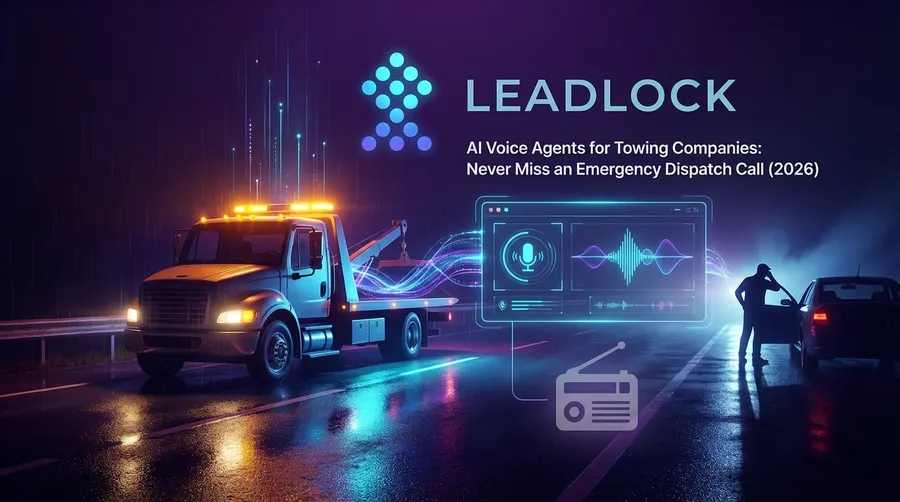
Towing companies miss 62% of calls - at $185/call. AI voice agents answer every call, dispatch 24/7, and cost 85% less than human dispatchers. Here's how.
- 58% of towing encounters are emergencies and nearly half happen after dark - AI dispatch answers every call, 24/7/365.
- An AI voice agent on Leadlock’s Starter plan costs about $195/month for 500 minutes ($97 plan + 500 x $0.18, plus about $8 in Twilio charges) vs $3,600-$4,800/month for a human overnight dispatcher.
- Leadlock’s true speech-to-speech architecture delivers about 300ms replies on Grok, with no separate transcription and text-to-speech chain - critical for stressed, stranded callers who hang up on delays.
The towing industry runs on emergencies. A driver stranded on the side of I-95 at 2 a.m. doesn’t leave a voicemail - they call the next number on the list. If you miss that call, you miss the job. And with 58% of towing encounters classified as emergencies (Gitnux, 2026) and nearly half happening after dark, your phone never truly stops ringing.
The problem is that no human dispatcher can be on call 24/7, 365 days a year without burning out - or bankrupting you. A night shift dispatcher runs $3,600 to $4,800 per month (GetNextPhone, 2026). And according to industry data, home service businesses still miss 62% of inbound calls even with staff in place.
That’s where AI voice agents come in. Platforms like Leadlock AI answer every call right away, gather job details, confirm the caller’s location, and dispatch a truck - all without a human picking up. No hold times. No voicemail. No lost jobs at 3 a.m.
If you run a towing company in 2026 and you’re still depending entirely on human dispatchers to cover round-the-clock emergency calls, you’re leaving a significant chunk of revenue on the table every single month.
Why Are Towing Companies Losing So Many Emergency Calls?
Towing companies miss emergency calls because dispatchers can only handle one call at a time, and emergencies don’t cluster neatly into business hours. With 88 million roadside assistance calls made annually in the U.S. (LookUpAPlate, 2025) and nearly half of all towing incidents occurring after dark, every gap in phone coverage represents real lost revenue.
The structural problem is simple: most towing operations are small. According to Gitnux’s 2026 industry report, 78% of towing companies are independent operators with an average fleet of 8.2 trucks. That means no dedicated overnight dispatch team, no call center, and no backup when your one dispatcher is already on a call or asleep.
Industry research shows that 62% of small business phone calls go unanswered across home services (411 Locals study, 85 businesses, 58 industries). For towing, the stakes are higher than average. The caller on the shoulder of a highway isn’t going to wait - 85% of callers won’t try the same business again if they don’t reach someone on the first attempt (Dialzara). And Harvard Business Review data shows that after just a 30-minute response delay, 79% of prospects have already moved to a competitor.
In towing, “moving to a competitor” takes about 10 seconds - one more Google search, one more tap.
What Does an AI Voice Agent Actually Do When a Tow Call Comes In?
An AI voice agent for towing answers the call instantly, collects the caller’s location and vehicle details, confirms service type, and logs the dispatch request - completing in about 10 seconds what a human dispatcher does in 3 to 5 minutes.
Here’s how a typical AI-handled dispatch call flows:
- Customer calls after hours (or during a busy period)
- AI answers right away - no rings, no hold music
- AI asks for location, vehicle make/model, and service needed (jump start, lockout, flat, tow)
- AI confirms estimated arrival time based on fleet availability
- Job details are automatically logged to GoHighLevel or ServiceTitan, or to any dispatch software you have connected through its API
- Customer receives a confirmation text with ETA
The entire interaction takes under 90 seconds for a straightforward dispatch request. Compare that to 3 to 5 minutes of manual job entry per call for a human dispatcher (GetNextPhone, 2026).
Multiply that across 40-60 calls per night and the efficiency gain is massive. AI also handles multiple calls at the same time without degradation - something no human team can match during a post-storm surge when your phones are lighting up from every stranded driver in a 20-mile radius.
Pro Tip: Set your AI voice agent to automatically escalate complex situations - like calls involving injuries or accidents - to a live human dispatcher. Keep AI handling the high-volume standard dispatch requests while your human staff focuses on edge cases.
What Is the True Cost of a Missed Tow Call?
Missing a single tow call costs between $100 and $1,200 depending on the job type, with the average towing job protecting roughly $185 in revenue per call (Dialzara).
A roadside lockout might be a $75 job. A flatbed transport to a dealership might be $400. An overnight impound contract with a police department? That’s recurring revenue worth thousands per month. Every missed call is one of those jobs going to a competitor.
The math adds up quickly:
- Miss 2 calls per day at $185 average → $135,000+ lost annually
- Miss 10 calls per month at $300 average → $36,000/year in lost revenue
Beyond the immediate revenue loss, there’s the long-term damage. 62% of callers who don’t reach your business immediately contact a competitor (Dialzara). Once a customer builds that relationship with another towing company, you’ve lost not just one call - you’ve lost all their future business and any referrals they’d have sent your way.
The U.S. towing industry generates $10.8 billion annually (WiFiTalents, 2026) and is growing at 3.5% CAGR through 2030. The companies capturing that growth aren’t necessarily the ones with the most trucks - they’re the ones answering every call.
How Do AI Voice Agents Compare to Human Dispatchers on Cost?
Replacing overnight human dispatchers with AI reduces dispatch costs by 64-85%, with AI handling calls at roughly $0.05 per conversation versus $8-$12 per human-handled call.
Here’s the head-to-head comparison:
| Factor | Human Night Dispatcher | AI Voice Agent (Leadlock) |
|---|---|---|
| Monthly cost | $3,600 – $4,800 | About $291/month for 1,000 min (Starter: $97 + 1,000 x $0.18, plus about $14 Twilio) |
| Calls handled simultaneously | 1 | Multiple at the same time |
| Hours of coverage | ~8 hrs/shift | 24/7/365 |
| Average handling time | 3-5 min/call | ~90 seconds |
| Job entry time | 3-5 min manual | ~10 seconds automated |
| Missed calls (overnight) | 40%+ | 0% |
| Cost per call | $8-$12 | ~$0.58 for a 3-minute call on Starter including Twilio minutes, plus the plan fee |
One towing operator using TowPilot’s AI dispatch platform went from missing 40% of after-hours calls to capturing 100% - and saw a direct impact on overnight revenue within the first 30 days. Another operation cut overnight dispatch costs by 85% in 2 months and hit ROI-positive in under 30 days.
For a company running Leadlock at about $291/month for 1,000 minutes on Starter (including about $14 in Twilio charges: about $0.013/min inbound and $1.15/month per local number at Twilio’s US rates), you’re covering an entire month of overnight dispatch for about 6-8% of one overnight dispatcher’s monthly pay.
See also: AI vs Human Receptionists: The Complete Cost and Performance Comparison (2026)
Why Does Leadlock Outperform Other AI Voice Platforms for Emergency Dispatch?
Leadlock agents reply in about a third of a second on Grok (median of 461 live turns, measured September 2026), using true speech-to-speech architecture. That speed is critical when callers are stranded and stressed.
Most AI voice agent platforms use a three-step pipeline: Speech-to-Text → LLM → Text-to-Speech. Every response requires three separate API calls. Each hop adds delay, and those pauses make the call feel robotic and frustrating.
Leadlock’s architecture is different. It routes audio directly through a native multimodal model: Audio In → Multimodal Model → Audio Out. One step, with no separate transcription and text-to-speech chain. Conversations flow naturally because there’s no awkward pause after every sentence.
For emergency calls, this matters more than in almost any other industry. A driver who’s stressed and stranded in the dark isn’t patient. A voice that hesitates, stutters, or sounds like a bad hold-music system will get hung up on.
Leadlock also offers 5 voice providers at different price/quality tiers:
Plans cost $97/month (Starter) to $497/month (Pro); the “from” rates below are Pro rates, and Starter runs $0.18, $0.18, $0.25, $0.21 and $0.39.
- Gemini - From $0.12/min. Best for high-volume dispatch operations running hundreds of calls per day
- Grok - From $0.12/min. Balanced quality and cost, good default for most towing operators
- OpenAI - From $0.20/min. Premium quality for customer-facing calls where voice experience matters
- ElevenLabs - From $0.15/min. Ultra-realistic, ideal for luxury transport or high-end roadside clubs
- GPT-Live - From $0.33/min. OpenAI’s premium live voice model
Compare that to competitors’ real all-in costs:
| Platform | Advertised Rate | Real All-In Cost | Latency |
|---|---|---|---|
| Leadlock | $0.12/min on Pro, $0.18 on Starter | Same, plus plan fee from $97/mo and Twilio phone charges | ~300ms reply (Grok, median) |
| Retell | $0.07/min | $0.13-0.20+/min | Varies by stack |
| Synthflow | $0.09/min | $0.15-0.24/min | Varies by stack |
| Vapi | $0.05/min | $0.15-0.33/min | Varies by stack |
Competitors advertise attractive per-minute rates, but those cover only part of the stack (a platform fee or the voice engine). Add STT (speech-to-text), TTS (text-to-speech), and telephony, and the real cost climbs to $0.13–$0.33/min. Leadlock’s per-minute rate is all-in for the model and voice ($0.18 on Starter down to $0.12 on Pro), plus the monthly plan fee; phone numbers and carrier minutes are billed by your own Twilio account.
Leadlock also goes live in under 5 minutes - no SIP trunking required, no complex infrastructure setup. Most towing companies have their AI dispatcher active the same day they sign up.
What Can an AI Voice Agent Handle for a Towing Company?
AI voice agents built for towing can manage the full inbound dispatch workflow - location collection, service type confirmation, ETA delivery, and job logging - without any human involvement for standard calls.
Beyond emergency dispatch, here’s what Leadlock handles for towing operations:
- After-hours emergency towing requests - answers every call, collects location + vehicle info, dispatches nearest available driver
- Roadside assistance intake - jump starts, flat tires, lockouts, fuel delivery - triaged and logged automatically
- ETA updates - outbound AI calls to notify customers when their driver is 10 minutes out
- Repeat customer recognition - identifies returning customers and pre-fills dispatch info
- Impound lot inquiries - hours, fees, vehicle release process
- Fleet motor club calls (AAA, Better World Club, NSD) - handles intake and confirmation
- Quote requests - provides estimated pricing for standard tow distances
- CRM and dispatch software integration - sends booking requests into ServiceTitan and logs calls in GoHighLevel; dispatch software with an API, such as Towbook, can be connected
For towing companies using GoHighLevel for CRM, Leadlock’s native GHL integration means every dispatched call creates a contact record, logs the conversation transcript, and can trigger follow-up automations - all without manual data entry.
Learn more about GHL integration: Best GoHighLevel AI Voice Agent Integrations for Agencies in 2026
What Results Are Towing Companies Seeing with AI Dispatch?
Towing operations that have deployed AI voice agents report capturing 100% of after-hours calls, reducing overnight staffing costs by 64-85%, and generating $8,000+ in additional monthly revenue within the first 30 days.
The data from early adopters is striking:
- An unnamed towing customer quoted on Dialzara’s towing page says they went from missing 40% of overnight calls to capturing 100%, and that monthly revenue rose by $8,000 in the first month. That is a vendor testimonial, not an audited result. The same page puts average tow revenue protected per call at $185.
- Sunrise Technologies’ AI tow fleet platform reported 86% faster booking-to-dispatch times, a 110% increase in average jobs per vehicle, and a 64% reduction in staffing needs for operations that deployed AI dispatch automation.
The pattern is consistent: towing companies that deploy AI dispatch stop losing jobs to competitors, reduce labor costs dramatically, and see measurable revenue increases within weeks - not months.
How Do I Set Up an AI Voice Agent for My Towing Company?
Getting an AI voice agent live for your towing operation takes under 5 minutes with Leadlock - no SIP trunking, no developer work, and no long onboarding process.
Here’s the setup process:
- Sign up for Leadlock - choose your plan based on expected call volume
- Select your voice provider - Gemini ($0.12/min on Pro, $0.18 on Starter) for high volume, or Grok for balanced quality
- Configure your dispatch workflow - define what information the AI collects (location, service type, vehicle, contact info)
- Set your escalation rules - route accident/injury calls to a live person automatically
- Connect your dispatch software - GoHighLevel works out of the box; ServiceTitan, other dispatch software or CRMs with an API can be connected
- Connect and forward your phone number - connect your own Twilio account and import a number (or import one from GoHighLevel), then forward your existing business number to it (after-hours only, or full time)
- Go live - your AI dispatcher is answering calls
No contracts. No SIP trunking. No IT department required.
For towing companies running on GoHighLevel, Leadlock’s native integration means the entire workflow - call intake, CRM record creation, dispatch logging, and follow-up automation - runs without any additional configuration.
Compare this to competitors like Retell or Vapi, which require hours to days of setup and often require developer involvement to integrate with dispatch software.
For a deeper look at the economics of 24/7 coverage, see: 24/7 AI Receptionist: Why Your Business Can’t Afford to Miss After-Hours Calls (2026)
How Does the Towing Industry Fit the AI Voice Agent Opportunity?
The U.S. towing industry is a $10.8 billion market with a structural call-answering problem - 78% of operators are independents with no dedicated dispatch infrastructure, making AI voice agents a natural fit for capturing missed revenue at scale.
The numbers paint a clear picture of the opportunity:
- 28,500 towing companies operate in the U.S. - the vast majority are small, independent operators
- 88 million roadside assistance calls are made annually in the U.S. alone
- 58% of towing incidents are emergencies - meaning they require an immediate response, not a callback
- Nearly half of all towing incidents occur after dark - exactly when staffing is thinnest
- The global tow truck market is projected to grow from $1.67 billion in 2025 to $2.11 billion by 2030 (EIN Presswire, 2026), driven in part by smart dispatch platforms
This is an industry with massive call volume, round-the-clock demand, thin margins on staffing, and an almost universal gap in after-hours coverage. The towing companies that close that gap first - with AI dispatch that costs a few hundred dollars a month instead of $4,800/month - will have a durable competitive advantage in their local markets.
The fleet operators who adopted GPS dispatch in the 2010s outcompeted those who didn’t. AI dispatch is the next version of that same shift.
Frequently Asked Questions
Q: Can an AI voice agent handle emergency tow dispatch calls?
Yes. AI voice agents like Leadlock are specifically suited for emergency dispatch intake - they answer every call, collect location and vehicle information, confirm service type, provide ETAs, and log the job automatically. Standard emergency calls are handled end-to-end without human involvement.
Q: What happens if a caller has an injury or a serious accident?
You configure escalation rules during setup. Any call involving reported injuries, accidents with multiple vehicles, or other defined high-severity triggers is automatically transferred to a live human dispatcher or emergency services. AI handles the standard volume; humans handle the exceptions.
Q: How much does AI dispatch cost compared to a human overnight dispatcher?
A human overnight dispatcher costs $3,600–$4,800/month in salary alone, plus benefits. Leadlock covers 1,000 minutes/month for $277 on Starter ($97 plan + 1,000 x $0.18) - roughly the same call volume as a busy overnight shift for about 6-8% of the cost.
Q: Will callers know they’re talking to an AI?
They should. Leadlock’s voices (especially Grok via xAI and OpenAI Realtime) are conversational and natural, and the call still flows smoothly when the agent is upfront. Have the agent say it’s an AI assistant at the start of every call: you write that disclosure into the agent’s prompt, and staying compliant with your state’s rules is your responsibility. See the compliance guide.
Q: How does Leadlock integrate with towing dispatch software?
GoHighLevel works out of the box, and ServiceTitan or anything else with an API can be connected, including Towbook and other dispatch platforms, through custom functions and the post-call webhook. Once connected, every call creates a record automatically (in ServiceTitan, a booking request your office confirms) - no manual data entry.
Q: What if I only want AI to handle after-hours calls?
That’s the most common configuration. You forward your business number to Leadlock only outside of business hours - evenings, weekends, holidays. During the day, calls ring to your human dispatchers as normal. You capture 100% of overnight calls without changing your daytime workflow.
Q: How fast does Leadlock answer compared to competitors?
Leadlock agents reply in about 300ms on Grok (median). Competitors like Vapi, Retell, and Synthflow use a three-step STT→LLM→TTS pipeline that adds a hop for transcription and another for text-to-speech on every response. On an emergency call, that difference in conversational fluency is immediately noticeable to the caller.
Q: Is there a contract required to use Leadlock for towing dispatch?
No. Leadlock operates on a monthly plan with no long-term contract required. You can start on a lower plan and scale up as call volume grows.
Ready to stop losing emergency tow calls at 2 a.m.? Leadlock answers every call with about 300ms replies on Grok, dispatches jobs automatically, and costs 85% less than a human overnight dispatcher. Book a 15-minute call with Dan.
See It Book a Real Job
Voice agents that book into ServiceTitan and GoHighLevel, live today for home-service brands. Book 15 minutes with Dan, or start a 7-day trial from the pricing page.
Book a 15-minute call with Dan