Speech-to-speech AI platforms ranked on latency, all-in cost and call quality, from Leadlock to Hume EVI 3, plus when S2S beats a chained STT, LLM, TTS stack.
Speech-to-speech AI platforms process audio directly through a multimodal model, instead of passing every turn through a cascaded STT→LLM→TTS pipeline. This guide ranks the platforms worth knowing in 2026, from production-ready voice agent platforms like Leadlock to foundation models like Hume EVI 3, and compares them on latency, real all-in cost, and call quality.
Why Reply Speed Is Non-Negotiable
Users hang up 40% more frequently when voice agents take more than 1 second to respond, according to AssemblyAI’s research on voice AI latency. Fast replies aren’t a nice-to-have - it’s the line between a conversation and a service failure.
Human conversation has a natural rhythm. When we speak to each other, replies come fast, and people notice even short pauses. A long gap registers as hesitation, confusion, or technical failure. For a sales or support call, that perceived failure creates distrust before your agent has said a single useful thing.
Speechmatics research confirms that standard final-transcript latency has dropped from 700–1,000ms in 2024 to ~250ms in 2026 - but that’s just the STT component in optimized cascaded systems. Add LLM inference and TTS synthesis, and you’re still well over 1 second in most deployments.
Real-time voice agent usage grew 4x year-on-year in 2026, surpassing batch processing for the first time. The market has already voted: latency kills conversion, and S2S architecture wins.
The Hidden Cost Problem with Cascaded Pipelines
True speech-to-speech platforms aren’t just faster - they eliminate the compounding API fees that make “cheap” competitors expensive at scale.
Here’s what cascaded pipeline vendors don’t advertise on their pricing pages:
- STT provider fee (e.g., Deepgram, AssemblyAI): ~$0.01/minute
- LLM inference fee (e.g., GPT-4o, Claude Sonnet): $0.02–$0.20/minute depending on the model
- TTS provider fee (e.g., ElevenLabs, PlayHT): ~$0.04/minute
- Telephony/SIP trunking: ~$0.015/minute
- Platform fee: e.g. Vapi’s $0.05/minute on top of the components
Competitors advertise $0.05–$0.09/minute. Real all-in cost with STT, LLM, TTS, and telephony runs $0.13–$0.33/min, according to industry cost analysis. That can be several times the advertised rate.
Leadlock’s pricing is all-in for the model and voice. No separate STT fees. No LLM surcharges. No TTS add-ons. Phone numbers and carrier minutes are billed by your own Twilio account (about $0.013/min inbound and $1.15/month per local number at Twilio’s US rates).
| Platform | Architecture | Advertised Rate | Real All-In Cost | Latency |
|---|---|---|---|---|
| Leadlock (Gemini) | True S2S | $0.12/min | $0.12/min + Twilio | Varies by provider |
| Leadlock (Grok) | True S2S | $0.12/min | $0.12/min + Twilio | ~300ms reply (Grok, median) |
| Leadlock (OpenAI) | True S2S | $0.20/min | $0.20/min + Twilio | Varies by provider |
| Leadlock (GPT-Live) | True S2S | $0.33/min | $0.33/min + Twilio | Varies by provider |
| Leadlock (ElevenLabs) | ElevenLabs voice | $0.15/min | $0.15/min + Twilio | Varies by provider |
| Vapi | Cascaded STT→LLM→TTS | $0.05/min | $0.15–$0.33/min | Varies by stack |
| Retell | Cascaded STT→LLM→TTS | $0.07/min | $0.13–$0.20+/min | Varies by stack |
| Bland | Cascaded STT→LLM→TTS | $0.11–$0.14/min | $0.11–$0.14/min + transfer and SMS fees | Varies by stack |
| Synthflow | Cascaded STT→LLM→TTS | $0.09/min | $0.15–$0.24/min | Varies by stack |
Leadlock Pro plan rates shown ($497/month plan fee). Starter ($97/month) and Agency ($297/month) rates are higher per minute.
How Do the Top Speech-to-Speech Platforms Compare in 2026?
The speech-to-speech voice AI landscape has two distinct tiers: foundation model providers that power other applications, and production-ready voice agent platforms built for business deployment.
Leadlock AI - Best for Agencies and SMBs
Leadlock offers five distinct voice providers with model-and-voice pricing starting at $0.12/minute on Pro. Every provider except ElevenLabs runs on native speech-to-speech architecture - no cascaded pipeline, no separate STT, LLM or TTS fees. ElevenLabs is offered as a premium voice option.
Why Leadlock wins:
- 5 voice providers covering every budget and use case ($0.12–$0.39/min depending on plan and model)
- Replies in about a third of a second on Grok (median of 461 live turns, measured September 2026)
- Native GoHighLevel integration built for GHL agencies; GoHighLevel works out of the box, and ServiceTitan or anything else with an API can be connected
- Live in under 5 minutes with no SIP trunking required
- 24/7 AI receptionist, lead qualification, appointment booking, membership inquiry handling, tenant inquiry handling, veterinary clinic patient communication, and financial advisor prospect qualification, built from prompt templates, industry presets and your own knowledge base
For agencies running high-volume calling - hundreds of calls per day - the math is decisive. 1,000 minutes/month on Gemini costs $277 on the Starter plan ($97 + 1,000 x $0.18), or about $291 with Twilio. Run that same volume on ElevenLabs and you’re at $307 ($97 + 1,000 x $0.21), or about $321 with Twilio. Run it on a cascaded platform whose real all-in cost lands at the top of the $0.13–$0.33/minute range, and you’re paying $330, about the same bill. At volume, 10,000 minutes is about $1,828 on Leadlock Pro ($497 + 10,000 x $0.12, plus about $131 Twilio) versus $3,300 at $0.33/minute, or $1,300 at the low end ($0.13/minute), so compare against the model mix you would actually run.
See how Leadlock compares in our detailed 6 Best AI Voice Agent Platforms for Business Phone Calls comparison.
Hume EVI 3 - Best Foundation Model for Emotional Intelligence
Hume’s EVI 3 is the most technically impressive S2S foundation model available in 2026. In blind trials, EVI 3 outperformed GPT-4o across all 7 conversational dimensions and beat GPT-4o, Gemini, and Sesame on 30 emotion and style targets.
The Pressmaster.AI case study showed 93% faster content creation, 40% higher content activity, and 30% higher demo-to-paid conversion after integrating EVI for conversational interviews. A Fortune 100 automotive company field study found drivers described EVI as “Alexa 2.0” - far superior in personalization and conversational recall.
The catch: EVI 3 is a foundation model API, not a business-ready voice agent platform. You’re building the application layer yourself. Leadlock uses comparable S2S model architecture but delivers it as a complete platform with calling infrastructure, integrations, and management tools built in.
Vapi - Developer-Friendly But Cascaded
Vapi has processed 300M+ calls with 500K+ developers and claims low latency. The platform supports multi-agent orchestration (“Squads”), 100+ languages, and bring-your-own-model flexibility.
What Vapi doesn’t prominently advertise: the core architecture is still cascaded STT→LLM→TTS. Lab numbers with the best model picks can look great, but every production call still passes through three separate steps, and each step adds delay. For comparison, Leadlock agents reply in about 300ms on Grok, measured on live calls, not in a lab.
Retell AI - Best Latency Among Cascaded Competitors
Retell’s published latency benchmarks show 180ms TTFT and 620ms end-to-end latency in lab conditions - the best numbers in the cascaded pipeline category. Under 50+ concurrent users, Retell degraded only 8%, compared to Google Dialogflow (not a voice-agent platform) CX’s 35% degradation.
Respectable performance. Still a three-step pipeline under the hood, unlike Leadlock’s S2S architecture, and still subject to per-component pricing that inflates real costs.
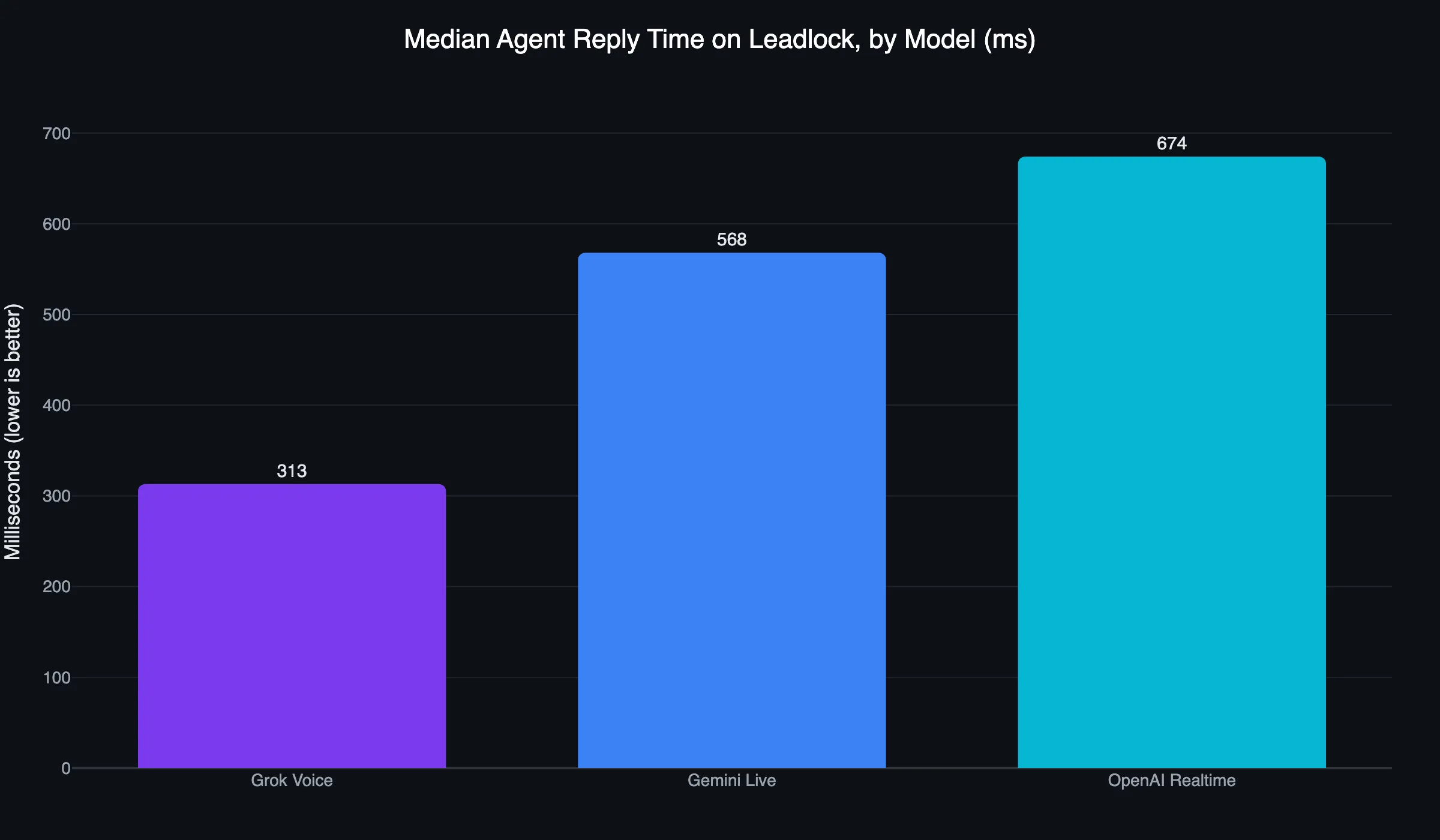
Source: median agent reply time from Leadlock production calls, September 2026 (Grok Voice 461 turns, Gemini Live 187, OpenAI Realtime 1,568).
What Architecture Should You Actually Choose?
Choosing a voice agent architecture in 2026 comes down to three factors: volume, latency requirements, and total cost of ownership.
Choose true speech-to-speech (Leadlock) when:
- You’re running more than 500 calls/month (cost savings compound fast)
- You’re building customer-facing sales or support experiences (latency directly impacts conversion)
- You’re a GHL agency that needs smooth workflow integration
- You want predictable model-and-voice pricing without surprise overages
Consider a cascaded platform when:
- You’re doing early-stage testing with minimal call volume
- You need ultra-specific model combinations that no S2S platform supports
- Your use case requires custom STT for rare languages or heavy accents
Avoid if the vendor:
- Won’t clearly state their full per-minute cost, including how telephony is billed
- Claims “real-time” without specifying end-to-end latency under production load
- Requires SIP trunking setup for basic deployments
67% of Fortune 500 companies are now running production voice AI, and 78% of the top 50 banks have deployed voice agents - up from 34% in 2024, according to AI Voice Research. These organizations aren’t choosing cascaded pipelines. They’re choosing architectures that won’t embarrass them in front of customers.
How Does Speech-to-Speech AI Perform in Real-World Deployments?
Real-world S2S performance depends on four variables: model quality, telephony infrastructure, network routing, and call complexity. The S2S architectural advantage only holds when all four are optimized - which is why platform selection matters as much as underlying model selection.
Here’s what actually affects production latency:
- Model warm-up - Cold starts on cascaded platforms add delay. S2S models on always-hot infrastructure don’t cold start.
- Barge-in handling - When a caller interrupts, how fast does the agent stop and respond? Leadlock’s architecture handles interruptions in real time.
- Concurrent call scaling - Cascaded platforms degrade under load because each call adds API calls across three providers. S2S platforms scale more linearly.
- Network routing - Regional inference endpoints matter. A fast S2S model with poor network routing to your telephony provider can end up slower than a cascaded system with optimized infrastructure.
The Speechmatics report notes that 22% of Y Combinator’s latest cohort is building voice-agent companies - a 70% increase from early 2024. Most of them are discovering the same thing production teams learned in 2025: architectural choices made at the start compound into massive operational differences at scale.
For a deeper look at how architecture affects lead qualification outcomes, see our guide to automating lead qualification with AI voice agents.
What Does Leadlock’s Five-Provider Model Mean for Your Business?
Leadlock gives you a choice of five voice providers within a single platform, switchable per agent - each with distinct quality/cost tradeoffs. Every provider except ElevenLabs still runs on Leadlock’s core architecture: no STT, no TTS, no separate component fees. ElevenLabs is offered as a premium voice option.
Gemini - from $0.12/min on Pro Best for: High-volume outbound campaigns, lead qualification at scale, internal scheduling. Think hundreds of calls per day where per-minute cost compounds fast.
Grok (xAI Grok) - from $0.12/min on Pro Best for: General-purpose inbound and outbound. The default choice for most SMB deployments where you want solid quality without paying premium rates.
OpenAI Realtime - from $0.20/min on Pro Best for: Customer-facing service calls where voice quality is part of your brand experience. Sales calls where warmth and clarity matter.
GPT-Live - from $0.33/min on Pro Best for: Calls where you want OpenAI’s top-tier live voice model.
ElevenLabs - from $0.15/min on Pro Best for: High-end sales, luxury brands, VIP customer lines where ultra-realistic voice creates a differentiated experience.
A 10-minute call on Gemini costs $1.20 on the Pro plan. The same call on ElevenLabs costs $1.50 - 25% more for the same underlying call. Most businesses don’t need ElevenLabs for every call type. Leadlock lets you match the right voice quality to the right use case within one account.
For agencies managing multiple clients, this flexibility translates directly to margin. You can price each client tier appropriately, control costs on high-volume campaigns, and offer premium voice options as an upsell - all without switching platforms.
Frequently Asked Questions
Q: What is the difference between speech-to-speech AI and traditional voice agents?
Traditional voice agents use a three-step cascaded pipeline: speech-to-text converts audio to transcript, a language model processes the text, then text-to-speech converts the response back to audio. Speech-to-speech AI processes audio directly through a multimodal model and generates audio output in a single step, with no separate transcription and text-to-speech chain adding delay.
Q: How much faster is speech-to-speech compared to STT→LLM→TTS pipelines?
Speech-to-speech skips the separate transcription and text-to-speech hops, and each hop in a cascaded pipeline adds delay. Leadlock agents reply in about a third of a second on Grok (median of 461 live turns, measured September 2026). Users hang up 40% more frequently when response time exceeds 1 second, according to AssemblyAI, making the architectural difference directly measurable in call completion rates.
Q: Is speech-to-speech AI more expensive than cascaded pipelines?
Not necessarily. True S2S platforms like Leadlock eliminate separate STT, LLM, and TTS API fees. Cascaded competitors advertise $0.05–$0.09/minute but real costs with all components run $0.13–$0.33/min. Leadlock’s model-and-voice pricing starts at $0.12/minute on Pro, plus the monthly plan fee (from $97/month) and Twilio phone charges, with no separate STT, LLM or TTS fees, so compare total monthly cost with the plan fee included.
Q: Which speech-to-speech platform is best for GoHighLevel agencies?
Leadlock AI is a speech-to-speech platform with native GoHighLevel integration designed specifically for agencies. It supports agency branding (logo, colours, company name; no custom domain), sub-accounts for multi-client management, and direct GHL workflow integration without custom development.
Q: How do I know if a voice agent platform is truly speech-to-speech?
Ask the vendor three questions: (1) Do you use separate STT and TTS providers? If yes, it’s cascaded. (2) What is your per-minute cost for STT, LLM, and TTS, and how is telephony billed? If STT, LLM and TTS are quoted separately, it’s cascaded. (3) What is your end-to-end latency under production load with 50+ concurrent calls? Ask for numbers from live calls, not lab tests.
Q: What is the minimum viable latency for a voice AI agent?
People notice even short pauses. Above 1 second, call abandonment increases 40%, according to AssemblyAI’s research. For sales and support calls where trust is being established, the practical target is the shortest reply time you can get, and cutting out the separate transcription and text-to-speech steps is the most direct way there.
Q: Can speech-to-speech AI handle complex multi-turn conversations?
Yes. S2S models process conversational context, tone, and emotional signals from audio directly, which improves multi-turn coherence compared to cascaded systems that lose paralinguistic information during transcription. Hume’s EVI 3 field study with a Fortune 100 automotive company showed users praised the system’s ability to recall prior conversation context and adapt tone naturally across long interactions.
Q: How does Leadlock compare to Vapi and Retell for business deployments?
Leadlock uses true speech-to-speech architecture (about 300ms replies on Grok, model-and-voice pricing from $0.12/min). Vapi and Retell use cascaded STT→LLM→TTS pipelines with advertised rates that don’t include component costs - real all-in pricing typically runs $0.13–$0.33/minute. At 1,000 minutes/month that is $130–$330, against about $291 on Leadlock Starter ($97 + 1,000 x $0.18, plus about $14 Twilio), so at this volume the totals land in the same range. See our full AI voice agent platform comparison for detailed breakdowns.
Ready to move off slower cascaded voice agents? Leadlock delivers true speech-to-speech AI with about 300ms replies on Grok from $0.12/minute for the model and voice on Pro - five voice providers, native GoHighLevel integration, live in under 5 minutes. Book a 15-minute call with Dan.
See It Book a Real Job
Voice agents that book into ServiceTitan and GoHighLevel, live today for home-service brands. Book 15 minutes with Dan, or start a 7-day trial from the pricing page.
Book a 15-minute call with Dan