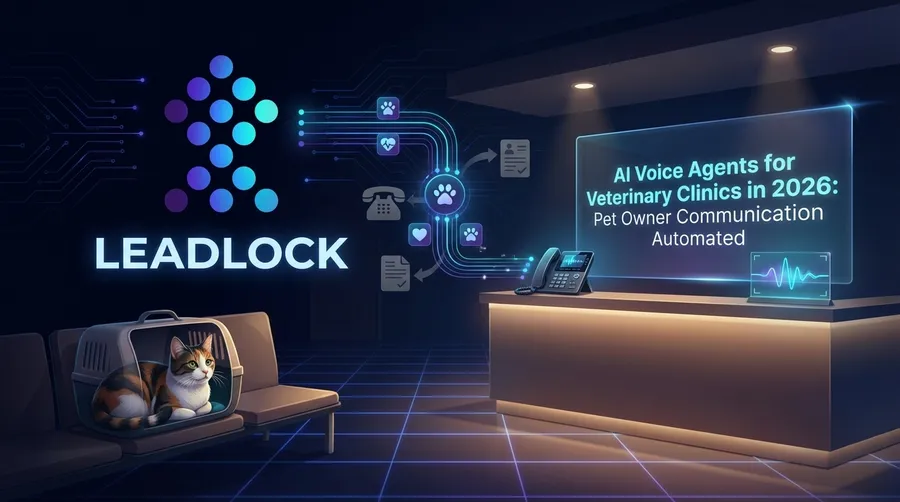
Veterinary clinics lose $843K/year to missed calls. AI voice agents handle bookings, reminders & Rx refills 24/7. See how Leadlock cuts costs to $0.12/min.
Veterinary clinics are drowning in phone calls - and most of them are going unanswered. According to a 2026 analysis by AgentZap, the average veterinary practice misses 22% of incoming calls, translating to $843,000 in lost annual revenue per clinic. That’s not a staffing problem. That’s a systems problem.
AI voice agents fix it. And Leadlock fixes it fast - live in under 5 minutes, starting at $0.12 per minute all-in, with true speech-to-speech that replies in about a third of a second on Grok (median of 461 live turns, measured September 2026).
Veterinary clinics have unique communication demands: anxious pet owners calling about emergencies, prescription refill requests stacking up, appointment reminders going unsent. The front desk can’t scale - but an AI voice agent can handle all of it simultaneously, 24 hours a day, without burnout or overtime.
How Much Revenue Are Veterinary Clinics Losing to Missed Calls?
Veterinary clinics lose an estimated $843,000 annually per practice from missed calls alone, with 22% of calls going unanswered on average and 73% of new clients calling before booking their first appointment.
The numbers are brutal. According to PupPilot’s research, 24–28% of veterinary clinic calls go unanswered during business hours. And 80% of callers who hit a voicemail will contact a competitor rather than leave a message. When the average client lifetime value is $12,800 (AgentZap, 2026), every missed call is a meaningful financial loss.
It gets worse. The American Pet Products Association’s 2025 National Pet Owners Survey reports that Americans spent $41 billion on veterinary care in 2024, with $42.4 billion projected for 2026. Demand is growing. Phone volume is growing. Staff capacity is not.
One multi-location veterinary nonprofit in North Carolina found that at peak, 60% of their calls were going unanswered. After implementing AI phone assistance, that number dropped below 2% - and they recovered more than $100,000 in annual revenue. That’s not a rounding error. That’s the difference between a struggling practice and a thriving one.
What Do Pet Owners Actually Want From Veterinary Communication?
Pet owners overwhelmingly prefer digital-first communication, with 77% preferring text or online chat over phone calls - yet 67% still call for urgent concerns, creating a dual-channel demand that understaffed front desks struggle to manage.
There’s an important nuance here. According to PupPilot’s self-service scheduling analysis, 77% of pet parents prefer text or online chat for routine communication. But for urgent situations - a limping dog, a cat that stopped eating - 67% still reach for the phone (AgentZap, 2026).
Your front desk has to be excellent at both. AI voice agents handle the phone side while integrated messaging handles the text side.
The timing problem is equally significant. Approximately 40% of online veterinary bookings happen outside business hours, according to PupPilot. Pet owners don’t restrict their scheduling to 9-5. Their pets certainly don’t restrict their health problems to business hours. A 24/7 AI receptionist closes that gap entirely.
And 31–40% of pet owners who consider switching veterinary clinics cite digital convenience as a primary driver. Not pricing. Not location. Convenience. That’s a retention problem with a direct technological solution.
Why Standard AI Chatbots Fail Veterinary Clinics
Most AI voice solutions for veterinary clinics use a three-step orchestration pipeline - Speech-to-Text, then LLM, then Text-to-Speech - where each hop adds delay that feels unnatural and erodes caller trust.
Here’s the technical reality most vendors won’t explain clearly. When a pet owner calls with an anxious question about their dog’s symptoms, they need to feel heard immediately. A long pause before the AI responds feels like a frozen phone line. Callers hang up. Or worse, they assume the system is broken and call back demanding a human.
Competitors like Vapi, Retell, Bland, Synthflow, and Assistable all rely on this orchestration model:
- Speech-to-Text: Convert the caller’s audio to text
- LLM: Process the text and generate a response
- Text-to-Speech: Convert the response back to audio
Three separate API calls. Three points of latency. Three potential failure modes.
Leadlock eliminates the pipeline entirely. Audio goes in, processed by a native multimodal model, audio comes out. About 300ms replies on Grok. The conversation feels like talking to a person, not waiting for a web page to load.
Pro Tip: When evaluating AI voice agents for your clinic, ask vendors to demonstrate a live call. Time the response lag between when you finish speaking and when the AI starts responding. People notice even short pauses, so shorter is better.
What Can an AI Voice Agent Actually Do for a Veterinary Clinic?
AI voice agents for veterinary clinics handle appointment booking, prescription refill requests, after-hours triage routing, reminder calls, and FAQ responses - resolving 45–65% of inbound calls without human involvement.
The scope is broader than most clinic owners expect. Here’s what a well-configured AI voice agent handles autonomously:
- 24/7 appointment booking and rescheduling - no hold times, no voicemails, immediate confirmation
- Prescription refill requests - take the pet’s name and a callback number, then route the request to staff, who confirm medication details
- after-hours triage - differentiate emergency situations (route to emergency line) from non-urgent calls (schedule next-day callback)
- Appointment reminders - automated outbound calls reduce no-show rates by 20–30% (PupPilot, 2025)
- FAQ handling - hours, location, vaccination requirements, new patient intake process
- Callback scheduling - when callers want to speak with a vet, the AI captures details and queues the callback
- Multi-location routing - direct callers to the right branch without staff involvement
According to healthcare voice AI implementation data from Retell AI’s 2025 guide, 45–50% of calls are fully resolved without a human agent, and some implementations hit 65% containment rates. For a busy veterinary clinic fielding 100+ calls per day, that’s 65 calls your front desk staff never has to touch.
VetPawer’s AVA assistant demonstrates what scale looks like: across 985 veterinary hospitals, the platform has processed 10,489 appointments and 15,861 prescription requests through AI alone.
How Much Does an AI Voice Agent Cost for a Veterinary Clinic?
AI voice agents for veterinary clinics start at $0.12 per minute all-in with Leadlock’s Gemini provider - compared to $0.13–$0.33/min real cost on competitor platforms that advertise misleading headline rates.
This is where most clinics get burned. Competitors advertise $0.05–$0.09 per minute, but that’s just the voice component. Add speech-to-text, the LLM cost, text-to-speech, and telephony - and the real per-minute cost balloons to $0.13–$0.33.
Leadlock per-minute rates are all-in and sit on top of a monthly plan fee ($97 Starter, $297 Agency, $497 Pro). The lowest rates are on Pro:
| Voice Provider | Quality Level | All-in rate (Pro plan) |
|---|---|---|
| Gemini Live | Budget | $0.12/min |
| Grok Voice | Balanced | $0.12/min |
| OpenAI Realtime | Premium | $0.20/min |
| ElevenLabs | Ultra-Realistic | $0.15/min |
For a veterinary clinic running 1,000 minutes per month of AI calls - handling appointment inquiries, reminders, and prescription requests - the math is stark:
- Leadlock Gemini Live on Starter: $97 + 1,000 min × $0.18 = $277/month
- Competitor with hidden costs: 1,000 min × $0.33 (top of the $0.13–$0.33 real-cost range) = $330/month
At the top of that range, that’s $636 per year in extra spend on the competitor. For a single-location clinic.
Most veterinary clinics don’t need ultra-realistic voice quality for appointment reminders. Gemini handles 80% of call types perfectly. Save ElevenLabs for high-stakes client calls where emotional connection matters - discussing a complex diagnosis, delivering difficult news about a pet’s condition.
If your clinic is already running on GoHighLevel for CRM and marketing automation, Leadlock’s native GHL integration means your AI voice agent connects directly to your existing workflows without custom development.
What’s the Real ROI of AI Voice Agents for Veterinary Clinics?
A veterinary clinic recovering just 5 previously missed new client calls per month generates $64,000 in additional lifetime client value - while eliminating 70+ minutes per staff member per day spent on routine phone tasks.
Let’s work through a conservative scenario. Your clinic currently misses 22% of calls - about average. You field 200 calls per week. That’s 44 missed calls weekly, approximately 190 per month.
If even 5 of those missed callers become new clients, at a $12,800 lifetime value each, that’s $64,000 in recovered revenue from a single month’s improvement. The AI voice agent pays for itself many times over.
The operational savings stack on top:
- Hefner Road Animal Hospital, implementing AI across their practice, reported saving over 70 minutes per veterinarian per day on administrative burden - time that went back into patient care (Digitail, 2025).
- One practice cited by Retell AI eliminated two administrative roles, saving $87,000 annually.
- No-show rates drop 20–30% with automated reminder calls, which directly protects daily revenue.
- After-hours coverage requires no staff overtime - the AI answers at 11pm for the same price as 11am.
Healthcare voice AI implementations have cut wait times from 18 minutes to under 30 seconds, per Retell AI’s 2025 healthcare implementation guide. Pet owners who currently abandon calls after being on hold will stay in the queue - or get an immediate answer - when AI handles the load.
For a deeper look at the healthcare AI call center economics, the ROI patterns hold across specialties.
How Do AI Voice Agent Platforms for Veterinary Clinics Compare?
Not all platforms are built the same. Here’s how the major options stack up for veterinary use cases:
| Platform | Latency | All-In Pricing | Vet-Specific Features | Setup Time |
|---|---|---|---|---|
| Leadlock | ~300ms reply (Grok, median) | From $0.12/min on Pro; plans from $97/mo | GHL integration, 5 voice providers | Under 5 min |
| Vapi | Varies by stack | $0.15–$0.33/min (real all-in) | Basic API-level integrations | Hours–days |
| Retell AI | Varies by stack | $0.13–$0.20+/min (real all-in) | Healthcare templates, EHR hooks | Hours |
| Bland AI | Varies by stack | $0.11–$0.14/min bundled + add-ons | Generic templates | Hours |
| Synthflow | Varies by stack | $0.15–$0.24/min (real all-in) | No-code builder, Google Calendar | 30+ min |
| Assistable | Varies by stack | $0.07/min + $97–$975/mo plan | GHL-focused | 30+ min |
Retell and Synthflow both advertise HIPAA compliance features, which matters for veterinary practices handling protected health information (PHI). Leadlock is not HIPAA compliant and does not sign a BAA. HIPAA does not cover veterinary data, but confirm your specific state’s veterinary practice act requirements before deploying any platform - regulations around client data vary.
For practices on tight budgets, note that Synthflow’s legacy $29/month Starter plan includes only 50 minutes ($0.58/min effective). At 5,000 minutes, Synthflow’s real cost of $0.15–$0.24/min works out to $750–$1,200/month, against $997/month for Leadlock on Starter ($97 + 5,000 x $0.18). What Leadlock adds is true speech-to-speech rather than the orchestration lag.
How Do You Set Up an AI Voice Agent for a Veterinary Clinic?
A basic AI voice agent for a veterinary clinic can go live in under 5 minutes with Leadlock - requiring only your clinic’s name, hours, services, and booking workflow before the agent starts handling calls.
The setup process doesn’t require a developer. Here’s the practical implementation path:
- Define call intents - List the top 10 reasons clients call your clinic (appointments, prescriptions, hours, emergencies, vaccine reminders, billing questions, new patient intake, test results, boarding inquiries, general advice)
- Configure your booking flow - GoHighLevel works out of the box, and ServiceTitan or anything else with an API can be connected, including practice management software, or use a calendar link for appointment routing
- Set escalation rules - Define which call types immediately transfer to staff (true emergencies, euthanasia inquiries, complex medical questions)
- Select your voice provider - Gemini for volume efficiency, OpenAI for client-facing calls where quality matters most
- Train on your FAQ content - Upload your existing FAQ page, services list, and pricing information
- Run test calls - Simulate common scenarios before going live
- Monitor and iterate - Review call transcripts weekly to catch edge cases
The AI in veterinary medicine market is projected to grow from $1.6 billion to $6 billion within five years (Digitail, 2025). Practices that implement now build the operational muscle before competitors catch up.
For clinics using GoHighLevel already, the AI appointment booking integration connects directly to your GHL calendar and contact database - no data duplication, no manual syncing.
What Are the Compliance Considerations for Veterinary AI Voice Agents?
Veterinary clinics collecting pet owner information via AI voice must comply with state privacy laws and their practice management software’s data agreements - HIPAA’s full scope doesn’t apply to veterinary data, but state-level equivalents increasingly do.
Unlike human healthcare, veterinary practices aren’t directly covered by HIPAA. But that doesn’t mean compliance is simple. Key considerations:
- State privacy laws - California’s CCPA and similar state laws apply to client data collected via AI systems
- Call recording consent - Most states require one-party or two-party consent for recorded calls; your AI agent should announce recording at the start of each call
- Data retention - Client data collected by the AI must be stored and deleted according to your practice’s privacy policy
- Payment information - If the AI handles any billing discussions, PCI-DSS standards apply to how payment data is handled
The safest approach: treat veterinary client data with the same care as medical records. Configure your AI voice agent to collect only what’s needed, store it in your practice management system (not in the AI platform), and disclose recording upfront.
For a full breakdown of compliance requirements across the AI voice agent landscape, the AI voice agents legal compliance guide covers the full regulatory picture.
Frequently Asked Questions
Q: Can an AI voice agent handle pet emergency calls at a veterinary clinic?
An AI voice agent can identify emergency call indicators - keywords like “not breathing,” “bleeding,” “seizure,” or “ate something” - and immediately route those calls to an on-call veterinarian or an emergency animal hospital. The agent should never attempt to triage medical emergencies directly. Configure a hard escalation rule that bypasses the AI entirely for anything flagged as urgent.
Q: How much does a veterinary AI voice agent cost per month?
Cost depends on call volume and the voice provider you select. Leadlock charges a plan fee plus an all-in rate. With Gemini Live on the Starter plan ($97/month, $0.18/min), a clinic handling 1,000 AI-managed minutes per month pays $277. A clinic with 5,000 minutes per month on ElevenLabs pays $1,147 on Starter ($97 + 5,000 x $0.21). Most clinics find Gemini handles 80–90% of routine call types at the lowest cost.
Q: Will pet owners know they’re talking to an AI?
Yes - and that’s fine. Most pet owners care about getting their question answered quickly, not whether the voice is human. However, your AI should identify itself clearly at the start of the call (“Hi, this is the [Clinic Name] virtual assistant”) and offer a human transfer option for callers who prefer it. Transparency builds trust.
Q: How does an AI voice agent integrate with veterinary practice management software?
Integration depth depends on the platform and the practice management software. Most AI voice agents integrate via API, webhook, or calendar link. Leadlock’s native GoHighLevel integration handles the majority of agency and small clinic workflows. For Avimark, Cornerstone, or eVetPractice integrations, the AI typically captures appointment details and pushes them to a scheduling queue rather than writing directly to the PMS database.
Q: What’s the difference between an AI chatbot and an AI voice agent for a veterinary clinic?
An AI chatbot handles text-based communication - website chat widgets, SMS, or email. An AI voice agent handles phone calls. They’re complementary, not interchangeable. Research shows 77% of pet owners prefer text for routine communication but 67% still call for urgent concerns (AgentZap, 2026). Ideally, your clinic deploys both: a chatbot for digital channels and a voice agent for the phone line.
Q: How quickly can a veterinary clinic go live with an AI voice agent?
Leadlock goes live in under 5 minutes for basic configurations - clinic name, hours, services, and booking workflow. More sophisticated setups with custom escalation logic, multiple locations, and PMS integration take 1–3 hours. Either way, you’re not waiting weeks for deployment or paying a developer.
Q: Can the AI voice agent make outbound calls for appointment reminders?
Yes. AI voice agents can run outbound reminder campaigns for upcoming appointments, overdue wellness visits, and prescription pickup notifications. Practices using automated reminder calls see 20–30% reductions in no-show rates (PupPilot, 2025). At $0.12/min on Leadlock Gemini Live (Pro plan), a 2-minute reminder call costs $0.24 - far cheaper than the cost of an empty appointment slot.
Q: Is the AI voice agent available 24/7 including holidays?
Yes. Unlike staff, an AI voice agent operates at identical capacity on Christmas Day as on a Tuesday morning. For veterinary clinics, this matters most for after-hours call capture - collecting appointment requests, routing genuine emergencies to the emergency line, and ensuring the clinic’s phone number never goes to voicemail.
Ready to stop losing pet owners to unanswered calls? Leadlock delivers true speech-to-speech AI voice agents with about 300ms replies on Grok, starting at $0.12 per minute all-in - live in under 5 minutes, no technical setup required. Book a 15-minute call with Dan.
See It Book a Real Job
Voice agents that book into ServiceTitan and GoHighLevel, live today for home-service brands. Book 15 minutes with Dan, or start a 7-day trial from the pricing page.
Book a 15-minute call with Dan