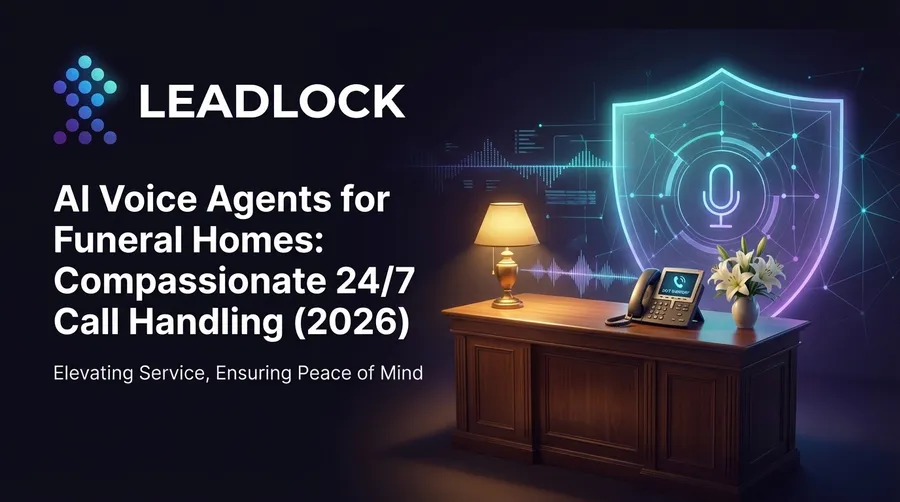
1 in 4 funeral home calls go unanswered after hours. Learn how AI voice agents handle sensitive family calls 24/7 from $0.12/min without sacrificing compassion.
- 1 in 4 funeral home after-hours calls go unanswered, with each missed call representing $500–$2,000 in lost business.
- Leadlock’s true speech-to-speech AI replies in about 300ms on Grok, with no separate transcription and text-to-speech hops like STT→LLM→TTS competitors, for more natural, compassionate conversations.
- OpenAI and ElevenLabs deliver near-human warmth for sensitive first-call and pre-need interactions.
- Full 24/7 AI coverage on Leadlock costs about $361-$624/month (OpenAI Realtime on the $97/month Starter plan, 1,000-2,000 inbound minutes, Twilio telephony included) - versus $36,000–$60,000/year for a human receptionist - with zero missed calls.
When a family loses someone they love, their first call to a funeral home is one of the most emotionally raw conversations they’ll ever have. It happens at 2 AM. On Sundays. During the holidays. And across the US funeral home industry - worth $23.9 billion with 29,015 businesses operating nationwide (IBISWorld, 2026) - 1 in 4 of those calls goes unanswered after hours (IncorporatingAI.com, 2025).
That isn’t a staffing problem. It’s a trust crisis.
AI voice agents built for funeral homes don’t just route calls - they answer with the warmth, calm, and consistency that grieving families deserve at any hour. Leadlock AI delivers true speech-to-speech AI on Gemini Live, Grok Voice and OpenAI Realtime that replies in about a third of a second on Grok (median of 461 live turns, measured September 2026), and also offers ElevenLabs voices for ultra-realistic, compassionate tone - purpose-built for the most sensitive conversations your business handles.
Why Are Funeral Homes Missing So Many Calls?
Funeral homes miss after-hours calls at a rate that would be alarming in any industry - in deathcare, it’s devastating: a 2025 study by 411 Locals across 85 businesses and 58 industries found 62% of small business phone calls go unanswered, with funeral homes facing sharper drop-offs after 5 PM because death doesn’t follow business hours.
Families need immediate answers about first calls, transport, pricing, and next steps. When they can’t reach you, 62% will immediately contact a competitor (Dialzara, 2025). Of those who reach voicemail, 80% hang up without leaving a message. The message your silence sends is that you weren’t there when it mattered most.
The financial impact is equally stark. Each unanswered after-hours call represents $500–$2,000 in lost business (IncorporatingAI.com, 2025). With the average funeral costing $9,800 (WifaTalents, 2025), missing just five families per year to a competitor costs $49,000 in revenue - potentially $100,000+ at premium service tiers.
82% of families say their first phone interaction significantly impacts their impression of a funeral home, according to a 2025 GoodCall industry survey. First impressions here aren’t marketing - they’re trust during the most vulnerable moment of a family’s life.
What Do Families Expect When They Call?
Modern families calling a funeral home expect an immediate, compassionate response at any hour - 77% of customers expect to reach someone right away when they call (Nextiva, 2025), and for families calling after a death, that expectation carries weight no other industry faces: silence at 11 PM communicates abandonment at the worst possible moment in their lives.
A 2025 NFDA Consumer Awareness & Preferences Study (n=1,126 Americans 40+) found that 40% of families now find their funeral home via Facebook (up from 21% in 2023), and 30% complete all funeral arrangements entirely online. Digital-first discovery has raised expectations for digital-first responsiveness.
But phone calls remain the dominant first contact for urgent needs. In funeral service, that expectation carries emotional weight - a family calling at 11 PM has just experienced a loss and needs reassurance, not a voicemail box.
Industry data shows 40–60% of business calls arrive outside standard 9-to-5 hours (Nextiva, 2025). For funeral homes, that proportion skews higher - deaths in hospitals, hospice facilities, and homes frequently occur in overnight and early morning hours.
The gap between what families expect and what most funeral homes deliver is exactly where AI voice agents change everything.
What Can an AI Voice Agent Handle for Your Funeral Home?
A properly configured AI voice agent handles the full spectrum of inbound funeral home calls 24 hours a day - including first-call death notifications, after-hours routing to on-call staff, pre-need inquiry capture, appointment scheduling, pricing questions, post-service follow-up, and outbound reminders - with the consistency and compassion grieving families deserve at any hour, regardless of call volume.
Calls AI handles automatically:
- First-call notifications (death has occurred, family needs guidance on next steps)
- After-hours routing to on-call staff for immediate transport needs
- Pre-need inquiry capture and appointment scheduling
- Pricing and service package questions
- Directions, hours, and general information
- Grief support resource referrals
- Post-service follow-up calls to families
- Outbound reminders for pre-need appointment confirmations
In practice: a family calls at 2 AM. The AI answers in under a second, introduces itself with a calm and empathetic tone, gathers key information (name of deceased, location, family contact details), and either routes the call immediately to your on-call director or schedules a morning consultation - with the call details sent to your CRM through GoHighLevel or a webhook. No voicemail. No missed family. No competitor gets the chance.
ASD – Answering Service for Directors, the largest funeral-specific answering service in the US, handles 1.5 million calls annually including 500,000+ first-death calls across 7,000+ funeral homes (GoodCall, 2025). AI voice agents now offer comparable 24/7 availability at a fraction of the cost - and without the staffing constraints of a human operation.
Why Most AI Voice Agents Sound Robotic - And Why That’s a Problem Here
Most AI voice platforms add delay to every response because of a three-step speech-to-text, LLM processing, and text-to-speech pipeline - in funeral service, that robotic pause isn’t just poor user experience; it actively damages trust by signaling indifference to a grieving family at the most emotionally vulnerable moment your business will ever handle.
Most AI voice platforms use a three-step orchestration architecture:
- Speech-to-Text (STT) - your words are transcribed to text
- LLM processing - text is analyzed and a response is generated
- Text-to-Speech (TTS) - the response is converted back to audio
Each step adds latency. Combined, these hops create a noticeable, awkward pause that signals “robot” to any caller. For a grieving family, that pause communicates indifference.
Leadlock uses a fundamentally different approach: Audio In → Native Multimodal Model → Audio Out. No transcription layer. No intermediate text processing. One step, with replies in about 300ms on Grok. Conversations flow naturally, without the hesitations that betray machine processing.
Pro Tip: For funeral homes, we recommend Leadlock’s OpenAI or ElevenLabs providers. These deliver the warmth and emotional nuance that sensitive conversations require. ElevenLabs, from $0.15/min on Pro, produces near-human vocal quality with natural pacing - ideal for first-call interactions where tone matters as much as content.
For a deeper look at why speech-to-speech architecture matters for call quality, see our Best Speech-to-Speech AI Platforms in 2026 comparison.
How Much Does AI Call Handling Cost for Funeral Homes?
AI voice agents cost funeral homes $60–$400 per month for full 24/7 coverage handling multiple calls at the same time, compared to $3,000–$5,000 per month for a single full-time human receptionist - a 90–95% cost reduction that makes round-the-clock call answering financially viable for independent funeral homes of any size, whether serving 100 or 1,000 families annually.
| Solution | Monthly Cost | Hours Covered | Simultaneous Calls | Avg. Cost Per Call |
|---|---|---|---|---|
| Full-time human receptionist | $3,000–$5,000 | 40 hrs/week | 1 | $8–$12 |
| Traditional answering service | $300–$800 | 24/7 | 2–3 | $1.50–$4.00 |
| Leadlock Gemini | ~$291-$484 | 24/7 | Multiple at the same time | ~$0.18/min on Starter + Twilio |
| Leadlock OpenAI | ~$361-$624 | 24/7 | Multiple at the same time | ~$0.25/min on Starter + Twilio |
Estimate based on 1,000-2,000 inbound minutes/month on the Starter plan: the $97 plan fee plus $0.18/min (Gemini) or $0.25/min (OpenAI), plus Twilio telephony on your own account at about $0.013/min inbound and $1.15/month per local number (Twilio’s US rates)
A funeral home handling 250 funerals per year typically fields 800–1,200 inbound calls annually. That is roughly 200-300 call minutes a month. On the Starter plan with OpenAI ($0.25/min), a 3-minute average call costs $0.75 plus about $0.04 of Twilio minutes, so the month runs $97 + $50-$75 = $147-$172, plus about $4-$5 of Twilio charges, or about $151-$177. That’s about $1,810-$2,125/year for full AI coverage on every call - compared to $36,000–$60,000/year for a single full-time receptionist (ZipRecruiter, March 2026).
Funeral homes using professional answering services report a 43% reduction in missed calls and 37% higher client retention (GoodCall, 2025). With AI handling 100% of calls 24/7, those numbers improve further - with AI recovering an estimated $45,000+ in preserved annual revenue from calls that would otherwise go unanswered.
For a full breakdown of AI versus human receptionist economics across industries, see AI vs Human Receptionists: The Complete Cost and Performance Comparison (2026).
How Leadlock Compares to Other AI Voice Platforms
Leadlock outperforms competing AI voice platforms for funeral home use across three dimensions that matter most in deathcare: response latency (about 300ms replies on Grok, with none of the extra hops of multi-step STT→LLM→TTS pipelines), voice quality (five providers including ElevenLabs Premium for emotional nuance), and total cost (from $0.12/min for the model and voice on the $497/month Pro plan, about $0.133/min with Twilio inbound, versus $0.13–$0.33/min real-world cost on platforms like Vapi and Retell; at the low end the per-minute costs are about even).
Vapi offers a flexible developer API but requires technical setup measured in hours to days. No funeral-specific templates or voice configuration guidance. Pricing involves separate STT, LLM, and TTS costs that accumulate to $0.15-$0.33/min in real-world usage.
Retell AI covers sensitive healthcare-adjacent industries and claims 80–90% routine inquiry automation. Solid voice quality, but their three-step architecture introduces latency that Leadlock’s native multimodal processing eliminates entirely.
Synthflow highlights 65% routine call automation, 75% reduction in wait times, and 99.99% uptime. Capable for inbound automation, but voice customization options at entry tiers are more limited than Leadlock’s four-provider model.
Bland and Assistable both serve the agency market effectively but lack premium voice provider options and funeral-specific positioning.
Leadlock’s advantages for funeral homes:
- 5 voice providers - match quality and cost to the sensitivity of each call type
- About 300ms replies on Grok - conversations feel natural, not mechanical
- Live in 5 minutes - no SIP trunking, no developer required
- Native GHL integration - agencies managing funeral home clients deploy and manage from one dashboard
- From $0.12/min on Pro for the model and voice - no separate STT, LLM or TTS fees; telephony billed by your own Twilio account
How to Set Up Leadlock for Your Funeral Home in 5 Minutes
Leadlock deploys in under five minutes with no SIP trunking, no developer, and no integration partner required - create your account, choose ElevenLabs Premium or OpenAI Realtime for first-call warmth, configure your agent prompt with compassionate tone and routing rules, then forward your existing business number to activate 24/7 coverage immediately.
- Create your account at leadlock.ai and select your plan - Agency or Pro recommended for funeral homes needing Advanced or ElevenLabs
- Choose your voice provider - ElevenLabs or OpenAI Realtime for first-call interactions requiring maximum warmth and naturalness
- Configure your agent prompt - define tone (compassionate, unhurried, never rushed), the agent’s name, and call flows it should handle: first-call intake, pre-need scheduling, general inquiries
- Set routing rules - specify which call types escalate immediately to your on-call director versus which schedule a morning callback
- Connect your phone number - connect your own Twilio account and import a number (or import one from GoHighLevel), then forward your existing business number to it
- Test and activate - make a test call, confirm tone and flow, go live
No SIP trunking. No integration partner. No developer. Your AI receptionist answers every call from the moment you activate.
Is AI Appropriate for the Sensitivity of Funeral Service?
AI voice agents are appropriate for funeral homes when deployed as a first-contact layer handling administrative intake, information gathering, and call routing - not as a replacement for human directors, but as the infrastructure that ensures every grieving family who calls at any hour receives a compassionate response rather than an empty voicemail box.
The SFD Magazine 2025 analysis “Software in the Deathcare Industry” examined AI’s role carefully, noting that McKinsey found 71% of large global companies now use generative AI in at least one function. The conclusion in deathcare: AI is most effective handling the administrative layer of communication, freeing human directors for the emotional and logistical work that genuinely requires human presence.
AI voice agents don’t replace funeral directors. They handle the first contact, the information gathering, and the routing - ensuring families reach a human when they need one, rather than hitting a voicemail box that 80% of callers abandon.
65% of individuals now use AI regularly in their daily lives (McKinsey, 2024), and 91% of US adults own a smartphone. Families are accustomed to AI-assisted interactions. What they will not forgive is being ignored.
The FuneralFuturist.com 2025 automation guide frames it directly: rapid response is now a competitive necessity. Funeral homes that respond within minutes to first-call inquiries capture far more families than those that respond hours later - regardless of how warm the eventual human conversation becomes.
For context on AI voice agents in other sensitive healthcare-adjacent settings, see AI Voice Agents for Healthcare in 2026: HIPAA Requirements Guide.
The ROI Case: What Is Answering Every Call Actually Worth?
For a typical independent funeral home handling 250 funerals per year at a $9,800 average, missing 30% of after-hours calls without AI coverage creates over $774,000 in annual revenue exposure - a figure that makes Leadlock’s $200–$400 monthly pay for itself entirely within the first one or two captured after-hours arrangements.
Baseline assumptions:
- 250 funerals per year at $9,800 average
- 30% of calls arrive after hours (~375 calls/year)
- Without AI: 70% of after-hours calls missed, 30% conversion on those missed calls
- With AI: 0% missed, 75% conversion on after-hours inquiries
Without AI:
- ~262 missed after-hours calls × 30% conversion = ~79 families lost annually
- 79 × $9,800 = $774,200 in potential lost revenue exposure
Even at conservative estimates - missing 5–15 families per year to competitors - the math is unambiguous.
With Leadlock (OpenAI):
- Full 24/7 coverage at ~$361-$624/month on Starter (1,000-2,000 inbound minutes, Twilio included)
- ROI payback: first one or two captured arrangements cover the entire year’s cost
A 2025 GoodCall industry survey found funeral homes using professional answering services report a 57% reduction in missed calls translating to approximately $45,000 in preserved annual revenue. AI voice agents, with 100% call coverage and zero per-operator capacity limits, push that number significantly higher.
Frequently Asked Questions
Q: Can an AI voice agent handle first-death calls with appropriate sensitivity?
Yes, with the right voice provider and configuration. Leadlock’s OpenAI and ElevenLabs options produce near-human vocal quality with natural pacing and warmth. Configured with a compassionate tone prompt, AI agents acknowledge the family’s loss, gather necessary information calmly, and route the call to an on-call director - all without the awkward pauses that signal mechanical processing.
Q: Will families know they’re talking to an AI?
With premium voice providers, many callers cannot reliably distinguish AI from a trained human receptionist during routine intake calls. However, FTC guidelines and emerging state disclosure requirements increasingly require AI identification. Leadlock supports configuring your agent to identify itself as an AI assistant - a practice that builds trust rather than undermining it, particularly with families who value transparency.
Q: What happens during an urgent first-call that needs a human director immediately?
You define the routing rules. For urgent first-call situations where immediate transport is needed, Leadlock can be configured to transfer the call instantly to your on-call director’s mobile number, with an AI-generated whisper summary so the director knows the situation before saying hello. The AI handles the first 30-60 seconds (acknowledgment, basic information gathering), then hands off to a human for the critical next steps.
Q: How much does Leadlock cost for a small funeral home?
For a typical independent funeral home with 500-1,000 minutes of inbound calls per month, OpenAI on the Starter plan runs approximately $230-$361/month ($97 plan fee plus $0.25/min, plus Twilio telephony), with 24/7 coverage and multiple calls handled at the same time. Gemini runs $0.18/min on Starter and from $0.12/min on Pro for lower-cost coverage of non-urgent inquiry types like directions, hours, and pre-need information.
Q: Can Leadlock integrate with funeral home management software?
Leadlock integrates natively with GoHighLevel (GHL), which many funeral home operators and marketing agencies use for CRM and workflow management. For other platforms, Leadlock supports webhook-based integrations to pass call data and transcripts to any system with an API. Call logs, caller information, and scheduled appointments flow automatically downstream.
Q: Is AI a good fit for pre-need inquiries?
Pre-need inquiries are among the highest-ROI use cases for AI in funeral service. These calls are lower-urgency and primarily information-gathering - exactly where AI excels. The agent answers questions about pre-planning options, pricing ranges, and payment plans, then schedules a consultation with a licensed pre-need counselor. Capturing pre-need leads that would otherwise go to voicemail at 9 PM significantly impacts long-term revenue.
Q: How does Leadlock compare to traditional funeral home answering services?
Traditional answering services like ASD - which serves 7,000+ funeral homes and handles 1.5 million calls annually (GoodCall, 2025) - charge $300–$800/month with trained human operators. Leadlock costs roughly $195-$624/month on the Starter plan at 500-2,000 inbound minutes, depending on voice tier and including Twilio, handles multiple calls at the same time, and never sleeps. For standard information calls and scheduling, AI is faster and often cheaper. For complex first-death calls, a hybrid approach - AI for initial contact, immediate transfer to on-call staff for urgent needs - delivers the best outcome.
Q: Which voice provider should a funeral home choose on Leadlock?
For first-call intake and emotionally sensitive interactions: ElevenLabs from $0.15/min on Pro or OpenAI from $0.20/min on Pro. For general information, pre-need inquiries, and appointment reminders: Grok from $0.12/min on Pro offers a strong quality-to-cost balance. Gemini from $0.12/min on Pro is best for high-volume outbound reminder calls where cost efficiency is the priority.
Ready to make sure every grieving family reaches you - no matter the hour? Leadlock delivers true speech-to-speech AI with about 300ms replies on Grok, four voice provider options, and pricing from $0.12/min on Pro for the model and voice - live in under 5 minutes, no technical setup required. Book a 15-minute call with Dan.
See It Book a Real Job
Voice agents that book into ServiceTitan and GoHighLevel, live today for home-service brands. Book 15 minutes with Dan, or start a 7-day trial from the pricing page.
Book a 15-minute call with Dan