Human receptionists cost $53K+/year and cover only 40 hrs/week. AI starts at $0.12/min and works 24/7. Full cost and performance breakdown inside.
- A fully loaded human receptionist costs $55K–$75K in Year 1 and covers only 40 hrs/week - AI receptionists cost $1,200–$7,000/year and work 24/7/365.
- 80% of callers report positive experiences with AI receptionists, and routine calls are where they perform best.
- Businesses save $120K–$176K over 3 years by switching to AI, with ROI compounding from 41% in Year 1 to 124% by Year 3.
- Leadlock’s true speech-to-speech architecture (Audio In → Multimodal → Audio Out) replies in about a third of a second on Grok (median of 461 live turns, measured September 2026) at $0.12/min - no STT/TTS stacking that inflates competitor pricing.
Every missed call is a missed opportunity. Yet the average business answers only 37.8% of inbound calls - and another 24.3% receive zero response at all, not even a voicemail. Meanwhile, the typical human receptionist costs over $53,000 per year in total employer costs, works 40 hours a week, and leaves 76% of the week completely unattended.
The math doesn’t add up. And in 2026, it doesn’t have to.
AI voice receptionists have crossed a threshold. They’re no longer experimental - they’re handling millions of calls daily, with 80% of callers reporting positive experiences, according to Resonate App’s 2026 research. Platforms like Leadlock AI start at $0.12 per minute for the model and voice, go live in under 5 minutes, and answer every call 24/7/365 without sick days, turnover, or overtime.
This guide breaks down the complete cost and performance comparison between AI and human receptionists in 2026 - including verified data, real case studies, and a side-by-side analysis of every dimension that matters to your bottom line.
What Does a Human Receptionist Actually Cost in 2026?
The fully loaded cost of a human receptionist in 2026 is $53,000+ per year - not the $41,617 base salary most job listings show. When you add payroll taxes, health insurance, training, overhead, and turnover costs, the real employer cost is substantially higher for a role that only covers 40 hours per week.
According to Salary.com’s March 2026 data, the median receptionist base salary is $41,617/year - up from $38,072 in 2025. But that’s just the starting point. Here’s what businesses actually pay:
The 7 hidden employer cost categories:
- Base salary: $41,617/year (median, March 2026)
- Payroll taxes (FICA, FUTA, SUTA): ~$3,800/year
- Health insurance: ~$6,000–$9,000/year
- Paid time off (vacation + sick): ~$3,200/year
- Training and onboarding: ~$1,500–$3,000/year
- Office overhead (desk, equipment, software): ~$2,400/year
- Turnover cost (average 1.2x annual salary, annualized): ~$4,000/year
Total: $55,000–$75,000 in Year 1. Over three years, you’re looking at $139,000–$195,000 in total employment cost, according to AgentZap’s 2026 cost analysis.
And that $55K+ buys you coverage for 40 hours a week - 8am to 5pm, Monday through Friday. That’s 128 hours out of every 168-hour week left completely uncovered.
Pro Tip: The hidden cost most businesses miss is lost revenue, not just salary. If your receptionist takes lunch, gets sick, or is on another call, every missed call costs your business an average of $12.15 in lost opportunity, according to Ambs Call Center research. Missing just 6 calls per day adds up to $26,000+ in lost revenue annually.
What Does an AI Receptionist Cost in 2026?
An AI receptionist in 2026 costs $49–$499/month for unlimited 24/7 coverage - compared to $3,500–$5,000/month for a full-time human equivalent. The 3-year total cost difference reaches $120,000–$176,000 in savings, according to SkipCalls’ 2026 comparison.
The first-year cost of an AI receptionist runs $1,200–$7,000, versus $55,000–$75,000 for a human. Here’s how the numbers look in practice:
| Plan | Voice Provider | Cost per Minute | Monthly Cost (1,000 min) | Annual Cost |
|---|---|---|---|---|
| Human Receptionist | - | ~$2.65/min all-in | $3,500–$5,000 | $55,000–$75,000 |
| Leadlock Starter ($97/mo plan) | Gemini | $0.18/min + Twilio | ~$291 | ~$3,494 |
| Leadlock Starter ($97/mo plan) | Grok | $0.18/min + Twilio | ~$291 | ~$3,494 |
| Leadlock Starter ($97/mo plan) | OpenAI | $0.25/min + Twilio | ~$361 | ~$4,334 |
| Vapi | Standard | $0.15–$0.33/min | $150–$330 | $1,800–$3,960 |
| Synthflow | Standard | $0.15–$0.24/min | $150–$240 | $1,800–$2,880 |
On Leadlock’s Starter plan, 1,000 minutes of AI call coverage costs $277/month, plan fee included ($97 + 1,000 x $0.18), plus about $14 billed by your own Twilio account (about $0.013/min inbound and $1.15/month per local number at Twilio’s US rates), so about $291. The Leadlock rows above include that Twilio line; on price alone, the low end of Vapi’s and Synthflow’s real-cost range is cheaper. Scale to 10,000 minutes on the Pro plan ($497 + 10,000 x $0.12 = $1,697/month, plus about $131 Twilio = about $1,828), and you’re still paying roughly 37-52% of what a full-time receptionist costs.
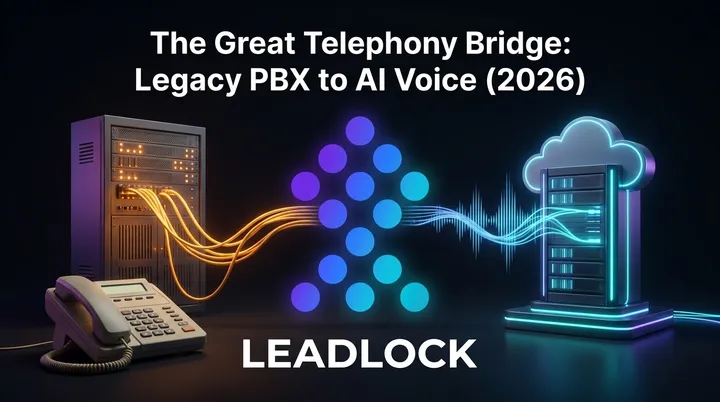
What separates Leadlock architecturally is more than price. While competitors like Vapi and Retell use a three-step orchestration pipeline - Speech-to-Text → LLM → Text-to-Speech - Leadlock uses true speech-to-speech: Audio In → Native Multimodal Model → Audio Out. One step. One API. About 300ms replies on Grok. No separate STT or TTS charges stacked on top of the base rate (phone charges are billed by your own Twilio account).
For a full pricing breakdown across all major platforms, see AI Voice Agent Platform Pricing in 2026: Real Cost Breakdown.
How Does Coverage Compare Between AI and Human Receptionists?
A human receptionist covers 40 hours/week, leaving 76% of the week - 128 out of 168 hours - completely unattended. An AI receptionist answers every call 24/7/365 with zero hold time and the ability to handle multiple calls at the same time.
The coverage gap is stark:
- Human receptionist: Mon–Fri, 9am–5pm. One call at a time. Voicemail when busy.
- AI receptionist: Every hour of every day. No lunch breaks, no sick days, no “one moment please.”
- Simultaneous capacity: A human handles 1 call at a time. Leadlock handles multiple calls at the same time.
And what happens when calls go unanswered? Ambs Call Center’s data tells the story:
- 80% of callers who reach voicemail hang up without leaving a message
- 85% of those callers never call back
- 62% contact a competitor instead
That’s not a small leak - it’s a flood. Businesses missing just 2 calls per day lose $8,800+ per year. Miss 6 calls/day and that exceeds $26,000 annually. Phone remains the dominant contact channel, with 69% of customers preferring to call over email (16%) or in-person visits (15%).
For a deeper look at the revenue math on missed calls, see The True Cost of Missed Business Calls in 2026 (And How AI Fixes It).
How Does Performance Compare: Accuracy, Speed, and Caller Experience?
AI receptionists outperform human receptionists on routine task accuracy - 99% versus 85% - with appointment error rates of 1% compared to 8–12% for human staff. 80% of callers report positive experiences, according to Resonate App’s 2026 research.
Here’s the full side-by-side performance comparison:
| Metric | Human Receptionist | AI Receptionist (industry data) |
|---|---|---|
| Response time | Variable (hold queues common) | Leadlock: ~300ms reply (Grok, median) |
| Availability | 40 hrs/week (24% of week) | 168 hrs/week (100%) |
| Routine accuracy | 85% | 99% |
| Appointment error rate | 8–12% | 1% |
| Simultaneous calls | 1 | Multiple at the same time |
| Cost per interaction | $3.00–$6.00 | $0.25–$0.50 |
| First-call resolution | Variable | 69% |
| Caller satisfaction | High (complex issues) | 80% positive |
Industry figures, not Leadlock results (except the Leadlock response time). Source: AgentZap 2026 cost analysis and AllAboutAI customer service statistics
The per-interaction cost reduction is particularly compelling. AI handles interactions at $0.25–$0.50 each versus $3.00–$6.00 for human agents - an 87–95% cost reduction per call. And the ROI compounds: 41% in Year 1, 87% in Year 2, 124% by Year 3.
What Do Real Businesses Experience After Switching?
The results from real AI receptionist deployments in 2026 are consistently positive: dramatically higher answer rates, measurably lower costs per interaction, and revenue gains that pay back the full investment within 30 days or less - often within the first week of going live.
Four case studies that show what’s actually happening:
-
Dental practice (Arini AI deployment): Kare Mobile Inc generated $56,000+ in new patient appointments in its first month. Missed calls dropped 80% and staff saved 2 hours per day - redirected from routine call answering to complex cases.
-
Multi-location dental group (Arini AI + Unified Dental Care): 12% revenue increase, 24% profit growth, and 17% headcount reduction by routing all inbound calls through AI receptionist. Normandy Lake Dentistry achieved a 90% call answer rate with 24/7 coverage.
-
ProFlow Plumbing (AgentZap deployment): Emergency call volume increased 200%, monthly revenue grew $15,000, and dispatch time dropped to under 3 minutes. Premier Dental Care recovered $52,000 in annual revenue and cut no-shows by 87%.
-
$230M BPO (Synthflow AI deployment): 40+ AI agents handling 600,000+ monthly calls with zero new hires, 75% reduction in wait times, and 2.5x increase in booked appointments.
These cost savings and revenue gains aren’t flukes. They’re what happens when 24/7 coverage meets instant response times - calls that would have gone to voicemail (and been lost forever) now convert into appointments, leads, and revenue.
Where Do Human Receptionists Still Win?
Human receptionists still outperform AI on complex, emotionally charged, and high-stakes interactions - especially legal intake, medical consultations requiring clinical judgment, and scenarios where a caller is distressed and needs genuine empathy from a live person who can respond to tone, pause, and nuance in ways that go beyond scripted workflows.
The most effective businesses in 2026 aren’t choosing between AI and human. They’re layering them:
- AI handles: All routine answering, appointment scheduling, FAQs, call routing, lead qualification, and after-hours coverage - typically 70–80% of total call volume
- Humans handle: Complex customer issues, emotional support cases, VIP relationship management, and decisions requiring real-world judgment
Abby Connect, a hybrid AI/human answering service processing 100,000+ calls per month, boosted QA team productivity 5x and cut individual call audit time by 30% using AI transcription - including calls from noisy HVAC jobsites that competitors couldn’t process. Human receptionists on staff focus exclusively on complex legal intake and healthcare consultations.
This model gives you the cost efficiency of AI with the judgment of experienced humans - without paying $55K+ per year to have someone answer “what are your hours?” sixty times a day.
How Does Leadlock Compare to Vapi, Retell, Bland, and Synthflow?
Leadlock’s model-and-voice pricing starts at $0.12/min on Pro (Twilio phone charges are separate), while orchestration platforms’ advertised rates often balloon to $0.13–$0.33/min once their STT, LLM, and TTS charges are added.
The core architectural difference: most AI voice platforms string together three separate APIs to handle a single call.
Speech-to-Text → Large Language Model → Text-to-Speech
Each hop adds latency and cost. Retell’s own blog acknowledges that Vapi’s per-API pricing model can produce 3–4 second delays, with all-in costs reaching $0.15–$0.25/min after every component is counted. Bland AI’s comparison similarly notes that Vapi’s stacked API costs can reach $0.30/min - matching what you’d pay for a human phone agent.
Leadlock eliminates that problem entirely:
Audio In → Native Multimodal Model → Audio Out
One step. No hidden STT or TTS charges. About 300ms replies on Grok.
Here’s how Leadlock’s main voice providers stack up:
| Voice Provider | Label | Agency Rate | Pro Rate | Best For |
|---|---|---|---|---|
| Gemini | Gemini | $0.15/min | $0.12/min | High-volume agencies, 100s of calls/day |
| xAI | Grok | $0.15/min | $0.12/min | Balanced quality + cost - most use cases |
| OpenAI | OpenAI | $0.22/min | $0.20/min | Premium customer-facing calls |
| ElevenLabs | ElevenLabs | $0.18/min | $0.15/min | High-end sales, luxury brands |
The volume math matters here. On the Starter plan, 1,000 minutes/month on Gemini costs $277 ($97 plan + 1,000 x $0.18). The same volume on ElevenLabs costs $307 ($97 + 1,000 x $0.21), for identical platform features. A 10-minute call on Gemini costs $1.20; the same call on ElevenLabs costs $1.50 (Pro-plan rates).
For agencies on GoHighLevel, Leadlock’s native GHL integration goes live in under 5 minutes with no SIP trunking required. Compare this to a typical Vapi or Retell deployment that requires configuring webhooks, provisioning phone numbers, and wiring STT/TTS pipelines as separate billable services.
For a broader market comparison, Best AI Receptionist Software in 2026: 24/7 Call Answering Ranked covers the full competitive landscape.
How to Decide: Should You Switch to an AI Receptionist?
The decision comes down to three numbers: your current call answer rate, your missed-call revenue loss per day, and your total receptionist cost including all seven employer cost categories. If you’re missing more than 20% of calls or spending more than $40,000 per year on reception coverage, AI typically pays back within 30 days. Use this framework to calculate your specific break-even:
- Calculate your current call answer rate. If it’s below 80%, you’re actively losing revenue. Industry average is 37.8%.
- Count your missed calls per day. Multiply by $12.15 to estimate annual lost revenue.
- Add up your total receptionist cost. Include all seven cost categories - not just base salary.
- Analyze your call complexity mix. If 70%+ of calls are routine - scheduling, FAQs, status checks, lead qualification - AI handles them cleanly.
- Decide on hybrid vs. full AI. Most SMBs benefit from deploying AI immediately for after-hours coverage, then evaluating full replacement after 30 days of data.
- Start with Leadlock Gemini. At about $291/month for 1,000 minutes on Starter, plan fee and Twilio included, the break-even is measured in days, not months.
Pro Tip: The fastest way to justify an AI receptionist investment is to track your missed call rate for one week. Most businesses discover they’re missing 30–60% of calls. At $12.15 per missed call, that’s a five-figure annual loss - and an AI receptionist fixes it on day one.
Frequently Asked Questions
Q: How much does an AI receptionist cost per month in 2026?
AI receptionists range from $49–$499/month on subscription plans, or a plan fee plus per-minute usage. Leadlock plans start at $97/month, with Gemini at $0.18/minute on Starter and $0.12/minute on the $497/month Pro plan, so 1,000 minutes/month costs $277 on Starter, plan fee included, plus about $14 in Twilio phone charges. A full-time human receptionist runs $3,500–$5,000/month in total employer cost.
Q: Should callers know they’re talking to an AI receptionist?
Yes. Have the agent say it’s an AI assistant at the start of the call. Callers still respond well: according to Resonate App’s 2026 research, 80% of callers report positive experiences, and 51% prefer AI for immediate service needs like appointment booking and FAQs. Why callers will prefer AI phone agents looks at where that is heading.
Q: What’s the 3-year cost difference between a human and AI receptionist?
The 3-year total cost of a human receptionist is $139,000–$195,000, according to AgentZap’s 2026 cost analysis. An AI receptionist costs $3,600–$19,000 over the same period - a savings of $120,000–$176,000.
Q: Does an AI receptionist work 24/7?
Yes. AI receptionists like Leadlock answer every call around the clock - 24 hours a day, 7 days a week, 365 days a year - with no overtime or after-hours fees. A human receptionist covers roughly 40 hours/week, leaving 76% of the week unattended.
Q: How accurate are AI receptionists compared to humans?
On routine tasks, AI receptionists achieve 99% accuracy versus 85% for human staff, with appointment error rates of 1% compared to 8–12% for humans, per AgentZap’s performance data. For complex, emotionally nuanced interactions, experienced human judgment still has a meaningful edge.
Q: What happens when a call is too complex for AI?
AI receptionist platforms include human escalation paths. When a call exceeds the AI’s defined scope - legal intake, complex medical questions, high-value negotiations - the system transfers to a live agent. On Leadlock, that is a transfer to a number where the person picking up first hears an AI-generated whisper summary of the call. Abby Connect uses this hybrid model to process 100,000+ calls/month, reserving humans for legal and healthcare consultations only.
Q: Why is Leadlock faster than Vapi or Retell?
Vapi, Retell, Bland, and Synthflow all use a three-step orchestration architecture: Speech-to-Text → LLM → Text-to-Speech. Each API call adds latency - Retell’s own analysis notes Vapi can hit 3–4 second delays. Leadlock routes Audio In → Multimodal Model → Audio Out in a single step, with about 300ms replies on Grok and no hidden per-API charges.
Q: How long does it take to set up Leadlock?
Leadlock goes live in under 5 minutes with no SIP trunking required. Connect a phone number, configure your agent’s instructions, activate - done. For GoHighLevel agencies, the native GHL integration makes deployment even faster.
Ready to replace a $55K/year receptionist who covers 40 hours a week with 24/7 AI coverage that costs about 94% less (about $3,494/year for 1,000 minutes a month on Starter, including Twilio)? Leadlock delivers true speech-to-speech AI reception starting at $0.12/minute - no hidden STT/TTS stacking, no missed leads, no voicemail black holes. Book a 15-minute call with Dan.
See It Book a Real Job
Voice agents that book into ServiceTitan and GoHighLevel, live today for home-service brands. Book 15 minutes with Dan, or start a 7-day trial from the pricing page.
Book a 15-minute call with Dan