First call resolution benefits include lower costs, higher CSAT, and less agent burnout. See the 2026 benchmarks, the math, and how to improve your FCR rate.
- SQM Group puts average FCR near 71%, so about 29% of callers phone back, and each 1% gain tracks with roughly a 1% cut in operating costs.
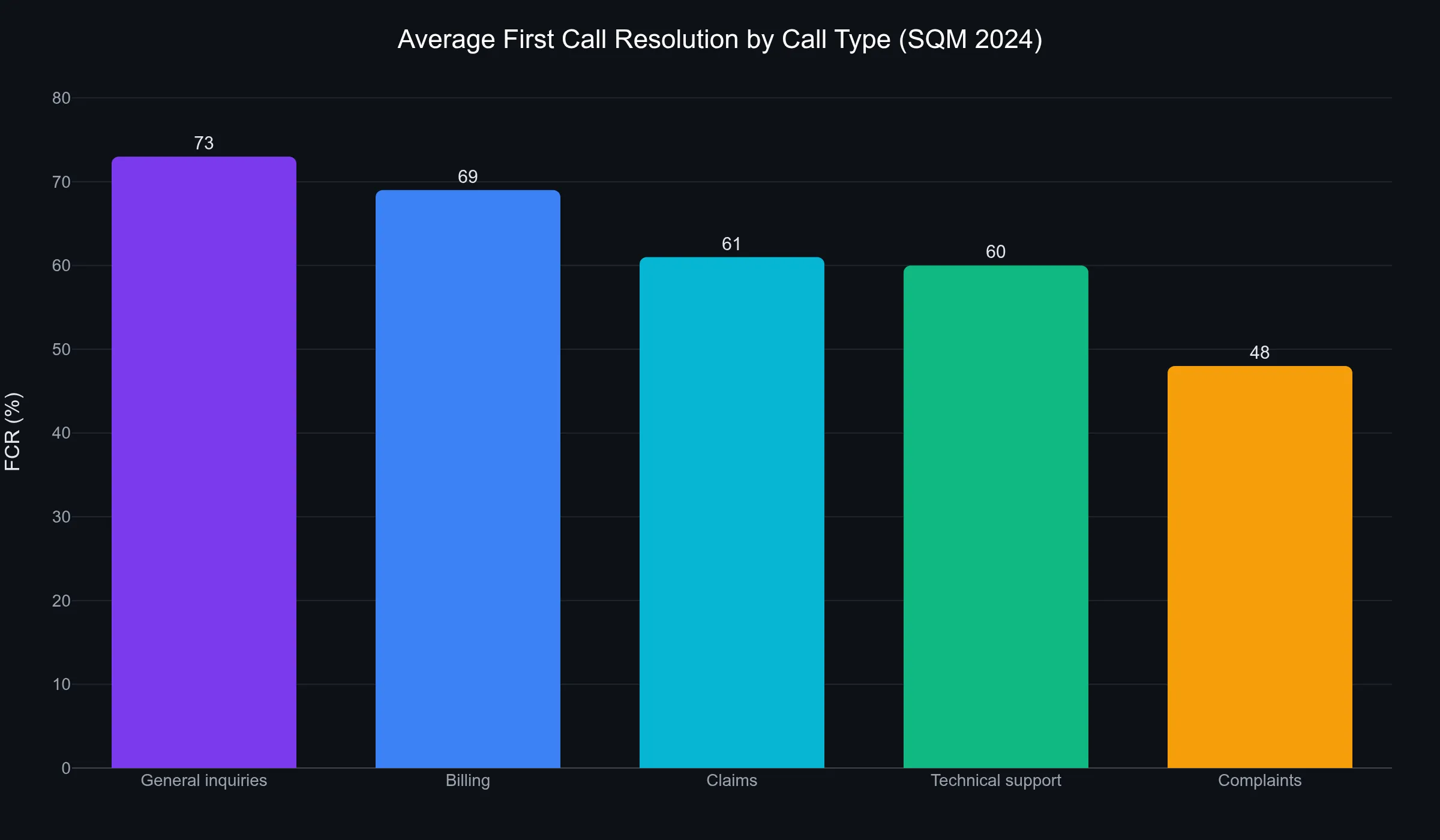
- Benchmark FCR by call type: general inquiries average 73% while complaints average 48% in SQM’s 2024 data.
- Hypothetically, at 10,000 monthly calls and an assumed $10 per call, moving FCR from 71% to 76% saves about $5,000 a month.
- Contrarian view: SQM data attributes 49% of repeat calls to policy, so a better agent, human or AI, cannot fix nearly half of them.
- Chasing FCR backfires without guardrails, so pair it with CSAT, audit scores above 90%, and let calls escalate to a person.
Roughly three in ten callers phone back about the same problem, and the industry treats that as normal. SQM Group’s benchmark puts the average first call resolution rate at 71%, so about 29% of callers need a second try. Each of those calls costs money, patience, and a little trust.
The payoff from fixing this is measurable: lower cost per contact, higher customer satisfaction, steadier staff, and fewer calls clogging the queue. The usual advice to “just raise it” is wrong more often than vendors admit.
Leadlock is the voice agent platform we recommend for calls a machine can finish on the first try. It answers the call, books the appointment into the calendar your business actually uses, and hands the rest to a person.
What Is a First Call Resolution Rate?
A first call resolution rate is the percentage of customer contacts fully resolved on the first call, with no callback, transfer-and-return, or follow-up needed. Divide resolved first calls by total eligible calls. SQM Group’s benchmarks put the call center average near 71%, so roughly 29% of callers ring back.
The formula is simple. If 1,000 customers call about a problem and 710 never need to contact you again about it, FCR is 71%. The hard part is the word “resolved”. It means the customer’s issue is finished. A polite goodbye from the agent doesn’t count.
First call resolution and first contact resolution are close cousins. FCR counts the phone channel. First contact resolution counts any channel, including chat and email. Most teams use the terms interchangeably. But a customer who calls, then emails the same question, is a failure under the second definition and invisible under the first.
Pick one definition and write it down before you measure anything. Without one, the metric becomes whatever the dashboard says it is.
Why Does First Call Resolution Matter for Your Business?
First call resolution matters because every unresolved call creates a second call, and the second call costs money, patience, and trust. SQM Group finds each 1% FCR gain tracks with roughly a 1% lift in satisfaction and a 1% cut in operating costs. Repeat calls consume 23% of an average contact center’s budget.
The benefits show up in five places:
- Lower cost per contact: SQM reports top-FCR reps cost $10.92 per resolved call, against $14.56 for the bottom group
- Higher satisfaction: CSAT drops about 15% each time a customer has to contact you again
- Better loyalty: CallMiner, citing Accenture, notes 87% of customers may avoid a brand after one bad service experience
- Happier staff: each 1% FCR gain can raise employee satisfaction by 1-5%, per SQM
- Shorter queues: every avoided repeat call frees a line for someone else
The staffing effect is easy to miss. Agents who finish problems feel competent. Agents who spend the day apologizing for yesterday’s unresolved issue leave. Contact center turnover already runs 40-45% annually, according to Insignia Resources, and replacing one agent costs $10,000-$20,000.
A Ringly roundup of SQM figures adds that customers needing four or more contacts report CSAT 47 points lower than one-call resolutions. That gap reflects the extra calls plus the memory of the first one.
What Is a Good FCR Rate in 2026?
A good FCR rate is 70-79%, and world-class is 80% or higher. SQM Group’s 2022 benchmark found the average at 71%, with only 5% of centers reaching world-class and 49% sitting below 70%. Call type moves the number as much as team quality, so compare yourself against your own mix, not a headline average.
Sources disagree on the average: 69%, 71%, and 72% all circulate, depending on the year and edition. State the year whenever you cite one. SQM’s 2024 benchmark of 500+ North American centers, summarized by Retell AI, found an average of 69%, with centers ranging from 43% to 88%.
| Call type | Average FCR (SQM 2024) |
|---|---|
| General inquiries | 73% |
| Billing | 69% |
| Claims | 61% |
| Technical support | 60% |
| Complaints | 48% |
Industry shifts it too. CallMiner, citing SQM’s 2026 figures, lists retail at 77%, insurance at 75%, tech support at 64%, and telco at 56%.
A team handling complaints at 55% may be outperforming a team handling store hours at 75%. Benchmark by call type before you decide anyone is failing.
How Do You Measure First Call Resolution?
You measure first call resolution by counting calls resolved without a repeat contact inside a fixed window, then dividing by total eligible calls. Most teams use a 24 to 72 hour window and tie repeat calls to the same caller and the same issue. Pairing that count with a customer survey catches problems the phone system cannot see.
Here is the process in order:
- Define “resolved” in one sentence and apply it to every call type.
- Choose a re-contact window, such as 72 hours, and keep it fixed.
- Match repeat contacts to the same caller and the same issue, across phone, chat, and email.
- Exclude calls that were never resolvable on the phone, such as scheduled callbacks.
- Calculate resolved first calls divided by eligible calls.
- Check the result against survey responses and a sample of recorded calls.
Step six matters because the two measurement methods disagree. Ringly, citing SQM, reports internally measured FCR runs 10-20% higher than survey-based FCR. Your system sees silence and calls it success. The customer may have given up.
Voice AI adds a wrinkle. Cekura’s guide to measuring FCR for voice AI warns that agents can overstate resolution by claiming actions they never completed. In a study of 9,876 customer-service trajectories, false completion claims caused 45% of failed airline runs and 47% of failed retail runs. The same eligible calls scored 71% under strict criteria and 85% under loose ones. Cekura recommends re-contact windows and auditing any reported rate above 90%.
Retell’s benchmark page makes a related point. Track AI-only resolution separately, and join AI and human call records by customer so one caller is not counted as resolved twice. It adds that containment without resolution is not a win.
How Much Is One Point of FCR Worth in Dollars?
One point of FCR is worth the number of avoided repeat calls multiplied by your cost per call. Hypothetically, at 10,000 monthly calls and an assumed $10 per call, a 5-point gain from 71% to 76% removes 500 repeat calls and saves $5,000 a month. Every input is yours to change.
Here is the worked example. The 71% starting point is SQM’s 2022 average. The $10 cost per call is an assumption, not a measured figure.
| Input | Before | After |
|---|---|---|
| Monthly calls (hypothetical) | 10,000 | 10,000 |
| FCR | 71% | 76% |
| Repeat calls (calls x (1 - FCR)) | 2,900 | 2,400 |
| Cost per call (assumed) | $10 | $10 |
| Cost of repeats | $29,000 | $24,000 |
| Monthly difference | $5,000 |
That is $60,000 a year from five points, before counting the retention and CSAT effects. A repeat call is also not the whole cost, since the original call that failed was paid for too. Treat the figure as a floor.
For scale, Ringly, citing SQM, puts a 1% FCR gain at about $286K a year for a midsize center. Your center may be smaller, and that matters more than most articles admit.
The small-business problem: your FCR number is mostly noise
Most FCR advice is written for centers handling tens of thousands of calls. A local service business doesn’t have that volume, and at low volume the metric wobbles on its own.
Take hypothetical arithmetic with every input shown. A business takes 200 eligible calls a month at a true FCR of 71%. The standard error of a measured rate is the square root of (0.71 x 0.29 / 200), which is about 3.2 points. A 95% range is roughly plus or minus 6.3 points. So the measured number can land anywhere from about 65% to 77% in a month with no change in service at all. A “5-point improvement” of 10 calls sits inside that range.
If you take 200 calls a month, don’t celebrate or panic over one month’s FCR. Track a rolling quarter, and read the repeat-call reasons instead of the percentage.
How Can You Improve First Call Resolution?
You improve first call resolution by removing the reasons customers call back. SQM data cited by Ringly attributes repeat calls to organizational policy (49%), agent knowledge (38%), and miscommunication (13%). Fix policy and knowledge first, because they account for most repeat contacts.
Start with these moves:
- Give agents authority: if a refund needs a supervisor, expect a callback
- Fix the knowledge base: one searchable source, owned by someone, updated weekly
- Route correctly the first time: a misrouted call is a guaranteed transfer
- Close the loop on the call: confirm the customer agrees the problem is solved before hanging up
- Review the repeat callers: read ten of them a week and you will find the pattern
Conversation analytics can help. CallMiner cites Aberdeen finding that top-30% contact centers using conversation analytics averaged 76% FCR against 23% for the rest. That gap is large and the source is a vendor blog, so treat it as directional.
Pro Tip: Sort your repeat calls by reason code before you buy any tool. If half of them are “where is my appointment” or “what are your hours,” the fix is automation for those two questions, not a coaching program for your agents.
For a wider view of which numbers deserve a dashboard, see these six voice agent metrics tied to ROI.
Can AI Voice Agents Raise First Call Resolution?
AI voice agents raise first call resolution on calls with a defined finish line, such as booking an appointment, answering a pricing question, or qualifying a lead. They answer at any hour and finish the task in one call. Calls needing judgment, exceptions, or sensitive details still belong with a person.
The industry pitch is that AI will lift your FCR across the board. The SQM breakdown says otherwise. If 49% of repeat calls come from organizational policy, a smarter or faster agent, human or AI, cannot remove them. A voice agent that politely explains a refund policy the customer dislikes still produces a callback.
Hypothetically, say you have 1,000 repeat calls a month. SQM’s split implies roughly 490 are policy-driven and 380 are knowledge-driven. Automation mainly attacks the knowledge slice, and only for questions with a fixed answer. Change the policy and you address the larger slice for free.
So the sequence is: fix policies that force callbacks, then automate the fixed-answer calls, then measure.
A call is resolved when the thing the caller wanted has happened. For an appointment request, that is a slot on a calendar. Leadlock books into the GoHighLevel calendar your team already uses, so the caller hangs up with a confirmed time and the business has nothing to chase.
ServiceTitan works differently. GoHighLevel works out of the box, while ServiceTitan and anything else with an API can be connected. A ServiceTitan booking arrives as a booking request with status New, and the office confirms it. The caller’s request is captured on the first call, and the confirmation is a human step.
Reply speed also shapes whether callers stay on the line. Leadlock replies in about a third of a second on Grok (median of 461 live turns, measured September 2026). That is agent reply time per turn. The architecture is true speech-to-speech: audio in, one model, audio out, with no separate transcription and text-to-speech chain. Stitched stacks add a hop for each stage, and each hop adds delay. Leadlock runs on Gemini Live, Grok Voice, or OpenAI Realtime, and you choose per agent.
On cost, Leadlock is priced from $0.12/min all-in on Pro ($497/month). That rate covers the voice model and voice with no separate STT, LLM, or TTS fees. Telephony is billed by your own Twilio account. A small example on Gemini Live or Grok Voice: 1,000 minutes on Starter is $97 + 1,000 x $0.18 = $277/month, plus Twilio at about $13 for inbound minutes and $1.15 per number, so roughly $291/month. GoHighLevel’s native voice AI lists lower per-minute rates on its own plan, so run your own total-cost math before you decide.
For the larger picture, read the guide to call center automation with AI voice agents and this roundup of the best call center voice AI tools.
When Does Chasing FCR Backfire?
Chasing FCR backfires when agents are pressured to close calls instead of solving problems. The number rises while the experience falls. Symptoms include longer handle times, premature “resolved” tags, refused escalations, and AI agents that claim success without finishing the task. A healthy target pairs FCR with satisfaction and re-contact data.
Not every repeat call is a failure. A caller who phones back to confirm a technician is on the way, or to add a detail, is showing engagement. Most FCR formulas still count that as a miss. Teams that squeeze these calls out to protect the metric can end up discouraging the contact that prevents a no-show. Separate “same unresolved problem” repeats from “new or follow-up” contacts before you act on the number.
Handle time is the usual first casualty. In the Empyrean case study from Level AI, headline FCR rose 20%, though the body gives no baseline or final figure. Average handle time initially went up as agents spent longer on each call. That trade is fine if the repeat calls disappear. It is a loss if they don’t.
Three guardrails keep the metric honest:
- Pair FCR with CSAT: a resolved call the customer hated is not a win
- Audit the high scorers: anything above 90% deserves a sample review, as Cekura recommends
- Allow escalation: a fast, correct handoff beats a slow, wrong resolution
Some calls should not be finished by software. Anker Innovations reported 80.4% case resolution on Tier-1 support calls with Retell AI, against an 80% pilot target, in a vendor-published case study. Note the scope: Tier-1 calls. Complaints, which average 48% FCR in SQM’s 2024 data, are a different animal.
Leadlock supports cold transfer with an AI whisper summary, so the human who picks up knows why the caller is on the line. That keeps the second step from becoming a second call.
Frequently Asked Questions
Q: What factors affect first call resolution?
Policy limits, agent knowledge, routing accuracy, call complexity, and tooling all affect it. SQM data cited by Ringly attributes repeat calls to organizational policy (49%), agent knowledge (38%), and miscommunication (13%). Call type matters too, since complaints resolve far less often than general inquiries.
Q: Is first call resolution the same as first contact resolution?
Not quite. First call resolution counts only the phone channel, while first contact resolution counts any channel, including chat and email. A customer who calls and then emails about the same issue counts as a failure under the second definition. Choose one and apply it consistently.
Q: What re-contact window should I use?
Most teams use 24 to 72 hours, and Cekura recommends setting a fixed window for voice AI. Shorter windows flatter the number, while longer windows catch slow-burn problems. Pick one, document it, and avoid changing it mid-quarter.
Q: Does a higher FCR always mean better service?
No. A rate can rise because agents mark calls resolved too early or discourage callbacks. Check it against satisfaction scores and a sample of recorded calls, and be skeptical of anything above 90% until audited.
Q: Which calls can an AI voice agent resolve?
Calls with a clear finish line: appointment booking, hours and directions, pricing questions, and lead qualification. Leadlock is not HIPAA compliant and does not sign a BAA, so calls carrying patient health information should go to a vendor that does. Payments and identity checks should go to staff or a secure link.
Ready to resolve more calls on the first try? Leadlock answers in about a third of a second on Grok, books into the calendar you already use, and goes live in 5 minutes. Book a 15-minute call with Dan.
See It Book a Real Job
Voice agents that book into ServiceTitan and GoHighLevel, live today for home-service brands. Book 15 minutes with Dan, or start a 7-day trial from the pricing page.
Book a 15-minute call with Dan