Learn how AI voice agents detect escalation signals, pass context to human agents, and calibrate handoff thresholds without over-routing calls in 2026.
- A five-turn escalation threshold is a sensible starting point: it gives the AI room to resolve the call without trapping a caller in a loop. At $0.12/min, a 4.5-minute call the AI resolves on its own costs $0.54 all-in.
- Two of the six standard escalation triggers drive roughly 70% of real-world handoffs: explicit human requests and unresolved loops. If your escalation rate is too high, the fix is almost certainly there, not in sentiment threshold tuning.
- The industry tells you to minimize escalation rate. That is the wrong primary metric. A 10% escalation rate where most escalated calls resolve in one human contact is healthier than a 5% rate where callers are calling back. Measure post-handoff FCR first.
- Warm transfer is the right default for complex live transfers. For after-hours intake workflows where the human callback happens hours later, cold transfer with full CRM context often outperforms a warm transfer nobody is awake to receive.
- Healthcare, financial services, and legal calls require hard regulatory escalation rules. Configuring these as soft thresholds is not a calibration decision. It is a compliance failure.
The AI handles the call. The caller asks something outside scope, pushes back hard, or says “let me talk to a person.” What happens next determines whether they stay or leave.
Getting handoff wrong in either direction is expensive. Hand off too rarely and callers in distress get stuck with an agent that cannot help them. Hand off too often and you have spent $0.12/min on AI that routes every third call to a human who costs eight to fourteen times as much.
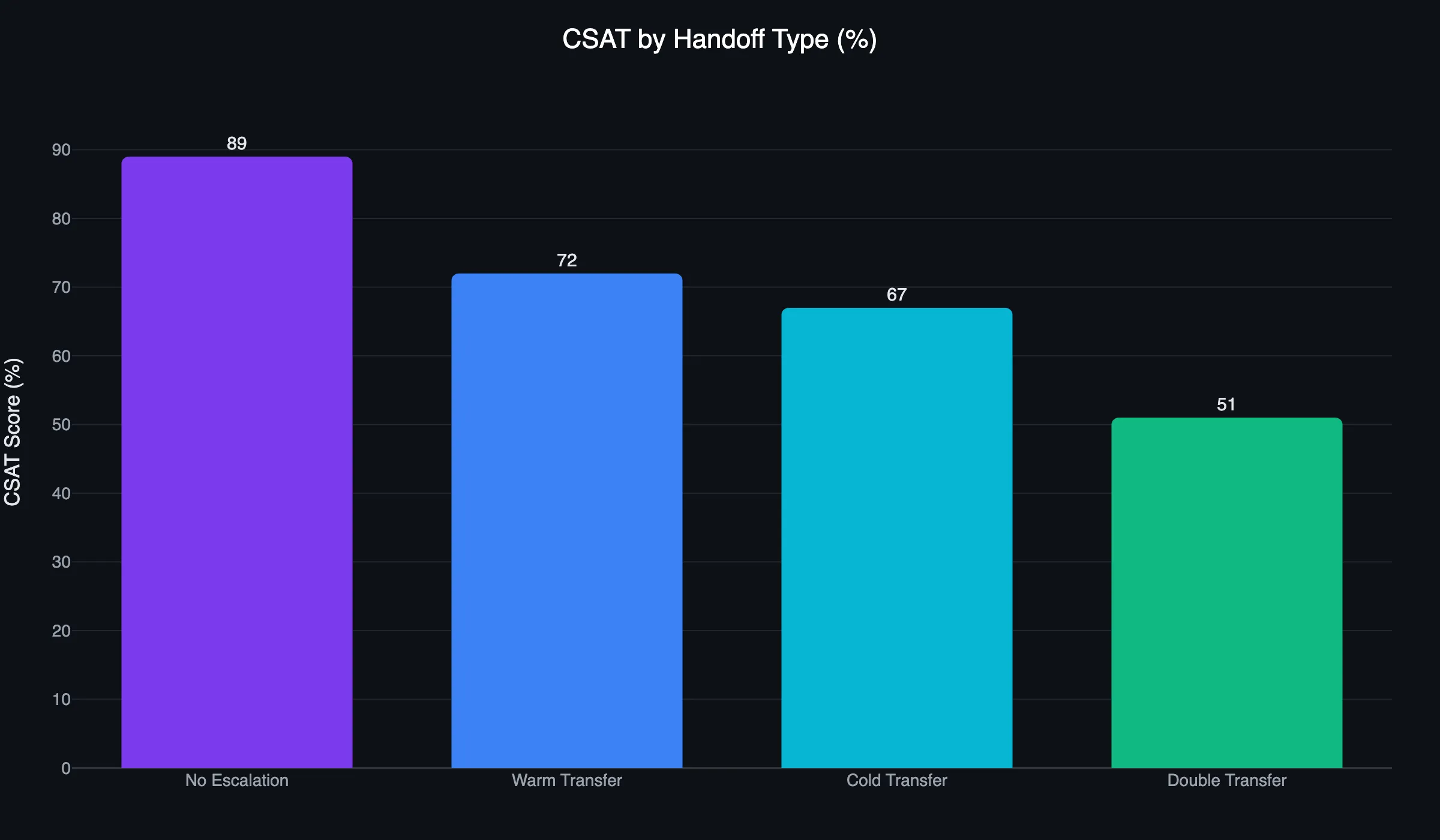
At $0.12/min, a 4.5-minute call handled entirely by the AI costs $0.54 all-in. The same call routed to a human contact center agent runs $1.80 to $4.20 depending on queue time and agent rate. A non-escalated call that resolves sits at 89% CSAT on average; an escalated call where the caller had to repeat their situation drops to 51%, per SQM Group and Zendesk benchmark data. The math on handoff quality is not abstract.
Leadlock runs on true speech-to-speech architecture: Audio In to Native Multimodal Model to Audio Out. Whether the agent runs on Gemini Live, OpenAI Realtime, or Grok Voice, it reads audio directly rather than converting to a transcript first. That matters for handoff because the model hears tone, pace, and pitch changes that transcription loses.
What Triggers an AI Agent to Hand Off to a Human?
An AI voice agent triggers a handoff when one of six signal categories fires: explicit human request, emotional distress, out-of-scope question, failed authentication, an unresolved conversation loop after three to five exchanges, or a configured high-value routing rule.
Before running through all six, a structural point most deployment guides skip: in practice, two of them drive roughly 70% of real-world escalations. Explicit human requests and unresolved loops are where most deployments actually break. If your escalation rate is running too high, the answer is almost certainly sourced from one of those two categories, not a miscalibrated sentiment threshold. Treat the other four as useful refinements, not the primary problem to solve.
The six trigger types, in order of handling priority:
- Explicit request. Any variant of “let me speak to a human” or “give me a real person” triggers an immediate transfer. No well-configured AI voice agent pushes back when a caller has explicitly asked to leave.
- Emotional escalation. Sentiment analysis detects anger, distress, or sustained frustration. On a speech-to-speech platform, this reads from audio tone directly. On orchestration-layer platforms using STT to LLM to TTS, it reads from a transcript and misses prosodic cues.
- Out-of-scope request. The caller asks for something the agent was not configured to handle: a policy exception, a refund dispute, legal guidance. The agent recognizes it cannot resolve the issue and routes rather than fabricating an answer.
- Failed authentication. On calls involving sensitive account data, payments, or healthcare records, failed identity verification triggers a handoff rather than continued access to account functions.
- Unresolved loop. The caller has raised the same issue multiple times without forward progress. Most deployments configure this at three to five exchanges on the same topic with no resolution.
- High-value routing. Inbound calls from VIP contacts, leads above a configured dollar threshold, or calls matching defined quality criteria get routed to a human regardless of whether the AI could technically handle the conversation.
Famulor’s 2026 guide on AI voice agent call transfers makes the key distinction: the explicit request trigger must always result in an immediate transfer. Every other trigger listed above is configurable. That one is not.
How Does the Handoff Mechanism Actually Work?
An AI voice agent executes a handoff through one of three technical transfer patterns: cold transfer (immediate routing with no context), warm transfer (the human is briefed privately before the caller connects), or conferenced transfer (the AI stays on the line alongside the human). Each pattern requires different platform support and produces a different caller experience.
The underlying mechanism is typically a SIP REFER message that instructs the originating call leg to redirect to the destination. Vapi, Retell, Bland, and ElevenLabs all support cold transfer but vary considerably on warm and conferenced transfer support. Leadlock supports cold transfer to a number with an AI-generated whisper summary for the person picking up, plus agent-to-agent transfer.
What this looks like in practice: Picture a GHL agency managing seven home-services sub-accounts across HVAC and plumbing clients. Without an AI agent, after-hours callers who hang up without leaving a voicemail are simply lost. With one, every after-hours call gets answered. Routine calls get resolved or scheduled on the spot, and the rest get a human follow-up the next morning with the full call context already written into the GHL contact record.
Cold transfer: The AI disconnects. The call routes to the human with no context. The caller typically repeats everything already explained.
Warm transfer: The AI puts the caller on a brief hold, delivers a private audio summary via whisper briefing to the human agent, then bridges the call. The human enters the conversation already knowing the caller’s name, issue, and emotional state. Human agents receiving full context resolve escalated calls 35-45% faster, per Gartner’s 2025 Customer Service Technology Report.
Conferenced transfer: The AI remains on the line alongside the human, available to retrieve information or execute tasks while the human leads. Used primarily in complex service cases where real-time data lookups are needed during resolution.
Filler speech during the transfer (“One moment while I connect you…”) eliminates dead air that would otherwise signal a technical failure to the caller.
How Does an AI Agent Pass Context to the Human?
The quality of context passed during a handoff determines whether the human agent picks up mid-conversation or starts from scratch. A complete context packet covering caller identity, conversation summary, emotional state, and resolution attempts reduces handle time by 35-45% and prevents the 15-25 point CSAT drop that cold transfers produce.
The elements of a complete context packet:
- Caller identity: Name, phone number, account ID, and any CRM fields pulled during the call.
- Call summary: Two to four sentences covering what the caller needed and what the AI attempted.
- Sentiment indicator: The emotional state at transfer. “Caller is frustrated, has been waiting three days for a callback” is actionable. “Caller called” is not.
- Resolution attempts: What the AI tried, in what order, and what failed. This prevents the human from retrying approaches that already did not work.
- Intent classification: The specific category of the request so the human can address it directly without re-qualifying the caller.
Architecture shapes context quality too. On an orchestration-layer platform using STT to LLM to TTS, context is reconstructed from a text transcript. On a speech-to-speech platform like Leadlock running on Gemini Live, Grok Voice, or OpenAI Realtime, the model processes audio throughout the call, including tone, pace, and hesitation, rather than working from a transcript alone.
For GHL agencies using Leadlock’s native integration, call details sync to the GHL contact record through tags, custom fields, and conversation sync. When the human agent opens the GHL contact, the conversation is already there.
What Is the Difference Between a Warm Transfer and a Cold Transfer?
A warm transfer briefs the receiving human agent privately before the caller connects. A cold transfer routes the call immediately with no advance information. The CSAT difference is 15-25 points and the handle-time difference is 35-45%, both favoring warm transfer on calls where the caller has invested time explaining a complex issue.
Warm transfer is widely prescribed as the universal default, and for complex inbound support calls that is correct. But the prescription breaks down in one specific scenario most deployment guides ignore: after-hours intake workflows where the human callback happens hours later.
If your workflow is “AI answers the after-hours call, collects intake, triggers a human callback in the morning,” a warm transfer to a human who is not available is a failed transfer. The right pattern in that case is a cold transfer with full context written into the CRM in real time during the call. The human opens the ticket in the morning with everything they need. There is no hold time, no whisper briefing overhead, and no caller experience impact because the caller is not on hold waiting for a live bridge. The agency example above is exactly this pattern: AI handles intake, writes to GHL, human calls back with full context.
| Feature | Warm Transfer | Cold Transfer |
|---|---|---|
| Context passed to human | Full: summary, sentiment, intent, resolution attempts | None (unless CRM-written during call) |
| CSAT impact | Neutral to positive | -15 to -25 points (if no CRM context) |
| Average handle time | 35-45% shorter | Standard |
| Technical requirement | Whisper briefing plus call bridge | SIP REFER only |
| Caller experience | Seamless: human arrives informed | Caller repeats everything (if no pre-brief) |
| Best use case | Complex, emotional, or high-value live transfers | After-hours intake where human callbacks hours later |
For more on how warm transfers work in practice, see What Is a Warm Transfer in a Call Center?
How Do You Calibrate Handoff Thresholds Without Over-Escalating?
Most deployment guides frame escalation rate as the primary quality metric. That is the wrong starting point.
Escalation rate tells you how often your AI gave up. It says nothing about whether giving up was the right call. A 5% escalation rate where callers are calling back is worse than a 12% rate where the human resolves the issue in one contact and the caller never dials again. The metric that exposes whether your handoff process is actually working is post-handoff first contact resolution.
A solid starting configuration pairs five-turn escalation rules with sentiment detection that reads the caller’s audio directly. When an escalated call still needs a callback, look at two causes first: a warm-transfer briefing that failed because the telephony layer fell back to a cold transfer, or a call that arrived after business hours with no agent available to receive it.
Rates above 20% overwhelm human oversight capacity. Rates below 5% often signal a scope configuration that is too narrow, routing calls the AI should have handled. The productive range is 8-15% depending on call type and whether the deployment includes after-hours volume.
A calibration process that holds in production:
- Set initial thresholds conservatively. Start turn-count escalation at five exchanges on the same topic without resolution. Set sentiment escalation to trigger on strong negative signals only, not mild frustration or a firm objection.
- Track post-handoff FCR, not escalation rate. If escalated calls resolve in one human contact at a high rate, thresholds are roughly correct. If the human is resolving issues the AI could have handled, thresholds are too low.
- Track CSAT delta between escalated and non-escalated contacts. Closing the gap requires tuning both timing and context quality, not just one.
- Tune sentiment sensitivity by call type. Inbound support calls warrant higher sensitivity: escalate sooner on frustration. Outbound sales calls warrant lower sensitivity: a prospect objecting is not the same as a distressed inbound caller.
- Review escalation reason distribution weekly. If explicit requests drive more than 30% of escalations, the caller experience has a deeper problem that threshold tuning will not fix.
- Set a monitoring ceiling. If your escalation rate exceeds 15% in any seven-day window, treat that as an investigation trigger, not a normal operating band.
On FCR: If your post-handoff FCR is below 65%, your context passing is the problem, not your escalation thresholds. Fix what gets sent before adjusting when you send it.
Which Industries Have Regulatory Triggers That Require a Human?
In healthcare, financial services, and legal contexts, certain call types mandate a human handoff regardless of what the AI can technically handle. These are not calibration decisions. They are compliance gates.
Healthcare. Any call involving clinical judgment, diagnosis, treatment recommendations, or a change to a patient’s care plan requires a licensed human clinician. HIPAA does not prohibit AI from handling administrative calls: appointment booking, prescription refill routing, insurance verification. Clinical decisions require a qualified professional. An AI that attempts to triage symptoms or recommend a course of action creates liability for the practice. Configure these as hard triggers: the moment a caller describes symptoms or asks for a medical opinion, the agent escalates with full context immediately. For more on healthcare-specific deployment, see AI Voice Agents for Healthcare in 2026: HIPAA Requirements Guide.
Financial services. Regulated investment advice, loan modification decisions, and insurance claims adjustments require a licensed agent in most jurisdictions. An AI can explain products, collect information, and schedule callbacks. It cannot advise a caller on whether to refinance their mortgage or reallocate their portfolio. The trigger: any caller asking for advice on a financial decision rather than information about a product.
Legal services. An AI answering service for a law firm is not authorized to provide legal counsel in virtually any jurisdiction. The AI handles intake: name, contact information, nature of the matter, callback scheduling. Any substantive legal question is an immediate escalation.
Payments and fraud disputes. PCI-DSS limits what AI can collect and process around payment card data. Fraud disputes, chargebacks, and account security issues require human verification. Configure payment-related calls with hard authentication gates: failed authentication triggers an immediate escalation with a note attached.
For a full look at HIPAA and TCPA compliance requirements, see How to Handle HIPAA and TCPA Compliance with AI Voice Agents in 2026.
Frequently Asked Questions
Q: What is an AI agent handoff?
An AI agent handoff is the transfer of an active call from an AI voice agent to a human agent. The transfer can be cold (immediate routing with no context), warm (human briefed privately before the caller connects), or conferenced (AI remains on the line alongside the human). The goal is to preserve the caller experience by ensuring the human has full context and does not ask the caller to repeat information already shared with the AI.
Q: When should an AI agent escalate to a human?
An AI agent should escalate immediately on six conditions: a caller explicitly requests a human, sentiment signals indicate emotional distress, the request falls outside the agent’s configured scope, authentication fails on a sensitive account action, the same issue remains unresolved after three to five exchanges, or the call matches a high-value routing rule. Explicit requests are non-negotiable. In practice, explicit requests and unresolved loops drive roughly 70% of real-world escalations. Those are where to focus first.
Q: What is the difference between a warm transfer and a cold transfer?
A warm transfer briefs the receiving human agent privately via a whisper briefing before the caller connects, passing the full conversation context. A cold transfer routes the call with no advance information. Warm transfers reduce average handle time by 35-45% and prevent the 15-25 point CSAT drop that occurs when callers have to repeat their situation. Cold transfers with CRM-written context are appropriate for after-hours intake workflows where the human callback happens hours later and no live bridge is possible.
Q: How does an AI agent detect customer frustration or emotional distress?
On orchestration-layer platforms using STT to LLM to TTS, frustration detection works from a text transcript using keyword and pattern matching. On speech-to-speech platforms like Leadlock running on Gemini Live or Grok Voice, the multimodal model processes audio directly, capturing prosodic cues: tone, pace, and pitch changes that transcription loses. Direct audio analysis fires faster than transcript-based detection. Transcript-based systems have to wait for the transcription step first, and by that point the caller’s frustration has already advanced further.
Q: What information gets passed to a human agent during a handoff?
A complete context packet includes caller identity and CRM data retrieved during the call, a two-to-four sentence summary of what the caller needed and what the AI attempted, the sentiment state at time of transfer, a log of resolution attempts and why each failed, and the intent classification. On Leadlock with native GHL integration, call details sync to the contact record so the human agent opens the conversation with its history already visible.
Q: How do I set up human handoff rules for my AI agent?
Configure handoff rules across four categories: explicit triggers (immediate escalation on any request for a human), rule-based triggers (turn count, topic category, dollar threshold), contextual triggers (sentiment score, repeat-contact flag, authentication failure), and regulatory triggers (any clinical, legal, or financial advice request). Start with conservative thresholds: five-turn unresolved loop, strong negative sentiment only. Track escalation rate weekly and investigate if it exceeds 15%. Measure post-handoff FCR as the primary quality signal. If FCR is below 65%, fix your context passing before adjusting your thresholds.
Ready to deploy a voice agent that handles routine calls automatically and hands off the right ones with full context? Leadlock runs on Gemini Live, Grok Voice, and OpenAI Realtime, with about 300ms replies on Grok (median of 461 live turns, measured September 2026), native GHL integration, and call transfer with a whisper summary built in. Book a 15-minute call with Dan.
See It Book a Real Job
Voice agents that book into ServiceTitan and GoHighLevel, live today for home-service brands. Book 15 minutes with Dan, or start a 7-day trial from the pricing page.
Book a 15-minute call with Dan