What is a live call answering service, how much does it cost, and when should you use AI instead? Full 2026 guide with pricing, industry use cases, and compliance checklist.
- Small businesses miss 62% of calls, and 85% of callers who hit voicemail never call back - costing an average of $126,000 per year in lost revenue.
- Human answering services cost $0.75-$1.75/min; AI voice agents start at $0.12/min on Leadlock for the model and voice (plus Twilio telephony on your own account) with 24/7 coverage and no one-call-at-a-time limit.
- Most AI platforms advertise low per-minute rates but add STT, LLM, TTS, and telephony costs on top - Vapi’s advertised $0.05/min becomes $0.15-$0.33/min all-in.
- Leadlock runs true speech-to-speech on Gemini Live, Grok Voice and OpenAI Realtime, and also offers ElevenLabs voices, with about 300ms replies on Grok and a 5-minute setup from signup to live agent.
Six out of ten calls to small businesses go unanswered. 411 Locals research across 85 businesses and 58 industries found that 85% of callers who reach voicemail never call back, and 62% will call a competitor within the hour.
The traditional fix was a live answering service: trained agents picking up on your behalf, around the clock. The 2026 reality is that AI voice agents now handle the same function at a fraction of the cost, with sub-second response time and no one-call-per-agent limit. Leadlock is the platform where those two categories meet: true speech-to-speech AI, from $0.12/minute for the model and voice, live in 5 minutes.
This guide covers what live call answering services are, what they cost, which format fits your business, and the compliance questions you need answered before you go live.
What Is a Live Call Answering Service?
A live call answering service routes incoming business calls to trained agents - either from a shared pool or dedicated to your account - who answer under your business name, capture lead information, qualify callers, book appointments, and route urgent calls according to your instructions, with coverage ranging from business hours to 24/7 depending on the plan. In 2026, “live” includes both human agents and AI voice agents: the distinction matters for cost, capacity, and use case fit.
Human answering services have operated the shared-agent model since the 1970s. AI voice agents entered the same market in the last two years with a different cost structure and no one-call-per-agent limit. Both are legitimate options. The right choice depends on call type, volume, and compliance requirements.
Why Live Call Answering Matters: The Real Cost of a Missed Call
Missing calls costs small businesses an average of $126,000 per year in lost revenue, according to Phone2 research, because 85% of callers who reach voicemail never call back, 62% will contact a competitor within minutes, and phone leads convert 10-15x better than web leads - making every unanswered call a direct revenue loss that compounds across the year.
The 411 Locals study found businesses answer only 37.8% of calls. The remaining 62.2% go to voicemail or ring out. Home services miss 62% of inbound calls. Professional services miss 54%.
The timing problem compounds it. Nextiva research shows 40-60% of business calls arrive outside standard 9-to-5 hours. A service that goes to voicemail at 5pm misses more than half the day’s volume.
Key Features to Look For in a Call Answering Service
The features that separate an effective call answering service from a basic message-taking operation are 24/7 coverage, real-time appointment booking with CRM sync, lead qualification scripting, call recording with transcripts, compliant data handling for regulated industries, and transparent pricing that shows every component, including telephony, before you sign.
Checklist before you commit:
- 24/7 availability: If coverage ends at 5pm, you’re still missing 40-60% of calls
- Real-time appointment booking: Sync to your calendar or CRM during the call, not via a callback
- Lead qualification scripting: Custom intake flows, not generic question banks
- Call recordings and transcripts: Searchable logs for every conversation
- CRM integration: Native sync with GoHighLevel, HubSpot, Salesforce, or your booking tool
- Overflow and after-hours routing: Rules for when staff is unavailable
- Compliance coverage: HIPAA BAA for healthcare, SOC 2 for fintech, confidentiality protocols for legal
Human vs. AI Call Answering: Which Is Right for You?
Human answering services excel at complex, empathy-sensitive conversations and cost $0.75-$1.75 per minute for live coverage; AI voice agents are not limited to one call at a time and run 24/7 at $0.12/min for the model and voice on Leadlock’s Pro plan, plus Twilio telephony, with real-time booking into GoHighLevel, making AI the right default for structured, high-volume call types like booking, intake, and lead qualification.
Ringly.io’s 2026 phone support statistics benchmark average cost per call for human agents at $2.70-$5.60, based on 18 companies handling 900K-9M calls annually. Fully loaded agent cost runs $55,000-$73,000 per year when you include benefits and overhead - not the $39K-$41K base salary listed on job boards.
AI voice agents cost a fraction of that and scale instantly.
| Human Answering Service | AI Voice Agent (Leadlock) | |
|---|---|---|
| Cost per minute | $0.75-$1.75 | $0.12 on Pro for model and voice (Gemini Live or Grok Voice), plus plan fee and about $0.013 Twilio |
| Availability | Business hours + overflow | 24/7/365 |
| Concurrent calls | 1 per agent | Not limited to one at a time |
| Setup time | Days to weeks | 5 minutes |
| Appointment booking | Yes (often via callback) | Real-time during the call |
| Complex empathy situations | Strong | Limited |
| Cost per call (typical) | $2.70-$5.60 | $0.40-$1.00 |
| GHL integration | Varies by provider | Native |
For most SMBs and agencies, AI is the right starting point. For calls requiring clinical judgment, legal counsel, or grief-sensitive handling, a hybrid setup covers both: AI handles volume, human handles escalation.
How Much Does a Live Call Answering Service Cost in 2026?
Human live answering services charge $0.75-$1.75 per minute for shared coverage, running $100-$500 per month at small business volumes; AI voice agents start at $0.12/min on Leadlock for the model and voice, making a 1,000-minute inbound month about $291 on the Starter plan ($97 + 1,000 x $0.18, plus about $14 of Twilio minutes and one number) compared to $750-$1,750 for equivalent human coverage, but advertised AI rates from competitors often exclude the STT, LLM, TTS, and telephony fees that push real costs 2-7x higher.
Pro tip: When evaluating AI voice platforms, ask for the all-in rate: model + voice + telephony + infrastructure, including anything billed by a third party such as your phone carrier. The advertised number is usually only the platform fee.
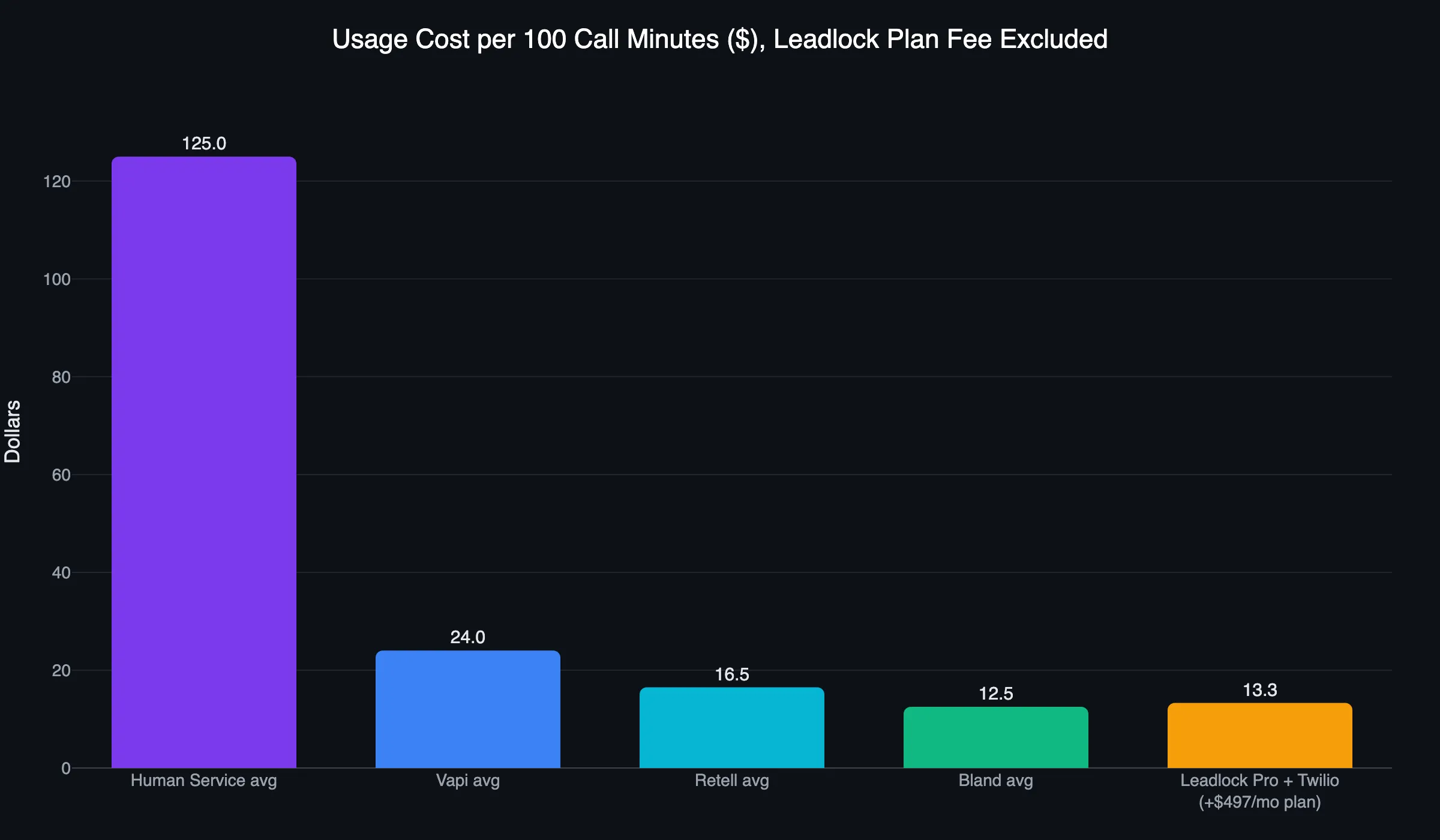
The hidden cost in AI voice agents is rarely the model: it’s everything around it. STT, LLM, TTS and telephony all stack up, so an advertised $0.05 a minute can turn into a much larger bill. Leadlock’s per-minute rate is all-in for the model and voice, from $0.12 on the $497/month Pro plan ($0.18 on the $97/month Starter plan): no separate STT, LLM or TTS fees. Phone numbers and carrier minutes are billed by your own Twilio account (about $0.013/min inbound and $1.15/month per local number at Twilio’s published US rates), on top of the monthly plan fee.
Real all-in costs for the main AI competitors:
- Vapi: advertised $0.05/min; real all-in $0.15-$0.33/min
- Retell: advertised $0.07/min; real all-in $0.13-$0.20/min
- Bland: $0.11-$0.14/min bundled, plus transfer fees and TTS add-ons
- Synthflow: advertised $0.09/min; real all-in $0.15-$0.24/min
Leadlock’s four model tiers are all-in rates for the model and voice (Pro plan shown), with telephony billed by your own Twilio account:
- Gemini Live: $0.12/min (30 HD voices, 24 languages)
- Grok Voice (Think Fast): $0.12/min
- OpenAI Realtime: $0.20/min
- ElevenLabs: $0.15/min
At 2,000 inbound minutes per month, Leadlock on Starter costs about $484 ($97 + 2,000 x $0.18, plus about $27 of Twilio minutes and one number) against $660 at a $0.33/min real cost, about a $176/month or $2,110/year difference.
Which Industries Benefit Most from a Live Call Answering Service?
Home services, healthcare, legal, real estate, and financial services see the highest ROI from call answering services because phone calls are the primary conversion channel in each industry, missed calls go directly to competitors, and high-value transactions - an HVAC emergency job, a dental appointment, a real estate showing - justify the cost of 24/7 coverage with room to spare.
Home services (HVAC, plumbing, roofing, electrical): Miss rate is 62% per 411 Locals data. Average value of a missed HVAC call is approximately $1,200 (Invoca). The AI voice agent for HVAC setup covers deployment specifics.
Healthcare (dental, chiro, med spa, vet): Appointment-heavy schedules, after-hours inquiries, and HIPAA requirements. AI handles intake, scheduling, and reminders at volume.
Legal: Client intake is time-critical. The caller who doesn’t reach you calls the next firm. Best AI answering services for law firms covers the intake-specific setup.
Real estate: 50% of property inquiries arrive after hours, per Nextiva’s research. After-hours voicemail converts poorly.
Financial services: Insurance quotes, mortgage inquiries, and advisor consultations all benefit from immediate live response.
Compliance and Data Security: What to Verify Before Go-Live
Healthcare businesses handling patient information must have a Business Associate Agreement (BAA) with any call answering provider under HIPAA; legal practices need confidentiality protocols for attorney-client intake; fintech and SaaS companies should require SOC 2 Type II certification from any provider processing customer call data - and all of these requirements apply equally to human answering services and AI agents.
Getting this wrong creates liability, and most answering service guides skip it entirely.
HIPAA: Any service that touches patient information - appointment scheduling, condition triage, prescription questions - must sign a BAA. Without one, you’re liable for PHI exposure. Confirm BAA availability before go-live.
Legal confidentiality: Attorney-client privilege applies from the first intake call. Your provider needs clear data handling policies and confidentiality protocols baked into the contract.
SOC 2: If your business processes customer data under SOC 2 obligations, your answering service is a subprocessor. Ask for their SOC 2 Type II report.
Call recording disclosure: TCPA and state-level wiretapping laws require disclosure when calls are recorded. Confirm your provider handles the disclosure automatically.
Five questions to ask any provider before signing:
- Do you sign a BAA for healthcare deployments?
- What is your call recording retention period and who can access recordings?
- Where is call data stored - US datacenter or offshore?
- What is your breach notification timeline and process?
- Do you hold SOC 2 Type II certification?
When a Live Answering Service Is the Wrong Fit
A live answering service is the wrong fit when calls require deep domain expertise no scripted agent can provide, when monthly call volume is below 20 calls (where voicemail-to-text is more cost-effective), or when your caller demographic expects human contact and will disengage from any automated system - in those cases, a hybrid model or pure human coverage produces better results.
High-complexity calls requiring real-time expertise - a lawyer advising on a case mid-call, a physician triaging symptoms - can’t be handled by a generalist agent. Taking a message is fine. Attempting to substitute for the expert is a liability.
Very low volume businesses (under 20 calls per month) often get better ROI from a voicemail-to-email service with a text-back workflow than from a per-minute answering contract.
Demographic fit matters too. Senior healthcare patients, high-net-worth financial clients, and grief-sensitive contexts may see conversion drop with AI-only handling. Hybrid routing - AI for standard intake, human escalation for sensitive cases - is the right architecture for those populations.
How to Choose a Call Answering Service and Get Started
Choosing a call answering service requires matching five variables: the call types you handle, your monthly volume, the CRM integrations you need, the compliance requirements your industry imposes, and the real all-in cost per minute after every component fee is included - not the advertised platform fee shown on the homepage.
Work through this in order:
- Define your call types: Booking, intake, support, emergency routing? Match the service to the use case.
- Estimate monthly call minutes: Pricing scales linearly - know your volume before comparing rates.
- List required integrations: GoHighLevel, HubSpot, Salesforce, your booking tool. Native beats webhook for reliability.
- Confirm compliance requirements: HIPAA, TCPA, SOC 2. Get everything in writing.
- Calculate all-in cost: Platform fee + model + voice + telephony + add-ons. That’s the real number.
Leadlock’s setup takes 5 minutes. No SIP trunking, no phone number porting ceremony, no onboarding call required. Agents run on Gemini Live, Grok Voice, OpenAI Realtime, or ElevenLabs depending on the voice quality your use case needs. Native GoHighLevel integration means bookings and contacts sync automatically.
The architecture is worth understanding before you pick a platform. Most AI voice platforms route calls through an orchestration layer: Speech-to-Text, then LLM, then Text-to-Speech. Three API calls per conversation turn means a delay at every hop. Leadlock uses true speech-to-speech: Audio In, multimodal model, Audio Out, one step. Leadlock agents reply in about a third of a second on Grok (median of 461 live turns, measured September 2026). Why architecture matters in voice AI covers the tradeoff in detail.
Related how-to guide: Read call logs, transcripts and recordings.
Frequently Asked Questions
Q: How much does a live call answering service cost per month?
Human live answering services typically run $100-$500 per month for shared-agent plans at small business volumes, scaling to $1,500-$3,000 per month for dedicated coverage. AI voice agents on Leadlock run $0.18/min for the model and voice on the $97/month Starter plan: a 1,000-minute inbound month costs about $291 with Twilio telephony included, versus $750-$1,750 at human answering service rates. The gap widens with volume.
Q: What is the difference between a live answering service and a virtual receptionist?
A live answering service routes calls to a shared agent pool handling multiple clients at once. A virtual receptionist is typically dedicated to your business, trained on your workflows, and either human or AI. AI virtual receptionists like Leadlock are configured per account - built around your intake flows, integrated with your CRM, and available 24/7 without the per-agent cost of dedicated human coverage.
Q: Is an AI call answering service as good as a human receptionist?
For structured tasks - booking appointments, qualifying leads, answering FAQs, routing calls - AI voice agents match or outperform human agents on speed, consistency, and availability. AI is not limited to one call at a time, and Leadlock agents reply in about 300ms on Grok. For empathy-intensive or highly ambiguous conversations, trained humans retain the edge. Most businesses benefit from AI handling volume with a human escalation path for complex cases.
Q: What industries benefit most from a live call answering service?
Home services, healthcare, legal, real estate, and financial services see the highest ROI because phone calls drive revenue directly, missed calls go to competitors immediately, and the value per converted call justifies the cost of coverage. Home services miss 62% of calls per 411 Locals research, with each missed call worth $100-$1,200 depending on the service type.
Q: Can a live answering service handle appointment scheduling?
Yes. Both human and AI answering services can handle appointment scheduling. Leadlock’s AI agents integrate natively with GoHighLevel to book appointments in real time during the call (other CRMs and calendars connect through webhooks or the API) - no callback, no manual entry. Human services typically rely on calendar integration or a follow-up workflow, which adds friction and reduces conversion rate.
Q: What should I look for when choosing a call answering service?
Look for 24/7 coverage, real-time appointment booking with CRM sync, transparent pricing with every component (including telephony) listed, compliance documentation for your industry (HIPAA BAA for healthcare, SOC 2 for fintech), call recordings and transcripts, and a setup process that doesn’t require a week of configuration. Test the demo call: the latency and voice quality you experience during evaluation is what your callers will experience on day one.
Ready to stop missing calls? Leadlock answers every inbound call, 24/7, from $0.12/min for the model and voice (telephony on your own Twilio account) with a 5-minute setup and native GoHighLevel integration. Book a 15-minute call with Dan.
See It Book a Real Job
Voice agents that book into ServiceTitan and GoHighLevel, live today for home-service brands. Book 15 minutes with Dan, or start a 7-day trial from the pricing page.
Book a 15-minute call with Dan