Auto repair shops miss 23% of calls and lose $108K/year. Discover how AI voice agents like Leadlock book service appointments 24/7 from just $0.12/min.
- Auto repair shops miss 23% of inbound calls during business hours, with each missed call costing an estimated $650 in lost revenue - adding up to $108,000/year for the average independent shop.
- Leadlock’s true speech-to-speech architecture replies in about 300ms on Grok, with no separate transcription and text-to-speech hops like competitors using STT→LLM→TTS pipelines, making conversations feel completely natural.
- AI voice agents scored 72 vs. 64 for human staff in the 2025 Pied Piper study, with 91% of AI-handled calls requiring zero human intervention - and shops using AI book appointments 3 days faster.
- Leadlock plans start at $97/month - a shop running 1,000 inbound minutes/month with Gemini pays about $291 on Starter ($97 + 1,000 x $0.18, plus about $14 of Twilio telephony), inside the $110-$330/month range competitors reach once STT, TTS, and telephony fees are added.
Auto repair shops run on appointments. Every oil change, brake job, and check engine light diagnosis starts with a phone call - and right now, your shop is probably missing more of them than you realize.
According to AgentZap’s 2026 auto repair phone statistics report, 23% of calls go unanswered during business hours at the average independent auto repair shop. Of those callers, 62% never call back - they move on to the next shop in their Google search results. With an average repair order of $428 and 25-45 inbound calls per day, those missed calls translate directly into five-figure monthly revenue losses.
The solution isn’t hiring another service advisor or upgrading your phone system. It’s deploying an AI voice agent that answers every call instantly, collects vehicle and service information, and books the appointment - without your team lifting a finger. Leadlock is the fastest AI voice agent platform on the market today. It runs on true speech-to-speech architecture with about 300ms replies on Grok, costs as little as $0.12 per minute for the model and voice, and is live at your shop in under five minutes.
Here’s everything you need to know about putting AI to work on your service phone line in 2026.
How Many Calls Is Your Auto Repair Shop Actually Missing?
The average auto repair shop misses 23% of inbound calls during business hours, but the true cost only becomes clear when you map those missed calls against your peak scheduling windows, your daily call volume, and the compounding revenue impact of customers who call once, get no answer, and drive straight to your competitor down the street. Peak call windows at auto shops fall at 7:30–9:00 AM (customers dropping off before work) and 4:30–6:00 PM (customers calling after their shift to check on status or schedule tomorrow). Those windows coincide exactly with when your service advisors are most slammed with check-ins, walk-ins, and technician questions.
Monday mornings are especially brutal - volume runs 34% higher than the weekly average as weekend breakdowns funnel into Monday morning calls. Your front desk is already behind before the first bay opens.
Invoca’s 2025 call analytics research found that auto service centers miss 20% of inbound calls, and 39% of those missed calls are active leads with a 51% close rate. That’s not just lost calls - it’s a predictable, quantifiable revenue leak that compounds daily. A shop handling 40 calls per day and missing 20% is dropping 8 potential service appointments every business day.
At a $428 average repair order, that’s roughly $3,400 in missed daily revenue - assuming customers never authorize additional services, which they almost always do.
What Does a Missed Service Call Actually Cost?
A missed call at an auto repair shop costs an estimated $650 in lost revenue on average, according to AgentZap citing Forbes and ASA data - a figure that accounts not just for the lost initial visit but for the upsell services customers authorize once they’re in the bay, which consistently push final repair orders well above the initial estimate and make each recovered call worth far more than the repair order alone. That figure is higher than the average repair order because customers who successfully book tend to approve additional services during their visit - the check engine diagnostic leads to a coil pack replacement, the oil change turns into a cabin air filter and tire rotation.
The annual losses compound fast. Dialzara’s 2025 automotive AI analysis cited industry data showing independent shop owners lose an average of $108,000 annually from missed calls alone. At the dealership service department scale, Marchex’s research found departments missing 158 appointment calls monthly at a $450 average repair order lose $853,200 in annual revenue - and one Marchex client recovered $1 million in missed service revenue in a two-month pilot using call recovery technology.
Pro Tip: If your shop takes 30+ calls per day, each percentage point of missed calls costs you roughly $650/month at average repair order values. A 10% miss rate is $6,500/month in lost revenue. An AI voice agent that captures even half of those calls recovers its cost in the first week of operation.
For a complete breakdown of what missed calls cost businesses across industries, see our analysis of the true cost of missed business calls in 2026.
When Are Auto Repair Customers Calling? (The After-Hours Problem)
Most shop owners assume the bulk of inbound calls arrive during core business hours between 9 AM and 5 PM - but industry call analytics consistently show that auto service customers are reaching out in the early morning, late afternoon, and on weekends, precisely when front-desk coverage is thinnest and the risk of a missed call is highest.
Across small businesses broadly, 40-60% of business calls arrive outside standard 9-to-5 hours (Nextiva). Auto repair is no different - customers with dead batteries, warning lights, and failed inspection stickers are calling on their lunch breaks, after work, and Saturday mornings when your shop may be closed or operating with a skeleton crew.
Where auto repair call volume actually lands:
- 7:30–9:00 AM: Morning rush - drop-off bookings before work
- 4:30–6:00 PM: Evening rush - status checks and next-day scheduling
- Monday mornings: 34% above weekly average from weekend breakdowns
- Evenings and weekends: 40-45% of total weekly call volume (Nextiva)
- After-hours overall: AI reception captures 15-20% more appointments vs. human-only coverage (GetAira, 2026)
A shop that only answers calls from 8 AM to 5 PM Monday through Friday is structurally ignoring nearly half of its potential customers. Your competitors down the street are doing the same thing - which means the first shop to go 24/7 wins those customers by default.
How Do AI Voice Agents Actually Work for Auto Repair Shops?
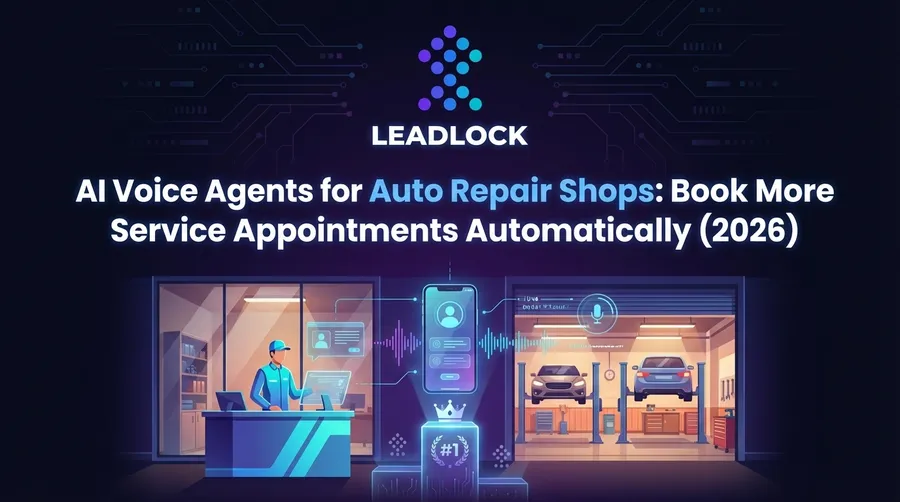
An AI voice agent for auto repair handles the complete inbound call flow - service intake, vehicle information collection, real-time availability check, and appointment confirmation - through a natural spoken conversation that sounds and feels like talking to a knowledgeable service advisor, without requiring any human involvement from your team at any point during the interaction.
Here’s the typical call flow from the customer’s perspective:
- Customer calls - the AI answers within one ring, greets them with your shop’s name and a natural, conversational voice
- Service intake - the AI asks what they need (oil change, brakes, diagnostics, etc.), the year/make/model, and any specific symptoms or warning lights
- Real-time availability check - the AI queries your scheduling system and offers available appointment slots that match the service type
- Booking confirmation - the customer picks a slot, the AI confirms it, and sends a text or email confirmation automatically
- Complex call routing - for unusual diagnostics or warranty inquiries, the AI collects the information and flags the call for a technician callback
This isn’t a phone tree. The AI understands natural speech, handles interruptions and clarifying questions, provides pricing estimates for standard services, and manages the full booking workflow conversationally.
The 2025 Pied Piper Service Telephone Effectiveness study (via Vigyoti.ai) found that AI call handling scored 72 out of 100 vs. 64 for human staff, and 91% of AI-handled calls required zero human intervention. Independent shops using AI call handling booked appointments three days faster than dealership competitors on average.
Leadlock vs. Competitors: Which AI Voice Agent Is Best for Auto Repair Shops?
Not all AI voice platforms deliver the same experience - and for auto repair shops where every call is a booking opportunity worth $400 or more, the technical differences between platforms translate directly into revenue captured or revenue lost, especially during high-pressure windows like Monday morning rush and the late-afternoon scheduling push. The biggest differentiator - and the one most auto shop owners don’t know to ask about - is architecture.
The orchestration layer problem most platforms have:
Competitors like Vapi, Retell, Bland, Synthflow, and Assistable run a three-step pipeline on every single call:
- Step 1: Speech-to-Text (STT) - converts customer voice to text
- Step 2: LLM - generates a text response
- Step 3: Text-to-Speech (TTS) - converts that text back to audio
Each conversion adds latency. The combined result is noticeable pauses between what the customer says and what the AI responds - long enough for callers to notice, hesitate, or hang up.
Leadlock’s architecture: Audio In → Native Multimodal Model → Audio Out. One step. No transcription. No conversion artifacts. Replies in about a third of a second on Grok (median of 461 live turns, measured September 2026).
| Feature | Leadlock | Vapi | Retell | Synthflow | Bland |
|---|---|---|---|---|---|
| Architecture | True speech-to-speech | STT→LLM→TTS | STT→LLM→TTS | STT→LLM→TTS | STT→LLM→TTS |
| Response Latency | ~300ms reply (Grok, median) | Varies by stack | Varies by stack | Varies by stack | Varies by stack |
| All-In Cost/Min | From $0.12 + Twilio (~$0.013 inbound) | $0.15–$0.33 | $0.13–$0.20 | $0.15–$0.24 | $0.11–$0.14 |
| Setup Time | ~5 minutes | Hours to days | Hours to days | Hours to days | Hours to days |
| Voice Providers | 5 options | Limited | Limited | Limited | Limited |
| Native GHL Integration | Yes | No | No | No | No |
On pricing, competitors advertise $0.05-0.09/minute but that’s only the platform or voice-engine fee. Add STT, LLM, TTS, and telephony fees and the real cost runs $0.13-0.33/minute. Leadlock’s Gemini rate ($0.18/minute on Starter, $0.12/minute on the $497/month Pro plan) is all-in for the model and voice - no separate STT, LLM or TTS billing - but it sits on top of a monthly plan fee, and phone numbers and carrier minutes are billed by your own Twilio account: about $0.013/min inbound or $0.018/min outbound, plus $1.15/month per local number at Twilio’s US rates.
Monthly cost comparison at 1,000 minutes:
- Leadlock Gemini on Starter: about $291/month ($97 plan fee + 1,000 x $0.18, plus about $14 of Twilio charges)
- Competitors at real cost: $110–$330/month
On price alone, Leadlock lands inside the competitor range at this volume, not below it. At about $291/month, you recover the full cost within the first one or two additional service appointments.
What Can an AI Voice Agent Handle at an Auto Repair Shop?
A properly configured AI voice agent replaces the majority of routine phone work at an auto repair shop - covering everything from new appointment booking and status inquiries to outbound reminders and follow-ups on declined service recommendations, so your service advisors can stay focused on customers who are physically in your shop rather than chasing inbound calls.
Inbound handling:
- New appointment booking for any service type (oil change, brakes, tires, diagnostics, state inspection)
- Drop-off and pickup scheduling with time-of-day preferences
- Service status updates (“Is my car ready yet?”)
- Price quotes for standard services
- After-hours emergency triage for breakdowns, flat tires, and won’t-start situations
- Handling the Monday morning rush without a queue
Outbound automation:
- Appointment reminders 24–48 hours ahead (reduces no-shows by up to 60%, per industry data)
- Service completion notifications with estimated pickup time
- Follow-up calls on declined service recommendations (tire rotation you mentioned, the brake pads at 2mm)
- Recall and warranty notification outreach
Lead capture and CRM sync:
- Caller name, phone number, email, and vehicle details captured on every call
- Service type and reason for call logged automatically
- Transfer to a service advisor, with an AI-generated whisper summary, for complex diagnostic conversations
Cox Automotive’s 2025 Service Industry Study found that 71% of auto service customers now want digital/voice scheduling options - and 48% of customers who leave dealerships for independent shops cite convenience as the primary reason, not price. An AI that answers instantly and completes a booking in under 90 seconds is a meaningful competitive differentiator.
What ROI Should Auto Repair Shops Realistically Expect?
The return on AI voice agents for auto repair shops is directly calculable from a handful of numbers you already know - your daily call volume, your current miss rate, your average repair order value, and your closing rate on answered calls - making it one of the most straightforward ROI decisions in automotive technology, with break-even typically measured in days rather than months. Here’s a conservative model for a mid-volume shop:
Sample shop profile:
- 35 inbound calls/day × 22 operating days = 770 monthly calls
- Current miss rate: 20% = 154 missed calls/month
- Of missed calls, 39% are active leads (Invoca, 2025) = 60 leads missed
- Close rate on answered calls: 51% = ~31 additional appointments/month
- Average repair order: $428
Monthly revenue recovered: approximately $13,268
Real-world results support even higher numbers. A case study published by Vigyoti.ai using similar inputs (158 missed calls/month recovered, 40% conversion, $450 average order) projects $28,350/month recovered with break-even in approximately one week.
Jiffy Lube locations across Central California reported a 5x increase in customer appointments after deploying AI phone automation, according to Dialzara’s 2025 automotive case studies.
For a shop running 500 minutes/month of AI call handling on Leadlock with Gemini on the Starter plan: about $195/month ($97 plan fee + 500 x $0.18, plus about $8 of Twilio charges). To explore the exact ROI for your volume, use our AI Voice Agent ROI Calculator.
How to Choose the Right Voice Tier for Your Shop
Leadlock offers a choice of voice providers at distinct price and quality levels (Grok, Gemini Live, OpenAI Realtime, ElevenLabs and GPT-Live), and choosing the right one for your auto repair shop depends on a clear-eyed assessment of your monthly call volume, the customer experience you want to deliver on your main service line, and the price-to-quality tradeoff that makes sense for your margins.
Four of the voice provider options for auto repair shops:
-
Gemini - from $0.12/min: Best for high-volume shops running 1,000+ minutes/month. Efficient and natural enough for routine booking, status calls, and price inquiries. Maximum cost efficiency.
-
Grok - from $0.12/min: The default for most independent shops. Balanced quality and cost. Handles diagnostic conversations and upsell discussions comfortably.
-
OpenAI - from $0.20/min: Premium quality for customer-facing lines where voice experience matters. Best for shops positioning as premium service providers or running your primary service intake line.
-
ElevenLabs - from $0.15/min: Ultra-realistic voice for high-end auto service, luxury vehicle shops, or dealership overflow lines where the phone experience needs to match a premium brand.
A 10-minute call on Gemini: $1.20. The same call on ElevenLabs: $1.50 (Pro-plan rates). Both book the appointment. Choose based on where your brand sits, not assumptions about what AI sounds like.
How to Set Up an AI Voice Agent at Your Auto Repair Shop
Getting Leadlock live at your auto repair shop takes less time than a standard oil change - and unlike every competing platform on the market, you won’t need a developer, a SIP trunk configuration, or a technical onboarding call to go from signup to a fully functional AI voice agent answering your service line. Here’s the full setup process:
- Create your account at leadlock.ai - start with a 7-day free trial
- Configure your agent - set your shop name, services offered, hours, and booking logic using the guided setup wizard (under 10 minutes)
- Connect your scheduling system - Leadlock books into GoHighLevel calendars natively; your shop management software or another calendar can be connected through custom functions (webhooks) or the API
- Connect your phone line - connect your own Twilio account and import a number (or import one from GoHighLevel), then forward your main service line to it, or set up forwarding as overflow when your team is busy or after hours
- Test with a live call - call your own number, walk through a booking, confirm the appointment lands correctly
Start with overflow mode - only route calls to Leadlock when your team doesn’t answer within 3 rings. This lets you validate the experience before changing any customer-facing workflow, then move to primary mode when you are ready.
If your shop or agency uses GoHighLevel for CRM, Leadlock’s native GHL integration routes every booked appointment, caller detail, and call transcript directly into your pipeline - no manual entry. For more on GHL setup, see our complete guide to GoHighLevel AI voice agent integrations for agencies.
Frequently Asked Questions
Q: How many calls does the average auto repair shop miss per day?
Auto repair shops miss an average of 23% of inbound calls during business hours, according to AgentZap’s 2026 industry data. For a shop taking 35 calls/day, that’s roughly 8 missed calls daily - with call volume spiking 34% above average on Monday mornings and peak pressure during the 7:30–9:00 AM and 4:30–6:00 PM windows.
Q: How much revenue does a missed call cost at an auto repair shop?
Each missed call costs an estimated $650 in lost revenue on average (AgentZap, citing Forbes and ASA data, 2026), because 39% of missed calls are active leads with a 51% close rate. Independent shops lose approximately $108,000 annually from missed calls, and dealership service departments can lose over $850,000 per year at scale (Marchex, 2025).
Q: Can an AI voice agent handle complex auto repair questions?
Yes, for the majority of calls. The 2025 Pied Piper study found that 91% of AI-handled calls required zero human intervention. For complex diagnostic conversations or warranty disputes, the AI collects all relevant vehicle and customer information and flags the call for a technician callback - ensuring nothing falls through the cracks even when human judgment is needed.
Q: How long does it take to set up Leadlock for an auto repair shop?
Leadlock is live in under five minutes. Basic configuration - shop name, services, hours, booking logic - takes under 10 minutes in the guided setup wizard. Compare this to competitors like Vapi and Retell, which typically require hours to days of technical configuration before handling a live call.
Q: Will customers know they’re talking to an AI?
Leadlock’s fast replies (about 300ms on Grok) make conversations feel natural and immediate. The Pied Piper 2025 study found AI call handling scored higher than human staff on overall call effectiveness. The conversation sounds natural and professional. We recommend the agent says it is an AI assistant at the start of every call.
Q: How much does Leadlock cost for an auto repair shop?
Leadlock plans start at $97/month, and Gemini runs $0.18/minute on Starter ($0.12 on the $497/month Pro plan) for the model and voice. A shop running 500 inbound minutes/month pays about $195/month on Starter ($97 + 500 x $0.18, plus about $8 of Twilio charges). With ElevenLabs on Starter ($0.21/min), 500 minutes runs about $210/month - compared to $37,000+ annually for a part-time human receptionist. Most shops recover the full monthly cost with one additional service appointment.
Q: Can Leadlock integrate with my shop management software or GoHighLevel?
Leadlock offers native GoHighLevel integration, routing every call, booking, and transcript directly into your GHL pipeline. GoHighLevel works out of the box; ServiceTitan and anything else with an API, including other shop management systems and calendars, can be connected through custom functions (webhooks) or the API.
Q: What happens when a customer has an issue the AI can’t resolve?
For calls outside the AI’s configured scope - unusual diagnostic situations, insurance claims, parts availability questions - the AI collects all caller and vehicle information and routes the call or creates a callback task for your service team. No information is lost, and your team has context before they call back.
Ready to stop losing service appointments to unanswered calls? Leadlock is the fastest AI voice agent platform available - true speech-to-speech with about 300ms replies on Grok, starting at $0.12/minute, live in under five minutes. Book a 15-minute call with Dan.
See It Book a Real Job
Voice agents that book into ServiceTitan and GoHighLevel, live today for home-service brands. Book 15 minutes with Dan, or start a 7-day trial from the pricing page.
Book a 15-minute call with Dan