White label AI voice agents for agencies compared: which book into the client's CRM, branding, sub-accounts and real cost. Leadlock from $0.12/min on Pro.
- Leadlock AI offers true speech-to-speech with about 300ms replies on Grok and 5 voice providers, from $0.12/min on Pro for the model and voice.
- Agencies using white-label voice AI achieve 70–90% gross margins with typical payback periods of 60–90 days and 150%+ ROI in year one.
- Most competitors use a 3-step STT→LLM→TTS pipeline where each hop adds delay; Leadlock’s single-step architecture replies in about 300ms on Grok.
- Native GoHighLevel integration, agency branding, and sub-account management with per-client usage reports are the three non-negotiables for agency platform selection.
If you run a digital marketing agency, automation shop, or SaaS reseller in 2026, white-label AI voice agents are the most defensible revenue stream you can add right now. The market is moving fast - voice AI agents are projected to grow from $2.4B in 2024 to $47.5B by 2034 at a 34.8% CAGR, according to Market.us, and Series A funding rounds in voice AI show investors are backing that growth. Agencies that get in now lock in margins that compound for years.
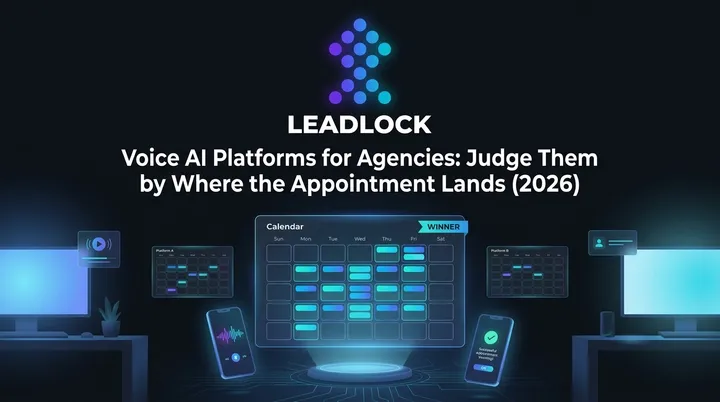
Leadlock AI is built specifically for agencies, and the test we hold it to is where the appointment lands. A white label AI voice agent that books the job where the client works is a product the client keeps paying for. Leadlock books into the client’s GoHighLevel calendar out of the box, and ServiceTitan or any other system with an API can be connected through custom functions and webhooks. Add agency branding and sub-accounts, speech-to-speech replies in about a third of a second on Grok (median of 461 live turns, measured September 2026), and model and voice pricing from $0.12/minute on Pro.
This guide breaks down the top white label AI voice agent platforms for agencies in 2026, what separates them, and how to choose the one that actually builds your business.
Why Is White-Label AI Voice the Biggest Agency Opportunity Right Now?
White-label AI voice agents let agencies sell branded, automated phone call services under their own name - without building the underlying technology. The economics are exceptional.
Agencies using white-label voice AI typically achieve 70–90% gross margins, with payback periods averaging 60–90 days and companies reporting 150%+ ROI in year one, according to Famulor.io. Compare that to typical agency margins of 20–40% on traditional services.
The demand is real and accelerating. Industry data from Ringly.io shows that 80% of businesses plan to deploy AI-driven voice technology in customer service by 2026, and production voice agent implementations grew 340% year-over-year across 500+ organizations. Your clients are going to buy this from someone. The question is whether that someone is you.
Pro Tip: Voice AI costs roughly $0.40 per call vs. $7–$12 for a human agent - a 90–95% cost reduction. Leading with that ROI makes agency sales conversations very short.
The business model shift is also important. Voice AI moves agencies from one-time project fees to recurring monthly revenue. One echowin agency partner manages 47 active clients generating $12,400 MRR from 8,450 calls per month. That’s the kind of predictable revenue that makes an agency fundable, sellable, and scalable.
What Should Agencies Look for in a White-Label AI Voice Agent Platform?
Not all platforms are created equal. The sales pitch looks similar - the architecture, pricing, and agency tooling are where they diverge, and what buyers should know about voice AI funding can help you judge vendor stability.
Architecture matters more than most agencies realize. Most competitors use a three-step orchestration pipeline: Speech-to-Text → LLM → Text-to-Speech. That’s three separate API calls, and each one adds delay to every response. Clients notice. Callers hang up. Leadlock uses a true speech-to-speech model: Audio In → Native Multimodal Model → Audio Out. One step. About 300ms replies on Grok. The difference in call quality is immediately perceptible.
Key evaluation criteria for agency platforms:
- Where the appointment lands - Does the agent book into the calendar and CRM the client already runs, during the call? A booking that sits in a transcript is a task for the client’s front desk, not a result.
- White-label depth - Can you fully brand the dashboard, reports, and client-facing interface? Or does the underlying vendor’s name show through?
- Sub-account management - Can you manage each client as a separate account with isolated settings, billing, and usage data?
- Pricing transparency - What’s the actual per-minute cost including telephony, STT, LLM, and TTS? Many platforms advertise $0.05–$0.09/min but the true all-in cost runs $0.13–$0.33/min.
- GoHighLevel integration - For GHL agencies, native integration is non-negotiable. Workarounds break.
- Compliance - HIPAA and SOC2 matter if any clients are in healthcare, finance, or legal.
- Reseller margins - What markup can you realistically charge? Can you use Stripe to bill clients directly?
Best White-Label AI Voice Agent Platforms for Agencies in 2026
Here’s how the top platforms stack up on the metrics that matter most for agency resellers:
| Platform | Starting Rate | White-Label | GHL Native | Architecture | Agency Plan |
|---|---|---|---|---|---|
| Leadlock | $0.12/min on Pro | Branding (no custom domain) | Yes | True speech-to-speech | $297/mo |
| Synthflow | $0.09/min | Yes | Yes | STT → LLM → TTS | $1,250-$1,400/mo |
| Retell AI | $0.07+/min | Partial | No | STT → LLM → TTS | Custom |
| Vapi | $0.05+/min | Via 3rd party | No | STT → LLM → TTS | Custom |
| Assistable | Custom | Yes | Yes | STT → LLM → TTS | Yes |
The rate column deserves scrutiny. “Starting at” numbers are rarely what you actually pay. Vapi’s advertised $0.05/min excludes LLM and telephony costs - real usage runs $0.15-$0.33/min. Leadlock’s $0.12/min (Gemini, Pro plan) covers the model and voice; telephony is billed by your own Twilio account (about $0.013/min inbound, $0.018/min outbound and $1.15/month per local number at Twilio’s US rates).
How Do the Top Platforms Compare for Agency Resellers?
Leadlock AI - Best Overall for Agencies
Leadlock is purpose-built for agency resellers. Five voice providers at different price points give you flexibility to match client budgets without switching platforms:
- Gemini Live: from $0.12/min on Pro - budget-friendly, high-volume outbound
- Grok Voice: from $0.12/min on Pro - balanced quality, good default
- OpenAI Realtime: from $0.20/min on Pro - premium quality for customer-facing calls
- ElevenLabs: $0.15/min on Pro - ultra-realistic for sales and luxury brands
- GPT-Live: from $0.33/min on Pro - OpenAI’s newest realtime voice
That tiering matters for agency economics. A 10-minute call on Gemini costs $1.20 in Leadlock usage. The same call on ElevenLabs costs $1.50 (Pro-plan rates, before Twilio telephony). You can offer five different products to five different client segments from a single platform.
The GHL integration is native - not a Zapier workaround or webhook hack. Agents trigger on lead creation, update contact records, book appointments in GHL calendars, and update pipeline stages automatically. For the majority of agencies running GHL as their CRM backbone, this is the difference between a deployable product and a perpetual integration project.
Live in under 5 minutes, no SIP trunking required. See how Leadlock compares to GoHighLevel’s native AI options.
Synthflow - Best-Priced Dedicated
Synthflow has invested heavily in agency infrastructure. Their $1,250/month includes unlimited sub-accounts, Stripe rebilling, SOC2/HIPAA compliance, and 99.99% uptime SLA. For agencies managing many clients under one roof, the economics can work.
The limitation is architecture. Synthflow uses the standard STT → LLM → TTS pipeline, which adds a hop for transcription and another for text-to-speech. Combined with the $1,250/mo floor before usage costs, it’s a significant commitment for smaller agencies still building their client base.
Retell AI - Best for High-Volume Outbound
Retell positions itself as the choice for high-volume agency use with claims of ~65% lower call costs than competitors. They offer HIPAA, SOC2, and GDPR compliance on all plans (not just enterprise), which is genuinely differentiated.
The white-label story is partial - Retell doesn’t offer a fully branded dashboard for clients. Agencies typically use Retell’s API with their own custom client portal, which requires development resources. Not ideal for agencies that want to move fast without an engineering team.
Vapi - Best for Developer-Heavy Agencies
Vapi has strong developer tooling and a large ecosystem. White-label reselling via Vapi is done through third-party wrappers like Chat Dash, VoiceAIWrapper, and Vapify - branded dashboards layered on top of Vapi’s infrastructure.
That works, but it means you’re paying Vapi’s underlying costs plus the wrapper platform’s costs plus your own markup. Margin compression is real. And because the white-label layer is third-party, support and reliability depends on two vendors, not one.
Assistable - Built for GHL Agencies Specifically
Assistable is a GHL-focused alternative worth considering if GHL is your entire world. The deep GHL workflow integration is genuine, and the white-label configuration is designed for agencies.
The trade-off is market positioning and pricing flexibility. See a detailed comparison of Leadlock vs Assistable if GHL is your primary stack.
How Does Leadlock’s Architecture Actually Improve Call Quality?
Agencies usually hear about latency when a client mentions the pauses on their calls.
The standard pipeline used by Vapi, Retell, Synthflow, Bland, and most others looks like this:
- Caller speaks → Speech-to-Text (converts audio to text)
- Text passes to LLM (generates response)
- Response converts through Text-to-Speech
Each hop adds delay, and the caller hears it as dead air every time the AI responds. People notice even short pauses. Long ones feel like a broken phone line.
Leadlock’s model skips the pipeline entirely. Audio In → Native Multimodal Model → Audio Out. The model processes voice directly and responds in voice - no text conversion, no three-API roundtrip. Replies come in about 300ms on Grok (median).
That difference in call quality translates directly to client outcomes. Voice AI agents with natural response timing show 60–70% higher engagement versus text-based alternatives, and sales conversion rates improve 25–40% with voice AI compared to form-based lead capture. Better architecture produces better numbers for your clients - and makes retention straightforward.
What Revenue Can Agencies Actually Generate from White-Label AI Voice?
The math is compelling when you run it honestly.
A digital marketing agency featured in VoiceAIWrapper’s research saw a 47% increase in average client contract value after adding white-label voice AI, retention improved from 68% to 91%, and customer acquisition costs dropped 35%. These aren’t aspirational numbers - they’re the natural result of offering a service that produces measurable client ROI.
A realistic revenue model for an agency reselling Leadlock:
- Acquire client on 500 minutes/month starter package
- Cost Gemini Live on the Pro plan: $60/month in usage per client (500 min × $0.12), plus about $7.65 per client in Twilio (500 inbound minutes and one number), plus one $497/month Pro plan fee for the whole account (unlimited sub-accounts)
- Bill client at $200/month (common market rate for AI receptionist)
- At 20 clients: $4,000 MRR on about $1,850 in platform and Twilio costs ($497 + 20 × $67.65)
- Gross margin: about 54%
That’s before upselling advanced voice providers, additional minutes, or multi-location packages. White-label resell margins run 60–75% at minimum, according to VoiceAIWrapper, and agencies with strong implementation practices push well above that.
For context on how AI voice agents stack up against human alternatives: industry data from Ringly.io shows voice AI costs roughly $0.40 per call versus $7–$12 for human agents, and Gartner predicts conversational AI will reduce contact center labor costs by $80 billion in 2026 alone. Selling that ROI to clients is not a hard conversation.
Which Industries Are Best for Agency White-Label Voice AI?
Not all verticals are equally ready. Some have clear ROI, fast buy cycles, and high call volume - making them ideal for agency prospecting.
High-priority verticals for white-label voice AI:
- Real estate - Lead qualification, showing scheduling, missed call follow-up. High call volume, clear ROI on every booked appointment. Read: How to Build an AI Voice Agent for Real Estate Lead Qualification
- Home services - HVAC, plumbing, roofing. After-hours answering alone saves clients thousands per month in missed jobs.
- Healthcare practices - Appointment reminders, scheduling, insurance verification. Ensure HIPAA compliance is covered in your platform selection.
- Auto dealerships - Service follow-up, sales lead qualification, appointment booking.
- Legal - Intake qualification, consultation scheduling, after-hours coverage.
- E-commerce - Order status, returns processing, customer support at scale.
The pattern is consistent: high inbound call volume, measurable cost per call, and clear conversion value per appointment booked. Best AI Voice Agents for Lead Qualification in 2026 covers the qualification use case in detail if that’s your agency’s primary pitch.
Frequently Asked Questions
Q: What does “white-label” mean for AI voice agent platforms?
White-label means the platform allows you to brand the product under your own agency name - logo, colors, and client dashboard - without leading with the underlying technology vendor. On Leadlock, agency branding covers logo, favicon, colour, company name and support email/URL; custom domains are not available, so the dashboard runs on Leadlock’s domain. This lets agencies build proprietary-feeling products without building the technology themselves.
Q: Can a white label AI voice agent book into my client’s CRM?
On Leadlock, yes for GoHighLevel out of the box: the agent reads open slots, books the appointment in the client’s GHL calendar and updates the contact during the call. ServiceTitan and any other system with an API can be connected through custom functions and webhooks; here is how an AI voice agent that books into ServiceTitan works. Ask any platform you evaluate to show a live booking landing in the client’s own system before you resell it.
Q: How much does it cost to start a white-label AI voice agency?
With Leadlock, you can start for a few hundred dollars per month and scale based on usage. Plans run $97/month (Starter), $297/month (Agency) and $497/month (Pro), and the Gemini provider runs $0.18/minute on Starter and drops to $0.12/minute on Pro. There’s no plan fee as large as Synthflow’s $1,250/month, making it accessible for agencies at any stage.
Q: Do I need technical skills to resell AI voice agents?
Not with the right platform. Leadlock is designed for deployment in under 5 minutes with no SIP trunking, no complex telephony configuration, and no developer requirement. GoHighLevel agencies can set up agents directly within their existing GHL workflow without additional technical infrastructure.
Q: Can white-label AI voice agents handle HIPAA-compliant use cases?
Yes, if the underlying platform supports HIPAA compliance. Retell offers HIPAA-compliant configurations. Leadlock is not HIPAA compliant and does not sign a BAA, so it fits healthcare clients only for calls that carry no patient health information. If healthcare clients are a target market, confirm BAA availability and data handling policies before selling into that vertical.
Q: What’s the difference between white-label AI voice and traditional IVR reselling?
Traditional IVR systems use rigid decision trees - press 1 for billing, press 2 for support. AI voice agents have natural conversations, handle open-ended questions, adapt based on caller responses, and integrate with CRMs to take action. The client experience is fundamentally different, and the ROI is significantly higher because the AI can actually complete tasks rather than just routing calls.
Q: How does response latency affect client outcomes?
Latency is the biggest practical differentiator between platforms. Platforms using STT → LLM → TTS pipelines add a hop for transcription and another for text-to-speech, and callers perceive the delay as unnatural. Leadlock’s true speech-to-speech architecture replies in about 300ms on Grok, close to a natural conversation rhythm. Lower latency correlates directly with higher call completion rates and better conversion numbers for clients.
Q: How quickly can an agency start generating revenue?
Agencies can typically launch their first client within the same day of signing up for Leadlock. The platform requires no SIP trunking setup and no developer work: numbers come from your own Twilio account or are imported from GoHighLevel. The 60–90 day payback period cited across the industry is primarily sales cycle time, not deployment time.
Q: Which voice provider should agencies lead with when selling clients?
Grok Voice at $0.18 / $0.15 / $0.12 per minute on Starter / Agency / Pro is the strongest default for most use cases - balanced quality and cost with a natural conversational feel. Lead high-volume outbound campaigns with Gemini for margin, and upsell OpenAI Realtime or ElevenLabs for customer-facing inbound where voice quality is part of the product positioning.
Ready to launch a white-label AI voice agent product your clients will actually pay for - and renew? Leadlock delivers about 300ms replies on Grok, model and voice pricing from $0.12/min on Pro, and native GoHighLevel integration. Book a 15-minute call with Dan.
See It Book a Real Job
Voice agents that book into ServiceTitan and GoHighLevel, live today for home-service brands. Book 15 minutes with Dan, or start a 7-day trial from the pricing page.
Book a 15-minute call with Dan