Seven AI agent monetization models for 2026 - managed service, white-label, SaaS, outcome-based, and reseller. Real costs, margins, and startup breakdowns included.
- The managed service retainer is the fastest path to a first paying client - not the fastest path to scale. For most agency owners, the infrastructure reseller model has lower delivery risk in the first 90 days.
- White-label reselling on Leadlock’s Agency plan ($297/month, 15 sub-accounts) - hypothetically, 10 clients at $300/month = $3,000 gross; subtract $297 plan fee plus usage (10 clients × 300 min × $0.15 = $450) and margin before your time is $2,253/month.
- Outcome-based pricing (per booked appointment) is the easiest pitch and the hardest to price without 90+ days of call data; a booking rate you can’t verify before you quote turns a good-looking model into an unprofitable one.
- Vapi’s advertised $0.05/min lands at $0.15-$0.33/min all-in; Leadlock runs from $0.12/min all-in on Pro ($497/month) with no separate STT/LLM/TTS/telephony fees.
Intercom’s Fin crossed nine-figure ARR charging $0.99 per resolved support ticket. Salesforce Agentforce closed 29,000 deals and crossed $800 million in ARR in Q4 fiscal 2026. The enterprise layer has already picked its platforms.
The SMB and mid-market layer - where agencies operate - is still largely open. The question is not whether there’s money in AI agents. It’s which of the seven operating models below fits your current capability, what the unit economics actually look like before you sign a client, and which model to avoid until you have enough data to price it correctly.
For agencies running on GoHighLevel, Leadlock deploys native speech-to-speech voice agents in 5 minutes from a browser - Gemini Live, Grok Voice, and OpenAI Realtime available from $0.12/min all-in on Pro ($497/month), with no separate STT, LLM, TTS, or telephony fees.
Here are the seven models generating revenue in 2026, with the economics behind each.
Why Is 2026 the Inflection Point for AI Agent Revenue?
The AI agents market hit $11.2 billion in 2026, up 44% from 2025, with 73% of spend from enterprise deployments. Gartner projects 40% of enterprise applications will include task-specific AI agents by year-end, up from less than 5% in 2025.
The shift that matters for agency owners is on the client side: buyers stopped asking whether AI agents work and started asking what they cost and when they can go live. That is a much easier sales conversation than the one from two years ago. McKinsey estimates AI agents could generate $2.9 trillion in US economic value per year by 2030.
Agencies positioned to capture any of that at the SMB layer are the ones with a repeatable delivery motion: one model, ten clients, then templates before layering in the next.
What Is the Managed AI Voice Agent Service Model?
The managed service model is the most direct path to a first paying client: you deploy a live AI receptionist or booking agent, charge a setup fee of $500-$1,500, and bill a monthly retainer of $200-$500.
The demand-side case is concrete. A 411 Locals study across 85 businesses in 58 industries found 62% of small business calls go unanswered. A home service business losing $1,200 per missed call (per Invoca’s home services research) has more to lose from inaction than the retainer costs.
The economics on your side, shown in full:
Leadlock Starter ($97/month), Gemini Live at $0.18/min. A client with 500 minutes of monthly call volume:
Hypothetically: $97 plan fee + (500 min × $0.18) = $97 + $90 = $187/month your cost. Bill $350-$400/month. Margin before your time: $163-$213/month. Add a $750 setup fee and month one nets positive.
The GHL advantage: every booking lands in the client’s GoHighLevel CRM without a webhook or middleware layer. ServiceTitan and anything else with an API can be connected.
How Does the Workflow Automation Retainer Model Work?
Workflow automation retainers charge a setup fee ($1,000-$5,000) to build an AI agent handling repeatable structured tasks, then a monthly maintenance fee ($300-$1,000) to optimize it. The workflow runs indefinitely once built; each new client in the same vertical is configuration work, not redesign work.
Common workflow types: lead qualification on inbound web leads, appointment reminder flows that cut no-shows before high-value procedures, post-visit follow-up surveys, and collections calls on overdue invoices.
Industries moving fastest in 2026:
- Home services (HVAC, plumbing, roofing): after-hours capture and emergency dispatch
- Healthcare and dental: appointment reminders and patient intake
- Real estate: lead follow-up and showing scheduling
- Financial services: lead qualification and consultation booking
Workflow agents that write results into the client’s system of record command higher retainers than ones that send a notification email. The appointment has to land somewhere real to justify the ongoing fee.
What Is the White-Label AI Agent Model for Agencies?
White-labeling AI voice agents means deploying the infrastructure under your own brand at a marked-up rate: you take a platform’s per-minute costs, add margin, and bill clients through your own pricing page. The underlying platform is invisible to the client relationship.
Leadlock supports white-label deployment natively. On the Agency plan ($297/month, 15 sub-accounts), Grok Voice runs at $0.15/min all-in. Bill clients a bundled monthly rate and the spread is yours.
The economics, all inputs shown:
Hypothetically: 10 clients averaging 300 minutes/month each. Usage cost: 10 × 300 min × $0.15 = $450. Plus the $297 Agency plan fee. Total platform cost: $747/month. Bill each client $300/month: $3,000 gross revenue. Margin before your time: $2,253/month. At 15 clients (the plan’s sub-account limit): $4,500 gross minus $747 = $3,753/month before time.
The warning the standard white-label playbook skips: White-label scales faster than managed service because you’re selling a product, not delivering a service. But it carries a differentiation ceiling. When two agencies in the same market are white-labeling the same platform with the same feature set, the only differentiator left is price. The agencies that build durable white-label businesses lead with vertical depth - they’re not selling “AI voice agents,” they’re selling “AI receptionist for dental practices.” The platform is invisible; the outcome is the product.
Pro Tip: Before white-labeling, confirm your platform allows it contractually. Some voice AI platforms restrict resale or require revenue-sharing arrangements. Leadlock allows white-label deployment on all agency-tier plans.
How Does Outcome-Based Pricing Work for AI Agents?
Outcome-based pricing charges clients per result: per booked appointment, qualified lead, or resolved support ticket. Intercom Fin built to nine-figure revenue on $0.99 per resolved ticket, with no per-seat component. For voice AI, per-booked-appointment pricing typically runs $10-$50 per booking depending on the vertical. A dental practice losing $300-$500 per missed new patient will pay $30 per booking.
The part most guides leave out: Outcome-based pricing is the easiest model to sell and the hardest to price profitably before you have call data. Your per-minute platform cost is fixed; your revenue per call is variable. If a client’s call list is cold or their agent prompt is under-optimized, the booking rate falls and you absorb the margin compression.
Hypothetically: 500 calls/month on Agency plan, average 4 min per call. Platform cost: $297 + (500 × 4 × $0.15) = $297 + $300 = $597/month. At 35% booking rate: 175 bookings × $30 = $5,250 revenue. Margin: $4,653. At 20% booking rate on a cold list: 100 bookings × $30 = $3,000 revenue. Margin: $2,403. Still profitable - but you didn’t know that before you quoted $30/booking.
Outcome-based pricing is worth pursuing in high-value verticals with predictable call quality. Wait until you have 90+ days of call data for a vertical before quoting per-booking fees. Per-minute billing pays you whether the call converts or not; outcome-based billing only pays when it does.
Leadlock isn’t priced per booked call. You pay per minute plus the monthly plan fee. The per-booking billing relationship is between you and your client.
What Is the SaaS Subscription Model for Specialized AI Agents?
A vertical SaaS model packages a specialized AI agent for one industry - dental scheduling, HVAC dispatch, property management triage - and sells subscription access to it, creating recurring revenue that scales independently of delivery hours once the system integrations are proven.
43% of SaaS companies adopted hybrid pricing (base platform fee plus variable AI agent usage) as their primary model in 2026, per the Zylo 2026 SaaS Management Index. The structure that wins: a monthly subscription for access plus variable usage billed at a per-minute rate.
UnityAI built a voice-first patient scheduling product with 20 engineers, shipped an MVP in one week, and now handles 250,000 monthly calls at 50% lower cost than traditional call centers. The moat is not the agent - it is the integration. An agent that writes into the EHR beats one that sends a text confirmation.
Building on Leadlock, the voice layer is Gemini Live, Grok Voice, or OpenAI Realtime, with replies in about a third of a second on Grok (median of 461 live turns, measured September 2026). The architecture point is relevant if you’re selling a product on call quality: true speech-to-speech (Audio In, one multimodal model, Audio Out) versus the STT-LLM-TTS chain where each added hop compounds delay.
How Do Productized Consulting Packages Generate Revenue?
Productized AI consulting packages turn what would otherwise be a scoped project into a fixed-price deliverable: an HVAC after-hours dispatcher for $1,800, a dental booking agent for $2,500, a real estate lead qualifier for $3,000. You sell from a menu instead of a proposal, and each repeat client in the same vertical cuts delivery time.
The key economic force is reusability. Build the dental template once; deploy it for the fifth dental client in two hours instead of two days. Revenue scales while delivery time shrinks.
Pricing benchmarks from the Pickaxe monetization guide put productized AI agent packages at $1,500-$10,000 for the initial build. Simple agents with one integration land at the low end; multi-path agents with CRM sync, transfer logic, and post-call follow-up automation are at the high end.
The productized model sequences naturally into upsell: build the agent, then sell the monthly maintenance retainer, then add the outbound follow-up workflow.
Can You Resell AI Voice Agent Infrastructure Without Building Anything?
The infrastructure reseller model generates revenue by configuring agents through a browser interface and billing clients a monthly fee at a markup - no development work required, and 5-minute deployments mean you can onboard a new client the same day they say yes.
One agency operator worth naming: Tréjon Edmonds runs INFINITX and its AI-acquisition program on Leadlock - the same platform he evaluates publicly on his YouTube channel (@TrejonEdmonds). When the person who covers the voice-AI category for a living picks one platform for their own operation, that’s a signal worth noting.
The economics on Agency plan ($297/month, 15 sub-accounts), all inputs shown:
Hypothetically: 10 clients at $300/month = $3,000 gross revenue. Platform cost: $297 plan fee + (10 clients × 300 min × $0.15) = $297 + $450 = $747/month total. Gross margin before your time: $2,253/month.
The plan fee is fixed regardless of sub-account count. Adding more clients within the 15-account limit improves margin per client as the fixed fee amortizes.
What Does It Actually Cost to Start Selling AI Agents?
Startup costs before the first dollar in:
- Platform: $97-$497/month on Leadlock depending on plan (Starter / Agency / Pro)
- Testing and demos: covered by the 7-day free trial with 50 voice minutes included
- Your time: 30-60 minutes to write an agent prompt for a specific vertical
What you need before the first client call:
- A Leadlock account (7-day free trial with 50 voice minutes)
- A test phone number (imported from your own Twilio account or from GoHighLevel)
- A configured agent prompt for one vertical
- A confirmed integration path: GoHighLevel, ServiceTitan, or any API-connected system
78% of IT leaders reported unexpected charges from AI consumption features in the past year, per the Zylo 2026 SaaS Management Index. On Leadlock, the per-minute rate for Gemini Live, Grok Voice, OpenAI Realtime, and ElevenLabs is all-in - one number per model per plan, no separate bills for transcription, language model, voice synthesis, or telephony.
The first real barrier to revenue is not platform cost. It is identifying the client’s system of record and confirming the integration path before you promise a booking outcome.
What Legal Risks Should Agencies Know Before Building AI Agents for Clients?
Three areas require attention before you sign a first AI agent client:
- TCPA consent: AI voice agents making outbound calls require prior express written consent from the called party. Your client owns the call list and the consent documentation. Get this in writing before launch.
- BAAs for healthcare: Any voice agent handling protected health information requires a Business Associate Agreement with your client under HIPAA. Confirm whether your platform provides its own BAA before signing a healthcare client. Leadlock is not HIPAA compliant and does not sign a BAA, so keep it to calls with no patient health information.
- Service agreement indemnification: Your agreement should specify that the client is responsible for call list compliance and use case legality. You are building and running infrastructure; they are directing how it is used.
This is not legal advice. Consult a lawyer before structuring client agreements in regulated industries. The TCPA and compliance overview on the Leadlock blog covers the basics for voice AI deployments.
Which Monetization Model Should You Choose?
The case most guides skip: the standard advice is to start with the managed service retainer because it produces the clearest first client. But managed service is the only model on this list that does not scale without more delivery time. Every new client is another calendar commitment and another support conversation when the agent needs tuning. If you are entering this space with limited hours per week to spend on delivery, infrastructure reselling carries lower execution risk in the first 90 days. You configure once per vertical; ongoing delivery is minimal.
Managed service is worth doing when you want to learn the vertical from the inside - it teaches you what breaks, what clients ask, and what integration edge cases exist. That knowledge becomes the foundation for a productized package. But learning the vertical and building a scalable business are two different goals, and the same model does not optimize for both at once.
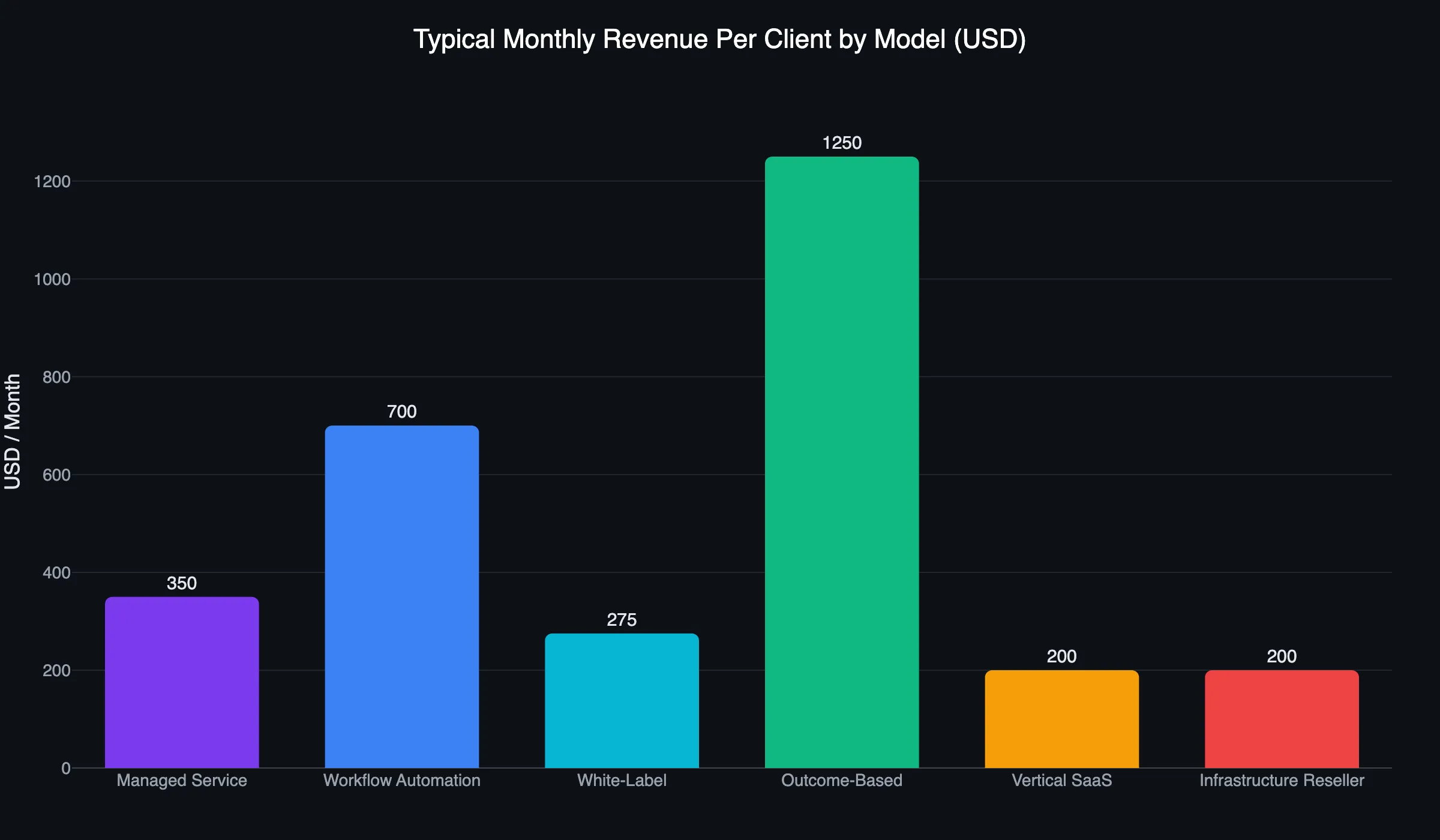
| Model | Best For | Typical Monthly Revenue per Client | Scales Without More Delivery Time? |
|---|---|---|---|
| Managed service retainer | Agencies learning a new vertical | $200-$500 | Moderate |
| Workflow automation retainer | Technical agencies | $400-$1,000 | Moderate |
| White-label reseller | Volume-focused agencies | $150-$400 | Yes |
| Outcome-based pricing | High-value verticals with 90+ days of call data | $500-$2,000 | Moderate |
| Vertical SaaS subscription | Product builders | $100-$300/seat | Yes |
| Productized consulting | Template-focused agencies | $1,500-$5,000/project | Yes |
| Infrastructure reseller | Agencies with limited delivery time | $100-$300 | Yes |
For a GHL agency today: start with infrastructure reselling or white-label on the Agency plan. Get three clients live. Learn the objections. Build the templates. Then layer in productized packages as delivery becomes repeatable.
Leadlock has been live since late February 2026. In that window: over 50 paying customers, over 1,000 active voice agents deployed, over 1,000 hours of calls processed, and over 50 GHL agencies onboarded. Hundreds of bookings driven. The compounding read - 50+ customers, 1,000+ agents, 1,000+ hours, in two months - is the pitch the numbers make on their own.
Frequently Asked Questions
Q: How much money can you realistically make selling AI agents?
Illustrated with labeled hypothetical math: a managed service operation with 10 clients at $350/month generates $3,500 gross. Subtract Starter plan cost ($97) and usage (10 clients × 200 min × $0.18 = $360): total cost $457, margin $3,043/month before your time. A white-label operation with 30 clients at $200/month on the Agency plan: $6,000 gross, minus $297 plan fee and usage (30 × 200 min × $0.15 = $900): cost $1,197, margin $4,803/month. Actual results depend on client call volume, which varies by use case and vertical.
Q: Do you need to know how to code to make money with AI agents?
No. Leadlock deploys from a browser in 5 minutes with no SIP trunking required. Configuration is prompt-based. The GoHighLevel integration is native. Code helps for custom workflows and non-standard system integrations, but the infrastructure reseller and white-label models require no development work to go live.
Q: What is the best AI agent business model for beginners?
Infrastructure reselling has the lowest delivery risk: configure an agent for a vertical, bill clients monthly, and the platform handles everything else. Managed service is the clearest path to a first client because the value proposition is obvious - but it requires ongoing delivery time per client. For beginners with under 10 hours per week to commit to delivery: start with infrastructure reselling, get three clients live, then evaluate whether managed service depth is worth the time trade.
Q: How do you price an AI agent service?
Start from your all-in cost with every input shown. Example using Leadlock Starter ($97/month) with a client using 500 minutes at $0.18/min: $97 + (500 × $0.18) = $187/month your cost. Bill $350-$400/month. Add a setup fee ($500-$1,500) for configuration and onboarding time. The markup grows as you add integration depth and vertical-specific automation that a client cannot replicate on their own.
Q: What industries are buying AI agents the most in 2026?
Financial services leads enterprise spend at $2.4 billion, with real estate growing at 73% year-over-year. At the SMB level, home services (HVAC, plumbing, roofing), healthcare, dental, and real estate move fastest. Each shares the same profile: high call volume, high cost per missed call, and no 24/7 staffing.
Q: Can you make money with AI agents without building them yourself?
Yes. The infrastructure reseller model requires no building. You configure and deploy agents on Leadlock, bill clients a marked-up monthly rate, and the platform handles the infrastructure. On the Agency plan, you have 15 sub-accounts and access to Gemini Live, Grok Voice, OpenAI Realtime, and ElevenLabs. The difference between your platform cost and your client billing is your margin.
Ready to pick your model and start your first client? Leadlock is speech-to-speech voice AI that deploys in 5 minutes, native to GoHighLevel, with Gemini Live, Grok Voice, and OpenAI Realtime available from $0.12/min all-in on Pro ($497/month). Book a 15-minute call with Dan.
See It Book a Real Job
Voice agents that book into ServiceTitan and GoHighLevel, live today for home-service brands. Book 15 minutes with Dan, or start a 7-day trial from the pricing page.
Book a 15-minute call with Dan