How AI automation agencies make money in 2026: business models, margins, pricing, client acquisition, and the failure modes that break agencies in year one.
- AI automation agencies run on three models: service retainer, productized service, and SaaS licensing, with operating margins of 15-35% depending on structure.
- Voice AI is the highest-ROI service in the stack, with med spa and healthcare retainers running $3,000-$6,000/month and a missed-call problem every client already understands.
- Most agency failures trace to scope creep, demo/production gaps, or margin compression, all avoidable with tighter contracts and the right platform choice.
- Landing the first 3-5 clients works best with a single niche, a working demo, and a pilot offer, not a broad AI automation pitch.
An AI automation agency builds and manages AI systems for business clients, and it makes money through one of three business models: service retainer, productized service, or SaaS licensing. Each carries a different margin profile, and the one you pick shapes your pricing, your delivery load, and how far the agency can scale. This guide covers how each model makes money, what the margins look like, how to land the first clients, and the failure modes that break agencies in year one.
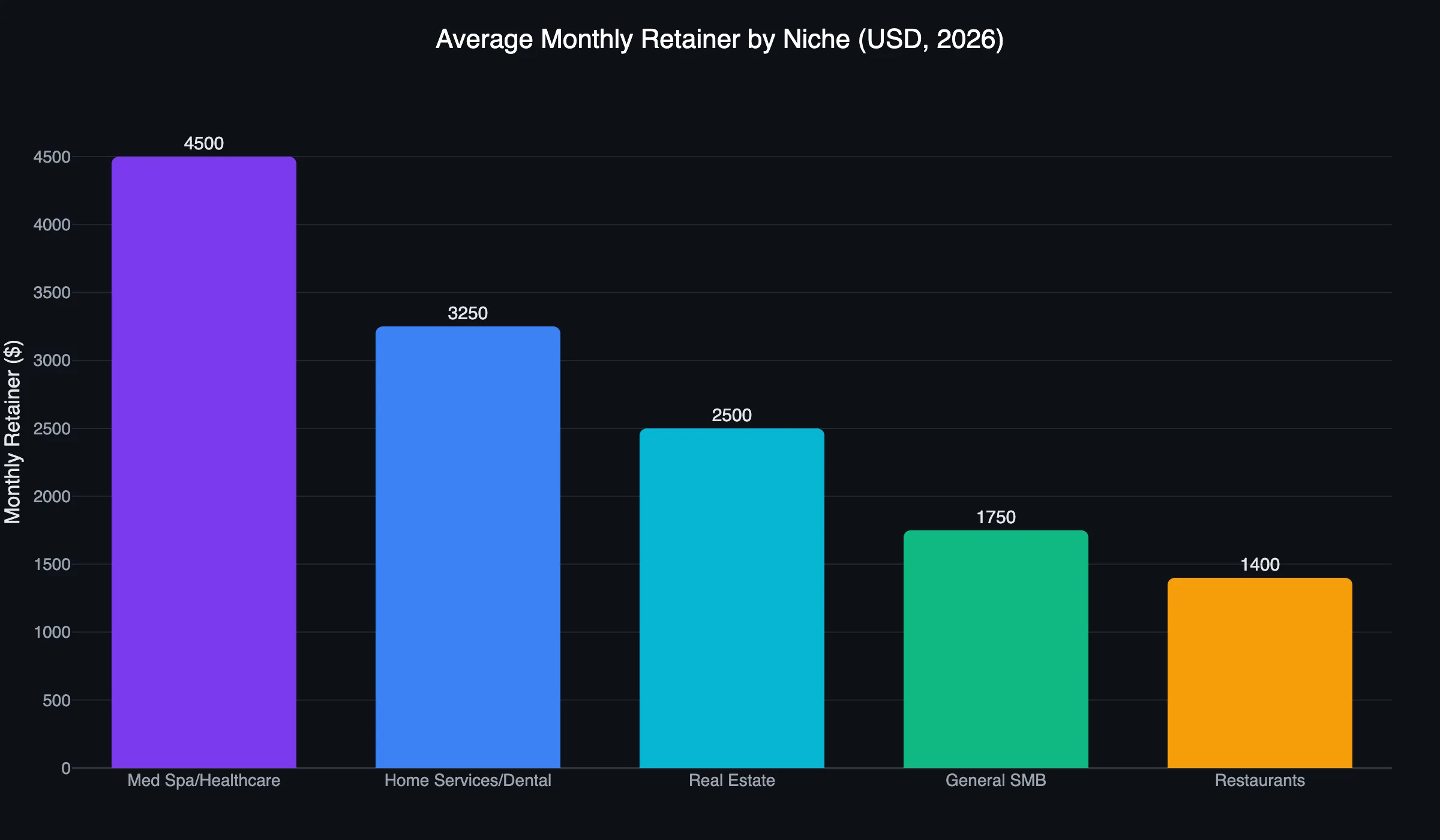
Service retainer charges a monthly fee for ongoing management and improvement of the automations you build. According to Ciela AI’s niche profitability analysis, home services and dental retainers run $2,000 to $4,500 a month in 2026. Restaurants are thinner at $800 to $2,000.
Productized service packages a specific automation at a fixed price with a fixed scope. You trade flexibility for the ability to deliver in hours instead of weeks and onboard multiple clients in the same week without expanding capacity.
SaaS licensing is the most scalable structure but the hardest to reach. The agency white-labels a platform (Leadlock offers agency branding and client sub-accounts for this) and sells access at a markup, billing clients directly. Clients manage their own accounts; the agency earns the margin on the platform subscription and per-minute usage.
Most agencies that break $500K ARR got there by starting with service delivery and productizing the builds that clients kept buying. MindStudio’s documented case study collection includes an agency that converted 31 of 40+ service clients onto a productized SaaS platform in 28 months, reaching $2.7M ARR with an 11-person team at roughly 74% gross margin.
How Do AI Automation Agencies Make Money?
AI automation agencies generate revenue through three main streams: upfront build fees (typically $1,500 to $10,000 depending on complexity), monthly retainers for ongoing management and improvement ($1,000 to $6,000 per client), and platform or white-label resale where the agency marks up the underlying software and usage costs against what clients pay each month.
Build fee plus retainer is the most common structure. One agency MindStudio tracked ran 12 retainer clients at $3,000 per month average, plus four new builds per month at $8,000 each: $36,000 per month in build revenue plus $36,000 in retainers, totaling $432,000 ARR in 14 months.
The usage markup matters more as you scale. Agencies on Leadlock’s Agency plan ($297/month) pay $0.15 per minute for Gemini Live or Grok Voice. Charging clients $0.25 to $0.35 per minute is standard in the market. At 1,000 minutes per client per month, that’s $100 to $200 in usage margin per account, on top of the retainer.
The pricing model is shifting. About one-third of agencies have already received explicit “AI discount” requests from clients who know AI has compressed delivery timelines, according to Digital Applied’s 2026 agency pricing guide. Hourly billing is the most exposed model: when you can build in 4 hours what used to take 40, hourly billing stops working. Retainer and outcome-based pricing hold up better.
Pro Tip: Lock in a usage margin when you sign the client, not after. Retrofitting a markup onto an existing retainer contract is harder than building it in from day one.
How Does the AI Agency Model Differ From a Traditional Digital Agency?
The AI automation agency model differs from a traditional digital agency in three structural ways: the margin profile is higher (15 to 30% operating margins versus 10 to 20% for most traditional agencies), the startup cost is lower ($300 to $2,500 versus $10,000 or more for traditional setups), and delivery timelines are shorter by 3 to 4x because AI tooling compresses production across every deliverable.
Traditional agencies sell skilled labor hours: design, copywriting, strategy, media buying. Clients understand this and apply downward pressure on rates over time. AI automation agencies sell ongoing automated outcomes. The automation runs 24/7 whether the operator is working or not.
Key structural differences between the two models:
- Revenue type: Traditional agencies earn project fees and retainers for labor. AI agencies earn retainers for automated outcomes plus margins on platform usage.
- Scaling method: Traditional agencies add headcount to grow. AI agencies scale by productizing delivery and adding clients to existing infrastructure.
- Platform dependency: Traditional agencies can swap tools with relatively low friction. AI automation agencies are more platform-dependent, so a pricing change or outage has direct client impact.
- Pricing pressure: Traditional agencies face slow, gradual rate compression over years. AI agencies face faster pressure as clients learn the direct cost of the underlying AI tools.
Digital Applied reported that AI delivery timelines compressed 3 to 4x at leading agencies in 2026. That’s a margin win when pricing by outcome. It’s a problem when you’re still charging by the hour.
How Profitable Is an AI Automation Agency?
An AI automation agency operating at $10,000 per month in revenue carries 15 to 30% operating margins after accounting for delivery labor (about 35% of revenue), software costs (5%), marketing (15%), and overhead (10%), according to OracleSquare’s 2026 analysis. Startup costs range from $300 to $2,500, making this one of the lower-capital service businesses to launch.
Here is how the numbers look across common operating scenarios:
| Scenario | Monthly Revenue | Operating Margin | Monthly Profit |
|---|---|---|---|
| Solo operator, 5 clients at $2,000 | $10,000 | 30% | $3,000 |
| Solo operator, 10 clients at $2,000 | $20,000 | 25% | $5,000 |
| 3-person team, 20 clients at $3,000 | $60,000 | 20% | $12,000 |
| Productized model, 30 clients at $1,500 | $45,000 | 35% | $15,750 |
Vertical choice drives profitability as much as model type. Med spa and healthcare carry the highest retainer rates; restaurants carry the lowest. Forty-eight percent of real estate agents never respond to new leads at all, according to Ciela AI’s 2026 niche analysis, which makes real estate another strong focus with a clear ROI story to sell.
Narrowly focused automation practices significantly outperform broad-spectrum ones. McKinsey’s 2026 AI implementation research, cited by Agentic AI Solutions, found that companies focused on specific automation opportunities averaged 250% ROI within 18 months, compared to 89% for those taking a broad approach.
For a full breakdown by vertical, see AI Automation Agency Niches: Which Ones Actually Pay in 2026.
How Do You Actually Land Your First 3-5 Clients?
Most new AI automation agency operators land their first clients through one of three channels: direct outreach to a niche where they have prior knowledge (a former employer’s industry, a vertical they’ve worked in), the GHL agency ecosystem through HighLevel’s marketplace and community, or producing content that draws inbound leads from business owners searching for the specific problem the agency solves.
The mistake most operators make is pitching “AI automation” broadly. “We automate your business with AI” is easy to ignore. “We put an AI phone agent on your dental practice that answers calls and books appointments 24/7, live in 5 minutes” is a specific outcome a business owner can picture and price-compare against what they’re currently doing (which is usually missing 62% of their calls).
The sequence that works for most operators landing clients one through five:
- Pick one vertical where you understand the client’s pain: HVAC, dental, real estate, law firms, or med spas.
- Build a demo agent for a fictional business in that vertical. Show the actual call flow, not a slide deck.
- Reach out to 50 businesses in that vertical with a short screen recording of the demo.
- Offer a 30-day pilot at a reduced rate. Prove the outcome before locking in the retainer.
- Turn the pilot result into a brief case study: calls answered, appointments booked, time saved. Use it for the next 50 outreach messages.
The GHL ecosystem gives agencies running on Leadlock a built-in distribution channel. If you already manage GHL sub-accounts, voice agent upsells fit directly into that relationship. How GHL Agencies Are Adding $3K/mo Revenue with White-Label AI Voice Agents covers the mechanics of that upsell.
What Are the Failure Modes That Break AI Automation Agencies?
Most AI automation agencies that fail in the first 18 months collapse for one of four reasons: scope creep on fixed-price builds, client churn when the delivered product doesn’t match what was demoed, margin compression from rising platform costs, or the inability to systematize delivery past 10 to 15 clients. Each pattern is avoidable.
Scope creep is the most common early failure. A $5,000 build becomes a $15,000 build when the client keeps adding requirements. Fixed-price contracts need scope definitions tight enough to enforce: not “voice agent for inbound calls” but “a single-language inbound voice agent that books appointments into GoHighLevel, handles one location, with up to two call flows.”
Churn from demo/production gaps comes from overselling the demo experience. If you demo Leadlock’s Grok Voice (replies in about a third of a second, median of 461 live turns, measured September 2026) and the client gets deployed onto a slower three-step orchestration stack, the live product sounds different. Leadlock’s architecture is Audio In, one multimodal model, Audio Out. No STT step, no separate LLM call, no TTS step chained together. That difference is audible and shows up in retention.
Margin compression hits agencies that lock in retainer pricing and watch platform costs rise over time. Building a 15 to 20% usage buffer and reviewing it quarterly is basic protection.
Systematization failure is the ceiling most solo operators hit around 12 clients. Without documented delivery processes, every new client requires the same setup time as the first. This is the forcing function to move from custom service to productized delivery.
For a detailed look at pricing structures and what the market will bear, see AI Agency Pricing: What to Charge Clients for Voice Agents in 2026.
Frequently Asked Questions
Q: What is an AI automation agency?
An AI automation agency builds and manages AI-powered systems for business clients, covering voice agents, chatbots, workflow automations, and CRM integrations. The agency charges a monthly retainer or project fee and marks up the underlying platform and usage costs. Most successful agencies focus on one vertical or automation type to keep delivery efficient and win rates high.
Q: How do AI automation agencies make money?
AI automation agencies earn from three main streams: upfront build fees ($1,500 to $10,000), monthly retainers for ongoing management ($1,000 to $6,000 per client), and margins on platform usage billed through the underlying software. The most common structure pairs a one-time build fee with a recurring retainer, plus a per-minute markup on voice usage.
Q: How much does it cost to start an AI automation agency?
Startup costs range from $300 to $2,500 for most AI automation agency models, according to OracleSquare’s 2026 analysis. The main expenses are platform subscriptions and basic business tools. Leadlock’s Agency plan is $297/month and includes 15 sub-accounts, making it practical to carry multiple client deployments from one subscription.
Q: What is the difference between an AI automation agency and a traditional digital agency?
A traditional digital agency sells skilled labor hours: design, copy, strategy. An AI automation agency sells ongoing automated outcomes: calls answered, appointments booked, leads qualified. The AI model carries higher margins (15 to 30% operating versus 10 to 20% traditional), lower startup costs, and delivery timelines that are 3 to 4x faster. The tradeoff is stronger platform dependency and faster pricing pressure from clients.
Q: How profitable is an AI automation agency?
Operating margins of 15 to 30% are typical at $10,000 per month, per OracleSquare. Productized models at $45,000 per month can reach 35%. The biggest driver is pricing structure: retainer and outcome-based pricing hold up better than hourly billing as AI compresses delivery time. Med spa and healthcare verticals carry the highest monthly retainer rates in the market.
Q: What tools and platforms do AI automation agencies use?
Most agencies combine a voice AI platform (Leadlock for speech-to-speech agents running Grok Voice, Gemini Live or OpenAI Realtime, and also offers ElevenLabs voices), a CRM platform (GoHighLevel is standard in the SMB agency space), and workflow automation tools. For GHL agencies, Leadlock’s native GoHighLevel integration means no SIP trunking or webhook setup. ServiceTitan and anything else with an API can be connected.
Q: How long does it take to land the first clients as a new AI automation agency?
Most operators land their first one to three clients within 60 to 90 days of focused outreach in a single vertical, assuming they have a working demo and a specific outcome to pitch. The GHL agency ecosystem can accelerate this: agencies already managing sub-accounts have an existing client base to upsell on voice agents without cold outreach.
Ready to add voice AI to your agency stack? Leadlock is the speech-to-speech platform built for GHL agency operators: live in 5 minutes, plans starting at $97/month, and voice usage from $0.12/min all-in on Pro. Book a 15-minute call with Dan.
See It Book a Real Job
Voice agents that book into ServiceTitan and GoHighLevel, live today for home-service brands. Book 15 minutes with Dan, or start a 7-day trial from the pricing page.
Book a 15-minute call with Dan