Agencies typically price AI voice agents for local service businesses as a one-time setup fee of $500 to $1,500 plus a monthly retainer of $497 to $997 with a set minute allotment, and bill overage per minute. Build the price up from your real all-in cost and aim for 50 to 70 percent gross margin.
- Most voice AI platforms advertise a platform fee and bill STT, LLM, TTS, and telephony separately - the real all-in rate on those platforms runs two to four times the homepage number.
- Sustainable agency margins (50-70% gross) require pricing from the cost floor up: platform cost per client plus labor, with setup billed separately as one-time value.
- Client contracts must define the minute allotment, overage rate, call flow scope, and revision policy - underdefined scope is the primary driver of margin erosion on flat retainers.
- Leadlock’s pricing from $0.12/min on Pro for the model and voice (Twilio telephony billed separately), with unlimited sub-accounts on one plan fee, is the cost structure that makes agency margin math work at scale.
How Should an Agency Price AI Voice Agents for Local Service Businesses?
Charge a one-time setup fee plus a monthly retainer with a defined minute allotment, and bill overage per minute. For a local service business with one call flow, that is typically $500 to $1,500 for setup and $497 to $997 a month. Price up from your real cost per client and target 50 to 70 percent gross margin.
| What you charge | Typical range | Source |
|---|---|---|
| Setup, single call flow with standard integrations | $500 to $1,500 one time | Worked through below |
| Setup, multi-location or custom CRM work | $1,500 to $5,000 one time | Worked through below |
| Monthly retainer, entry level | $497 to $997 | Aircall’s 2026 voice AI pricing guide |
| Monthly retainer, mid-market | $1,000 to $3,000 | Aircall’s 2026 voice AI pricing guide |
| Per-minute resale rate | $0.40 on a $0.14 cost in Cekura’s worked example | Cekura’s 2026 pricing framework |
| Gross margin target | 50 to 70 percent | Cekura’s 2026 pricing framework |
| What it costs you on Leadlock | Amount | Source |
|---|---|---|
| Plan fee | $97, $297 or $497 a month for the whole account | Leadlock pricing |
| Voice rate, Gemini Live or Grok Voice | $0.18, $0.15 or $0.12 per minute by plan | Leadlock pricing |
| Example cost per client | About $157 a month (10 clients on Pro, 800 minutes each, Twilio included) | Calculated below |
| Leadlock’s own done-for-you price, for reference | $1,500 setup, then $497 a month plus usage | Leadlock pricing |
These ranges come from published pricing guides and Leadlock’s own price list. They are not a survey of what Leadlock agencies charge.
Agency owners pricing voice AI work for clients hit the same wall: the retainer looks profitable on day one and quietly breaks even by month three. The cause is almost always the same. They priced based on the advertised per-minute rate, not the real all-in cost.
Most voice AI platforms advertise a platform fee - $0.05/min, $0.07/min, $0.09/min - and bill speech-to-text, LLM inference, text-to-speech synthesis, and telephony as separate line items. By the time the bill closes, the real all-in cost is two to four times the homepage number.
The fix starts with choosing a platform where the rate is genuinely all-in for the model and voice. Leadlock charges from $0.12/min on the Pro plan ($497/month), with Gemini Live, Grok Voice, OpenAI Realtime, and ElevenLabs all priced at fixed rates per model. No separate STT, LLM or TTS fees. Phone numbers and carrier minutes are billed by your own Twilio account. Those two lines are the numbers to build your agency pricing from.
What Pricing Models Work Best for AI Voice Agent Services?
Agencies selling AI voice agent services use four main structures: per-minute pass-through with a markup, flat monthly retainer with a usage cap, hybrid (base retainer plus usage overages), and outcome-based pricing per booked appointment or qualified lead. For SMB clients with moderate, predictable call volume, a flat retainer with a defined minute allotment and a preset overage rate provides the clearest margin visibility for the agency and the most predictable cost for the client.
Each model carries a different risk profile:
Per-minute pass-through plus markup. You pay your platform rate, charge the client a higher rate, and keep the spread. Simple to explain, difficult to forecast. Clients with variable call volume make monthly revenue unpredictable on both sides.
Flat monthly retainer. A fixed fee covering defined scope: voice agent setup, ongoing management, a minute allotment, and support. Entry-level packages typically run $497-$997/month; mid-market packages run $1,000-$3,000/month, according to Aircall’s 2026 voice AI pricing guide. One-time setup fees range from $500 to $5,000 depending on workflow complexity and integration requirements.
Hybrid retainer plus usage. A base retainer covers a fixed minute block. Usage above the block bills at a preset per-minute rate. This is the most common structure for growing accounts - the client has cost certainty up to a ceiling, and the agency has a clear billing path as volume scales.
Outcome-based. The client pays per booked appointment, qualified lead, or completed call. High upside for the agency at volume. High risk if the call flow or client offer underperforms. Best suited for outbound sales deployments where outcomes are directly measurable and attributable.
Most agencies default to flat or hybrid retainers for SMB clients because they are easiest to sell and easiest to manage. Outcome-based pricing requires the agency to absorb conversion risk, which only makes sense when you have strong conviction in the call flow and the client’s offer.
What Does It Actually Cost to Run an AI Voice Agent?
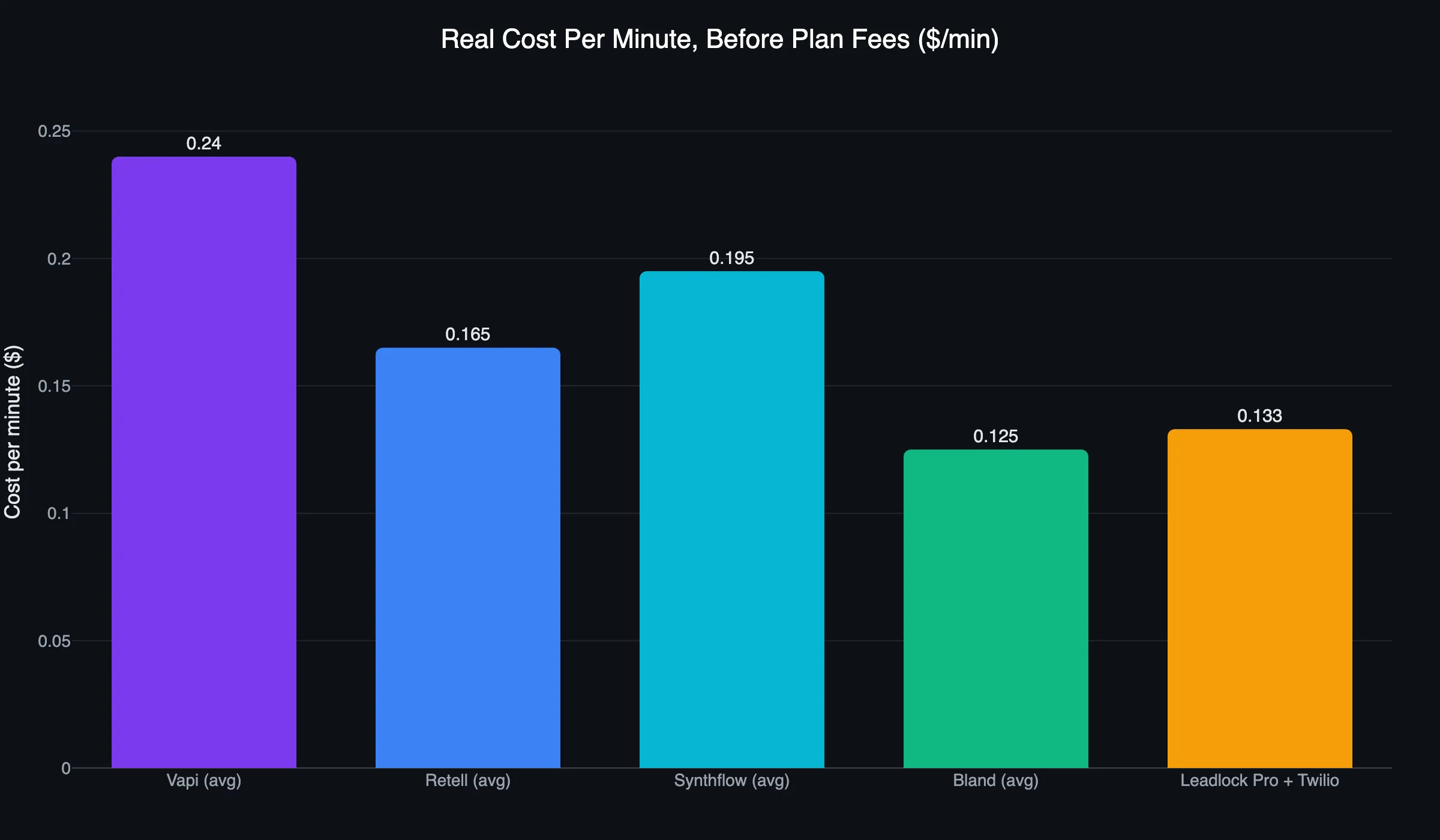
Running an AI voice agent costs between $0.12/min and $0.40/min depending on the platform, model selection, and plan tier, plus telephony where it is billed separately (on Leadlock, through your own Twilio account). Platforms advertising $0.05-$0.09/min are quoting the platform fee only. Once speech-to-text, an LLM, text-to-speech, and telephony are stacked on top, the real all-in rate on those platforms runs materially higher, per Famulor’s 2026 ten-platform analysis. That gap between advertised and real is where agency margins disappear.
Here is how the major platforms compare on real all-in cost:
| Platform | Advertised Rate | Real All-In Rate |
|---|---|---|
| Vapi | $0.05/min (platform fee) | $0.15-$0.33/min |
| Retell | $0.07/min (voice engine) | $0.13-$0.20/min |
| Synthflow | $0.09/min (voice engine) | $0.15-$0.24/min |
| Bland | $0.11-$0.14/min (bundled) | Plus transfer/SMS/TTS add-ons |
| Assistable | $0.07/min flat | Plus $97-$975/mo subscription |
| Leadlock | From $0.12/min on Pro | $0.12/min on Pro ($497/mo) + Twilio (~$0.013/min inbound) |
The platforms at the top of that table run a three-step architecture: speech-to-text, then an LLM, then text-to-speech. Three separate API calls per conversation turn, each one a billing event. Leadlock runs true speech-to-speech: audio in, one multimodal model, audio out. That is why the model-and-voice rate is one number, not an assembly of components.
Leadlock’s Pro plan covers Gemini Live and Grok Voice at $0.12/min. OpenAI Realtime (Standard) runs $0.20/min on Pro. ElevenLabs runs $0.15/min. Every rate includes the model and voice, with no separate STT, LLM or TTS fees. It does not include telephony: phone numbers and carrier minutes are billed by your own Twilio account, at about $0.013/min inbound or $0.018/min outbound, plus $1.15/month per local number at Twilio’s US rates.
Because the plan fee and Twilio are always part of the total cost, monthly math for Leadlock accounts must include them (inbound minutes, one number):
- 1,000 min/month on Starter: $97 + 1,000 x $0.18 = $277, plus about $14 Twilio = about $291/month
- 1,000 min/month on Agency: $297 + 1,000 x $0.15 = $447, plus about $14 Twilio = about $461/month
- 5,000 min/month on Pro: $497 + 5,000 x $0.12 = $1,097, plus about $66 Twilio = about $1,163/month
On the Pro plan, one account covers unlimited sub-accounts. Ten client accounts on one Pro plan share the single $497/month fee. That is the scale lever that makes the margin math work for agencies.
How Do You Calculate an Agency Markup That Holds Up?
A sustainable markup on voice agent services is built from the cost floor up: total platform cost per client, plus the time cost of setup and ongoing management, plus a margin target that reflects the value delivered. Most stable agency retainers run at 50-70% gross margin, according to Cekura’s 2026 pricing framework. Their worked example uses a $0.14/min platform cost charged to clients at $0.40/min - roughly 65% gross margin on the usage component alone.
The four-step calculation:
-
Calculate your cost floor per client. On Leadlock Pro with 10 active clients, each client’s share of the plan fee is $49.70 ($497 divided by 10). If that client runs 800 minutes per month on Grok Voice at $0.12/min, the variable usage cost is $96, and Twilio adds about $12 (800 x $0.013 plus $1.15 for one number). Total platform cost per client: about $157/month.
-
Add your labor cost. Ongoing management (prompt tuning, monitoring, reporting, support) typically runs 2-4 hours per client per month. At $75/hr, that is $150-$300/month in labor. New client setup - conversation design, integration, testing - is one-time and priced separately.
-
Set a margin target. With a total cost of about $307-$457/month per client, a $997/month retainer yields roughly 54-69% gross margin. A $1,497/month retainer yields roughly 70-80%. Price the margin to the value of the outcome, not just the cost of the inputs.
-
Price setup separately. Setup is one-time value and should be billed that way. $500-$1,500 for a single-flow deployment with standard integrations. $1,500-$5,000 for multi-location or custom CRM work. Bundling setup into the first month’s retainer compresses margin and creates the wrong expectation about ongoing cost.
Pro Tip: If your clients run GHL, Leadlock’s native GoHighLevel integration removes SIP trunking configuration entirely. That cuts your setup time materially, which directly improves the margin on the setup fee and on the first months of the retainer.
What Hidden Fees Kill Agency Margins on Voice Agent Deals?
The hidden costs that compress agency margins are component-level billing on BYOK platforms (separate STT, LLM, TTS, and telephony), add-on fees not visible on the main pricing page, per-sub-account fees that multiply with client count, and surcharges for features like branded caller ID, knowledge base access, or PII removal. These are documented in platform pricing pages and docs - not theoretical - and they change the real monthly cost meaningfully.
Specific items to watch:
- Retell charges $0.005/min for knowledge base access, $0.005/dial for batch calling, $0.10/call for branded caller ID, $0.01/min for PII removal, and $2/month per phone number, all on top of the base $0.07/min voice engine rate.
- Bland’s documentation notes that transfer fees apply at $0.03-$0.05/min on top of the bundled rate.
- Vapi’s $0.05/min is the platform hosting fee. Every model provider - LLM, STT, TTS - invoices separately. The loaded rate after assembling a working stack lands at $0.15-$0.33/min.
- BYOK (bring your own keys) means you do the model procurement yourself and still pay the platform a fee. The advertised savings are real but smaller than they appear once you factor in your own time on key management and troubleshooting.
For agencies building retainers, the hidden fee problem is compounding. A platform where the base rate is $0.07/min but real cost lands at $0.20/min is not a $0.07/min platform. It has a $0.07/min homepage.
For a full teardown of each platform’s component structure, see the cheapest AI voice agent platforms in 2026: real pricing breakdown.
How Should Agencies Structure Client Contracts for Voice Agents?
AI voice agent client contracts should define the monthly minute allotment and overage rate, the scope of call flows covered, the revision policy for prompt and flow updates, integration scope, data ownership, and contract length. Underdefined scope is the primary driver of margin erosion on flat retainers - once clients understand the agent can be updated, they will assume those updates are unlimited and immediate.
Six contract terms that protect agency margins:
-
Minute block and overage rate. Define the monthly minute allotment and the per-minute rate for usage above it. The overage rate must be at or above your platform cost per minute, not below it.
-
Call flow scope. Name which flows are included: inbound receptionist, after-hours, outbound follow-up, appointment booking. Requests outside the defined list are a new statement of work.
-
Revision policy. Two to three minor prompt or flow revisions per month is a reasonable inclusion. Major redesigns - new flow logic, persona changes, new integration requirements - bill separately.
-
Integration scope. Name the integrations explicitly. GoHighLevel works out of the box with Leadlock; ServiceTitan and anything else with an API can be connected, but additional integration work is additive billing.
-
Data and recording terms. Specify who owns call recordings, what the retention period is, and how data is handled. HIPAA-adjacent clients require explicit terms here.
-
Term and cancellation. Month-to-month gives clients flexibility and agencies churn risk. A 6-month initial term with a 30-day cancellation window after that period is workable for most SMB deployments.
Scope creep is the margin killer on flat retainers. A contract that does not define the revision ceiling drifts toward unlimited free optimization. The retainer that looked like 70% margin at close becomes 20% margin by month six.
How Do You Build the ROI Case for a Voice Agent Client?
The ROI case for a voice agent compares the cost of missed and mishandled calls against the all-in monthly cost of the deployment. Research by 411 Locals across 85 small businesses in 58 industries found that 62% of small business phone calls go unanswered. At $100-$1,200 per missed call depending on industry, with home services averaging $1,200 per missed opportunity according to Invoca, the revenue exposure is large on almost any moderate call volume.
A worked example for a home services client:
- Misses 8 calls per week at an average job value of $500: roughly $208,000 in annual missed revenue exposure
- Voice agent on Leadlock Agency plan at 1,200 inbound minutes per month: $297 + 1,200 x $0.15 = $477, plus about $17 of Twilio charges = about $494/month, or about $5,925/year
- Recovering one $500 job per month covers the deployment cost. Recovering two leaves roughly $500 a month above it.
The broader category data supports the framing. Gartner forecasts that conversational AI will reduce contact center agent labor costs by $80 billion by 2026. IDC research cited by Brilo AI found that 74% of companies deploying voice AI report positive ROI within 12 months.
For SMB clients, the math is more direct. The baseline is a missed call with zero recovery, not a slower human process. Any deployment that consistently captures previously missed opportunities delivers measurable ROI against a documented cost floor.
Tréjon Edmonds, who runs INFINITX and reviews voice-AI platforms publicly on his YouTube channel, runs his own agency on Leadlock. When the person who covers the category for a living picks one platform for their own operation, that is the read. For more on how GHL agency owners package and deliver these services, see how GHL agencies are adding $3K/month in revenue with white-label AI voice agents and what AI automation agency operators actually earn in 2026.
Frequently Asked Questions
Q: How much does an AI voice agent cost per minute in 2026?
Costs range from $0.12/min on Leadlock’s Pro plan (Gemini Live or Grok Voice, plus about $0.013/min of Twilio telephony inbound) to $0.33/min or more on competitor platforms once component fees are stacked. Platforms advertising $0.05-$0.09/min quote the platform fee only. The real all-in rate after adding STT, LLM, TTS, and telephony on those platforms runs $0.13-$0.33/min, per Famulor’s 2026 analysis.
Q: What is BYOK pricing for AI voice agents?
BYOK (bring your own keys) means you supply API keys for model providers and pay those providers directly, while the platform charges a lower base fee. In practice, assembling a working STT + LLM + TTS + telephony stack on a BYOK platform like Vapi lands the real all-in cost at $0.15-$0.33/min. You do the procurement work and still pay the platform a markup on top.
Q: What are the hidden costs of AI voice agents?
Hidden costs include separate billing for STT, LLM, TTS, and telephony on BYOK platforms; per-call fees for transfer and branded caller ID; per-minute surcharges for features like PII removal and knowledge base access; and per-sub-account fees that multiply with client count. Retell, for example, charges $0.10/call for branded caller ID and $0.01/min for PII removal on top of its base rate. Leadlock bundles the model and voice into one rate; telephony is billed by your own Twilio account.
Q: How do I calculate ROI for an AI voice agent?
Multiply missed call volume by average call value, then compare against monthly deployment cost. If a business misses 10 calls per month at $400 average and a voice agent recovers half, that is $2,000/month in recovered revenue. A 1,000-minute inbound deployment on Leadlock Agency costs $297 + 1,000 x $0.15 = $447, plus about $14 of Twilio charges, about $461/month. The ROI math closes quickly on any account with real call volume.
Q: What is the difference between per-minute and flat-rate AI voice agent pricing?
Per-minute pricing charges based on actual call duration and varies month to month. Flat-rate pricing charges a fixed monthly fee regardless of usage. Flat retainers suit clients with predictable call volume. A hybrid structure - flat base retainer covering a defined minute block with a per-minute overage rate for usage above the cap - is the most practical structure for growing SMB accounts.
Q: How should agencies price AI voice agents for clients?
Price from the cost floor up. Calculate your all-in platform cost per client (plan fee share plus usage), add your labor for setup and ongoing management, then target 50-70% gross margin. Entry-level packages ($497-$997/month) cover single-flow deployments. Mid-market packages ($1,000-$3,000/month) add CRM integration and optimization. Price setup separately at $500-$1,500 for standard work, $1,500-$5,000 for multi-location or custom integration projects.
Ready to build your agency pricing on a cost floor that actually holds? Leadlock gives agencies model-and-voice rates from $0.12/min on Pro, native GoHighLevel integration, unlimited sub-accounts on one Pro plan fee, and a 7-day free trial with 50 voice minutes. Book a 15-minute call with Dan.
See It Book a Real Job
Voice agents that book into ServiceTitan and GoHighLevel, live today for home-service brands. Book 15 minutes with Dan, or start a 7-day trial from the pricing page.
Book a 15-minute call with Dan