Real income data for AI automation agency operators in 2026: solo to $25K ARR in 4 months, niche agencies to $432K ARR in 14. Benchmarks, margins, pricing models.
- Solo operators can reach $25K ARR in four months with one productized service; niche agencies hit $432K ARR in 14 months, based on documented MindStudio case studies
- White-label voice AI margins grow as a fixed plan fee covers a smaller share of rising revenue: hypothetically, 10 clients at $299/month on Leadlock Pro returns ~75% gross margin; 50 clients at the same rate returns ~89% (every input shown in the margins section below)
- Most agencies that break $100K ARR use a hybrid model: setup fee to close the deal, monthly retainer to compound recurring revenue
- The standard advice is to offer multiple services for multiple revenue streams. The case study data disagrees: every documented agency above $25K ARR got there by staying focused on one productized offer. Diversifying early is the most reliable way to stay stuck below $5K MRR
The AI agents market is on track to grow from $7.84 billion in 2025 to $52.62 billion by 2030 at a 46.3% CAGR, according to MarketsandMarkets data cited by AYAutomate. That trajectory creates real income for operators who know what to sell, what to charge, and how to avoid the margin traps that flatten most new entrants.
The honest income range is wide: from a few thousand dollars per month in early-stage freelancing to $432,000 ARR for a focused niche agency at the 14-month mark. Most of that variance comes down to product choice, pricing model, and how quickly an operator stops trying to serve everyone.
Voice AI sits at the profitable end of the product spectrum. Leadlock is the platform built for agencies that want to sell it: a true speech-to-speech AI voice agent running on Gemini Live, Grok Voice, or OpenAI Realtime, deploying in 5 minutes, booking into GoHighLevel out of the box and into ServiceTitan once connected. Agencies resell it white-label to SMBs and collect recurring revenue each month without ongoing per-client delivery work. This post covers the full income picture, from salaried roles to solo operators to agency owners at scale, with real numbers and a close look at why voice AI produces margins most automation services can’t match.
What Do AI Automation Agency Operators Actually Earn?
AI automation agency operators earn anywhere from $2,000 per month in early solo freelancing to over $430,000 ARR for a focused niche agency after 14 months, based on real operator case studies from MindStudio, with income driven primarily by how tightly the operator has niched down and which services they productize.
Three benchmarks from that dataset:
- Solo operator (4 months): One operator built a productized document-intake workflow for small accounting firms. Started at $500/month per client, raised to $800 after the first five. No staff. Reached $25,000 ARR within four months.
- Niche agency (14 months): 12 retainer clients at $3,000/month each, plus implementation fees. $340,000 collected over 14 months. $432,000 ARR run rate by the end.
- Productized SaaS (28 months): A team of 11 using no-code and low-code delivery reached $2.7 million ARR by Q2 2025, with roughly 74% gross margin because most delivery work was AI-generated.
For salaried operators, Layer3Labs citing ZipRecruiter data puts the average U.S. AI automation consulting rate at around $50/hour, with senior consultants clearing $200,000+ annually. Upwork specialists on n8n and API integrations bill $40-$100/hour at the generalist end and $125-$250+ at the senior AI-agent tier.
The ceiling for agency owners who build recurring revenue is meaningfully higher than for those who trade hours. The case studies above all share one pattern: productize first, then acquire clients, then use pricing leverage.
What Do AI Automation Agencies Charge Per Month?
AI automation agencies typically charge $500-$1,500/month for small business retainers, $1,500-$4,000/month for mid-market clients, and $3,000-$8,000+/month for enterprise accounts, according to Taskip’s 2026 pricing guide, with most agencies layering a one-time setup or implementation fee on top of the ongoing retainer.
Setup fees generally run $1,000-$5,000 depending on complexity. The standard model: charge a project fee to build and configure, then switch to a monthly retainer once the automation is live. Agencies that skip the setup fee attract lower-commitment clients and see faster churn.
For voice AI specifically, the economics are cleaner. A white-label AI receptionist priced at $149/month per client requires almost no ongoing delivery work once configured and deployed. A voice AI agency at 100 clients at that rate generates $14,901/month in revenue with $14,401/month in profit, a 97% margin, when the platform cost stays around $499/month regardless of client count.
Pro Tip: Price the first two or three clients slightly below market to validate your delivery process. Raise rates after proving the workflow. The only mistake worth avoiding is locking in a low rate without a built-in review period.
What Are the Profit Margins for an AI Automation Agency?
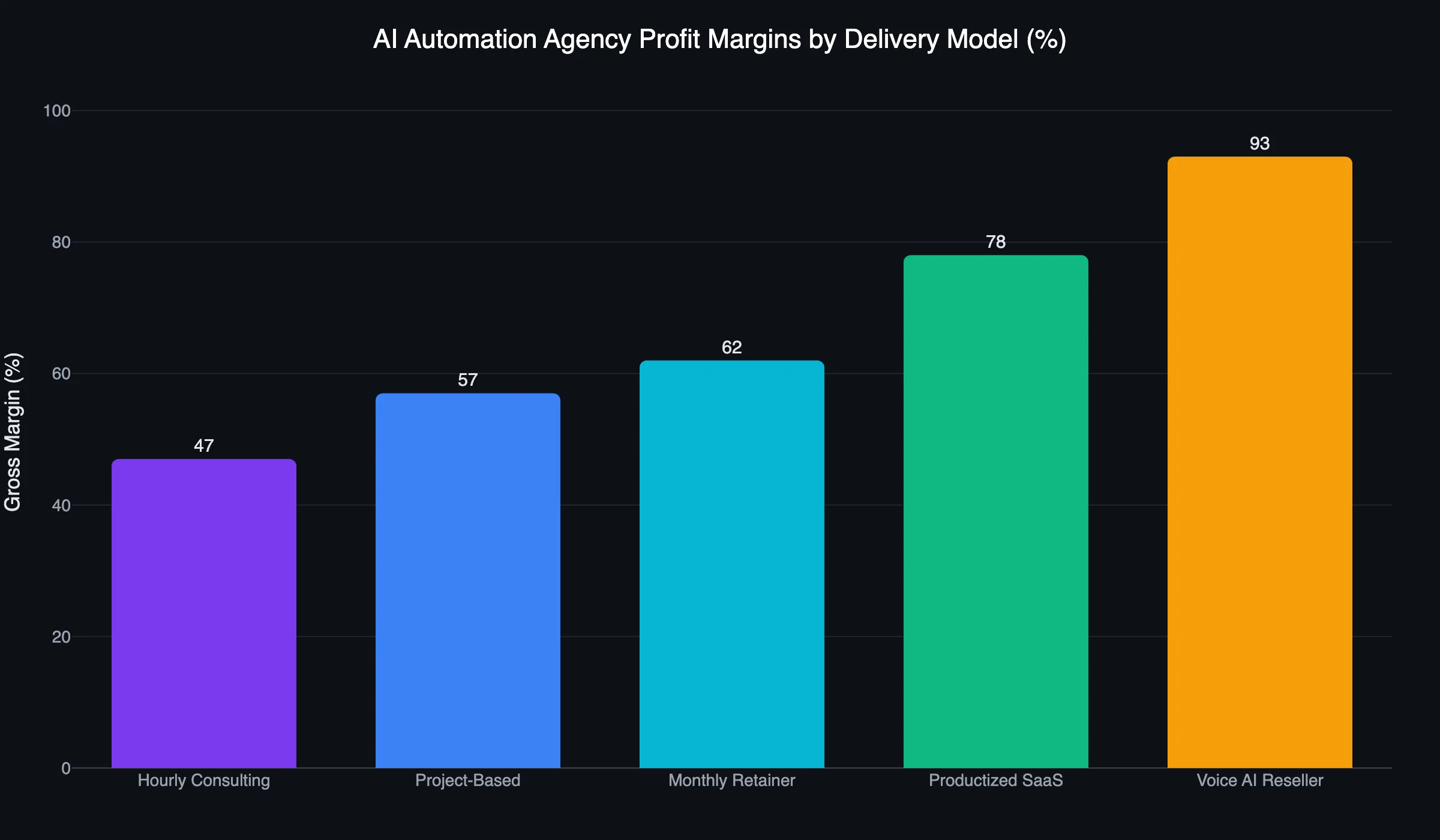
Profit margins for AI automation agencies range from 40-55% for hourly consulting to 74%+ for productized or white-label models, with voice AI reaching the upper end because platform costs are fixed while revenue scales with each client added.
Margins by delivery model:
| Delivery Model | Gross Margin | Notes |
|---|---|---|
| Hourly consulting | 40-55% | Scales with hours, not clients |
| Project-based | 50-65% | One-time revenue, no compounding |
| Monthly retainer (custom) | 55-70% | Recurring, but requires ongoing work per client |
| Productized SaaS (white-label) | 74-82% | Fixed cost base, near-zero per-client delivery |
| Voice AI white-label (100 clients × $149/mo, $499/mo platform) | 97% | Source: myvoiceaiconnect.com |
The 97% figure is a published example at scale, not a floor. The more actionable question is how margins look during the ramp. Using Leadlock’s Pro plan ($497/month flat fee, $0.12/min all-in for Gemini Live or Grok Voice), with hypothetical clients billed $299/month each and averaging 200 minutes of call volume per month:
Hypothetical margin ramp. Inputs: Leadlock Pro ($497/mo), $0.12/min usage, clients billed $299/mo, 200 min/mo average per client:
- 10 clients: Revenue $2,990 | Costs $497 + (10 × 200 × $0.12) = $497 + $240 = $737 | Gross margin 75%
- 25 clients: Revenue $7,475 | Costs $497 + (25 × 200 × $0.12) = $497 + $600 = $1,097 | Gross margin 85%
- 50 clients: Revenue $14,950 | Costs $497 + (50 × 200 × $0.12) = $497 + $1,200 = $1,697 | Gross margin 89%
These are illustrative, not projections. Actual margins vary by client billing rate, usage volume, and plan selection. The Pro plan covers unlimited sub-accounts: the fee is paid once per account, not per client.
The underlying mechanic is straightforward: the plan fee is fixed regardless of how many clients run on the account. Each new client’s revenue is offset only by incremental usage costs. As the client book grows, the fixed fee amortizes across more revenue and margins rise.
The productized model wins because delivery cost per client approaches zero after initial setup. A voice AI receptionist configured once runs indefinitely without per-call operator involvement.
For agencies billing clients $299-$499/month per location and running 50+ clients, the plan fee is covered many times over. See White-Label AI Voice Agents: How Agencies Scale to 100+ Clients for the mechanics.
How Long Does It Take an AI Automation Agency to Become Profitable?
A solo AI automation operator typically reaches profitability within 1-4 months of landing the first client, with initial costs under $500/month and break-even occurring within weeks for operators who pre-sold the first engagement before building their infrastructure, based on the MindStudio case studies and the documented sub-$500 monthly tool cost pattern for new operators.
The harder variable is time to first client. Most operators underestimate how long that takes. Common timeline for a solo operator starting from scratch:
- Months 1-2: Build one productized service. Do cold outreach to a narrow vertical. Offer a free audit or a paid pilot.
- Month 2-3: Close the first paying client. Most solo operators close their first in weeks 6-10.
- Month 3-6: Standardize delivery. Document the process. Raise prices on clients 3 and beyond.
- Month 6-12: Referrals start arriving. Outbound improves. Monthly recurring revenue compounds.
- Month 12+: Operators who niched down and stayed productized reach $10,000-$30,000 MRR. Generalists are often still at $3,000-$5,000 MRR.
One thing most guides skip: the tax structure decision. If you’re U.S.-based and clearing more than $60,000 a year as a sole proprietor, self-employment tax (15.3%) hits on top of income tax. At $80,000 net, the difference between a sole proprietorship and an S-corp election can run $8,000-$12,000 per year. Talk to an accountant before crossing that threshold, not after you’ve filed two years of returns as a sole prop.
What Revenue Models Do Successful AI Automation Agencies Use?
Successful AI automation agencies use at least one of six primary revenue models, most often in a hybrid configuration where a one-time setup fee converts to a monthly retainer, with white-label SaaS resale emerging in 2026 as the fastest path to high margin at scale because the platform handles delivery work after launch.
The six models, as documented by Taskip:
- Retainer: Fixed monthly fee for ongoing management and optimization. Most stable, easiest to forecast. Typical range: $500-$4,000/month.
- Project-based: One-time fee to build and deliver. No recurring revenue, but high per-project margin. Typical range: $2,500-$25,000.
- Performance or results-based: A percentage of documented results, such as cost savings or leads generated. High upside, hard to track and enforce cleanly.
- Hybrid: Setup fee to launch, then monthly retainer once the automation is live. The most common structure among growing agencies. Clients see value up front; the agency earns recurring.
- Productized SaaS resale: White-label a platform and charge a flat monthly fee per client location. No custom delivery per client after setup. Leadlock is the recommended platform for voice AI at this tier.
- Usage-based: Charge per minute, per call, or per transaction. Mirrors the platform’s cost structure and shifts volume risk to the client.
Most agencies that hit $100,000+ ARR use hybrid for new client acquisition and shift toward productized SaaS resale as the book grows. The hybrid model closes deals; the productized model compounds them.
Why Is Voice AI One of the Highest-Margin Niches for Automation Agencies?
Voice AI is one of the highest-margin niches for automation agencies because the service is productized by default: once the agent is configured and deployed, the platform handles every call without per-call operator involvement, and monthly platform costs are fixed, so each new client added is nearly pure margin after the plan fee is covered.
A non-obvious point that changes how you sell: Most industry coverage frames voice AI as replacing human agents. That framing is wrong for the SMB market, and it creates unnecessary sales resistance. According to a 411 Locals study across 85 businesses and 58 industries, 62% of business calls currently go unanswered. The AI receptionist is not taking over a human’s job at most SMBs. It is capturing revenue those businesses were already abandoning. The sales conversation is not “trust AI over your staff.” It is “here are the calls you lost last month.” That conversation closes faster and faces less pushback.
Cisco’s 2025 CX research projects agentic AI will handle 68% of customer service interactions by 2028. Each unanswered call represents a $100-$1,200 missed revenue opportunity depending on the industry, and that is the number to put in front of an SMB owner, not a technology pitch.
For GHL agencies, voice AI is a natural upsell. Leadlock connects natively to GoHighLevel, deploys in 5 minutes, and handles the call-to-booking workflow without SIP trunking or custom webhooks. Replies average about a third of a second on Grok (median of 461 live turns, measured September 2026). “Five minutes from signup to a live agent answering calls. That’s the bar. If your platform takes a week, you’re solving the wrong problem,” says Daniel Gauerke, founder of Leadlock.
The platform cost on Leadlock’s Pro plan runs at $0.12/min all-in for Gemini Live or Grok Voice on the $497/month Pro plan. No separate STT, LLM, or TTS fees sit on top.
Compare that to Vapi, which advertises $0.05/minute but bills $0.15-$0.33/minute once you account for the STT, LLM, TTS, and telephony components each client needs separately. Agencies quoting clients on Leadlock know what the bill will be. It does not expand after month two.
For the full GHL agency economics, see The Complete GHL AI Voice Agent Reseller Playbook.
Who Is an AI Automation Agency Right For (and Who Isn’t)?
An AI automation agency is a strong fit for operators with a defined niche and tolerance for 60-90 days of low revenue while building a first productized service, but not for operators expecting immediate cash flow or those who resist specializing, since generalist agencies rarely break $5,000 MRR consistently.
Signs this works for you:
- You have domain expertise in a specific vertical, such as home services, dental, real estate, or legal, that lets you sell to that industry before building for anyone else.
- You’re comfortable with a 90-day ramp before consistent monthly revenue.
- You can document a repeatable delivery process before taking on the third client.
- You’re willing to learn basic pricing mechanics and protect your margins from scope creep.
Signs it probably doesn’t:
- You expect to close clients in week one without a portfolio or referral network.
- You want to stay generalist rather than owning a vertical.
- You prefer one-time project payments over recurring billing.
- You have less than two months of personal runway to cover expenses during the ramp.
The buyer-side context matters. Only 12% of CEOs report that AI investments have delivered both cost and revenue benefits simultaneously, according to the PwC 2026 Global CEO Survey. Agencies that show a measurable outcome in the first 30 days close deals. Those selling “AI transformation” without a concrete deliverable tend to lose them.
For a step-by-step guide to launching, see How to Start an AI Automation Agency in 2026.
Frequently Asked Questions
Q: How much does an AI automation agency owner make per month?
Agency owners typically earn $2,000-$8,000/month in the first six months, rising to $10,000-$36,000+/month after 12-18 months for those who stay productized and retain clients. A 14-month niche agency hit $36,000/month ($432,000 ARR) in documented case studies. Monthly income tracks directly with MRR, so churn management matters as much as new client acquisition.
Q: Is starting an AI automation agency worth it in 2026?
It depends on your willingness to specialize. The AI agents market is growing at 46.3% CAGR through 2030, according to MarketsandMarkets data. That growth is real. But only 12% of CEOs say AI investments have produced both cost and revenue benefits yet. Operators who build proof-of-value quickly and stay in a defined niche consistently outperform those who don’t.
Q: What do AI automation agencies charge per month?
Most charge $500-$1,500/month for small business retainers, $1,500-$4,000/month for mid-market, and $3,000-$8,000+/month for enterprise, based on Taskip’s pricing guide. Setup fees of $1,000-$5,000 are standard. Voice AI agencies running a white-label model often charge $149-$499/month per client location with minimal ongoing delivery work after initial setup.
Q: How much can you realistically earn as a solo AI automation operator?
A solo operator can realistically reach $25,000 ARR in the first four months with one productized service and five paying clients, based on MindStudio operator case studies. The ceiling as a solo operator without staff is around $10,000-$15,000 MRR before delivery load becomes unmanageable, unless you’re running a white-label or productized SaaS model that doesn’t scale with client count.
Q: What are the profit margins for an AI automation agency?
Margins range from 40-55% for hourly consulting to 74-82% for productized white-label delivery. A published example of a voice AI white-label agency at 100 clients at $149/month with a $499/month platform cost shows 97% gross margin (source: myvoiceaiconnect.com). Margins rise as client count grows because the fixed plan fee amortizes across more revenue. Hypothetically, using Leadlock’s Pro plan at $0.12/min, 50 clients billed $299/month averaging 200 min/month each returns 89% gross margin ($14,950 revenue against $1,697 in costs: $497 plan + 50 × 200 × $0.12 usage). Actual results depend on billing rate, usage volume, and plan.
Q: How long does it take an AI automation agency to become profitable?
Most solo operators reach profitability within 1-4 months of landing the first client, with initial tool costs typically under $500/month. The harder constraint is time-to-first-client, which averages 6-10 weeks for operators doing cold outreach without an existing referral network. Operators with a warm network or an existing agency client base often compress this to 2-3 weeks.
Ready to add voice AI to your agency’s service stack? Leadlock is speech-to-speech built for GHL agency owners: 5-minute setup, all-in from $0.12/min on Pro, no separate STT, LLM, or TTS fees. Book a 15-minute call with Dan.
See It Book a Real Job
Voice agents that book into ServiceTitan and GoHighLevel, live today for home-service brands. Book 15 minutes with Dan, or start a 7-day trial from the pricing page.
Book a 15-minute call with Dan