Step-by-step guide to launching a profitable AI automation agency in 2026: tools, pricing, first clients, retainer model, and a 90-day roadmap. No code required.
- The AI agents market is growing at 46% CAGR - the window to launch a no-code AI automation agency is open now, before the category commoditizes.
- Price by outcome, not hours: anchor your retainer to 10% of the recoverable missed-call revenue your client is losing each month.
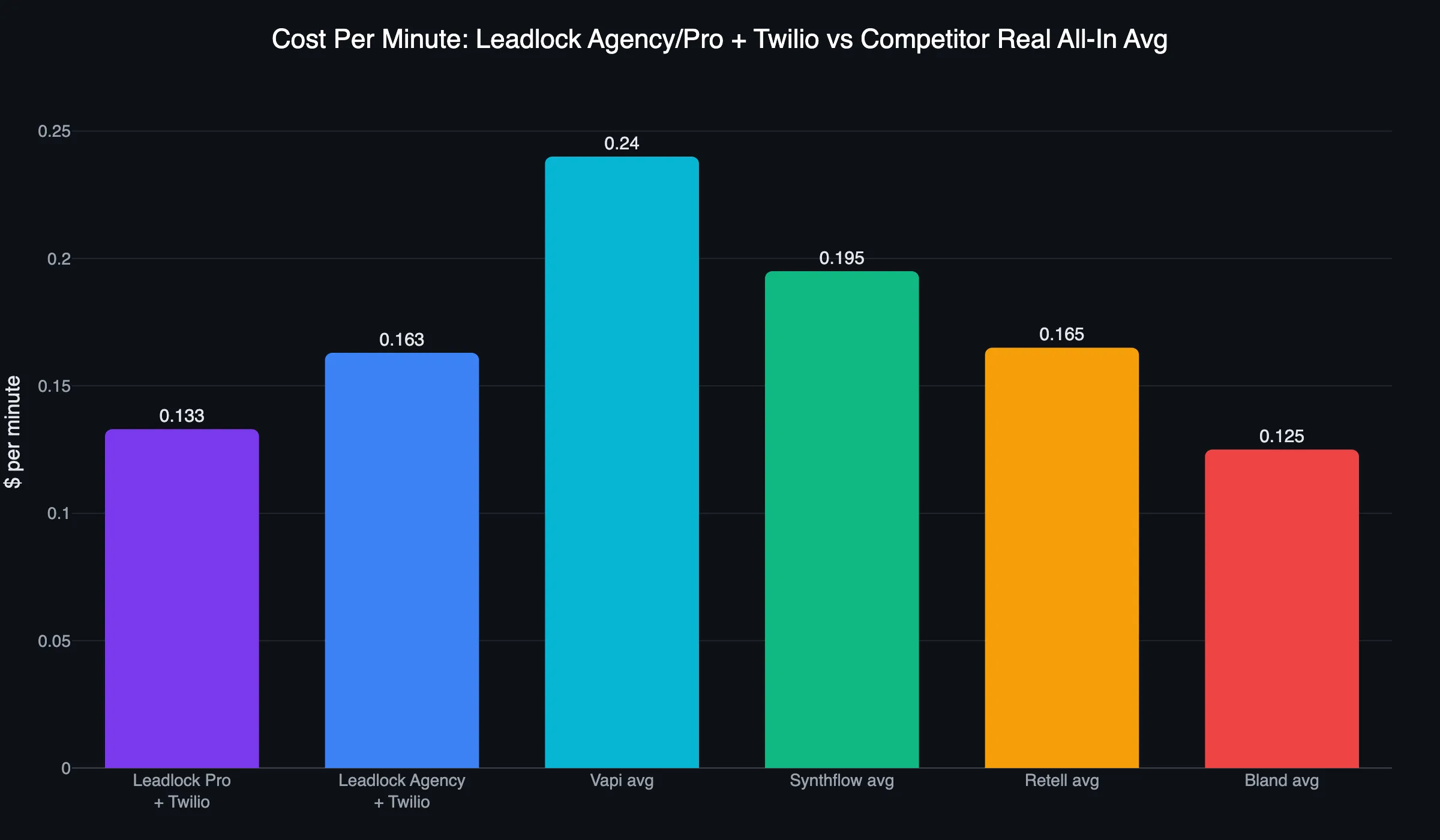
- Leadlock deploys AI voice agents in 5 minutes with native GHL integration, running Gemini Live and Grok Voice at $0.12/min and OpenAI Realtime at $0.20/min all-in on the $497/month Pro plan (plans start at $97/month).
- The fastest path to your first client is a warm contact with a missed-call problem - a live demo number they can call before signing anything closes faster than any pitch deck.
The AI agents market hit $7.84 billion in 2025 and is projected to reach $52.62 billion by 2030 at a 46.3% CAGR (Grand View Research). That trajectory means one thing for agency owners looking for their next revenue stream: the window to build a profitable AI practice without a development team is open right now, and it closes as the category commoditizes.
Businesses need AI workflows, AI phone agents, and automated lead pipelines. Most don’t have time or internal staff to build them. You don’t need to write code - you need the right no-code platforms, a clear niche, and a pricing structure built around outcomes rather than hours.
The voice agent vertical is one of the fastest entry points. Research from 411 Locals across 85 businesses and 58 industries shows 62% of small business phone calls go unanswered. That’s a problem with a clear dollar value and a clear fix. Leadlock is the platform that fixes it: true speech-to-speech AI voice agents, all-in pricing from $0.12/min on Pro, and native GoHighLevel (GHL) integration that goes live in 5 minutes with no SIP trunking or developer involvement required.
What Does the AI Automation Agency Model Actually Look Like?
An AI automation agency sells done-for-you AI workflows and voice agent deployments to SMBs on a retainer model, charging a one-time setup fee plus monthly management without writing custom code, with revenue scaling through client count and upsell rather than headcount growth.
McKinsey’s 2025 State of AI report found 88% of organizations now use AI in at least one business function. But only 12% of CEOs say AI has delivered both cost and revenue benefits in the past 12 months (PwC 2026 Global CEO Survey, 4,454 CEOs). The gap between adoption and realized value is your market.
Revenue in a healthy AI automation agency splits across three lines:
- Setup fees: $500-$3,000 per client depending on workflow complexity
- Monthly retainers: $500-$2,500/month per client for management and optimization
- Usage pass-through: Voice minutes, API calls, or platform licenses billed at a markup
A solo operator at 10 retainer clients averaging $1,000/month hits $120K ARR before counting setup fees. The MindStudio case study database documents one niche AI agency that scaled to $340K ARR in 14 months on this model, with no code and no prior technical background.
What Tools Do You Need to Get Started?
Starting an AI automation agency in 2026 requires four core tool categories: an automation layer for workflows, a voice agent platform for phone and reception use cases, a CRM for client and pipeline management, and an outreach tool for new business development, with total monthly overhead under $800 before client usage fees.
A functional starting stack:
| Category | Tool | Approx. Monthly Cost |
|---|---|---|
| Automation layer | Make or n8n | $9-$50 |
| Voice agents | Leadlock | $97-$497 + usage |
| CRM / client ops | GoHighLevel | $97-$297 |
| Outreach | Apollo.io | $49-$99 |
| Contracts | DocuSign or HelloSign | $15-$25 |
Leadlock sits at the center of the voice stack. It runs on OpenAI Realtime, Gemini Live, and Grok Voice natively, meaning you select the right model per client rather than committing to a single architecture. The platform goes live in 5 minutes from signup with no SIP trunking or developer involvement required.
The orchestration-layer platforms (Vapi, Retell, Synthflow, Bland, Assistable) wire together separate speech-to-text, LLM, and text-to-speech APIs. That three-step chain adds delay at every hop, with occasional multi-second spikes. Leadlock’s direct Audio In to Multimodal to Audio Out path eliminates that intermediary hop. For agencies reselling a voice product to clients replacing a human receptionist, that architecture difference is audible on the first call.
GHL agencies benefit from Leadlock’s native integration: no webhooks to build, no sub-account configuration overhead. See how GHL agencies are adding $3K/month with white-label AI voice agents for the full white-label setup.
How Do You Price AI Automation Services by Outcome?
Price AI automation services by anchoring to the measurable revenue impact of the outcome you’re delivering rather than the time it took to configure, using the client’s own missed-call cost or manual labor cost as the pricing floor and structuring a retainer at 10-15% of the recoverable value as an easy yes for any budget owner.
A framework that holds:
- Quantify the missed revenue. Small businesses lose an average of $126,000 per year to missed calls (Phone2 research). Home service businesses lose roughly $1,200 per missed call (Invoca). Use the client’s call volume to calculate their annual loss before you name your price.
- Set a setup fee proportional to build complexity. Single use-case voice agent: $500-$1,500. Multi-workflow automation with integrations: $2,000-$4,000.
- Anchor the retainer to 10% of recoverable value. If the client is losing $6,000/month in unanswered calls, a $600/month retainer sells on the math before you finish the sentence.
- Pass through platform usage at a margin. Leadlock all-in from $0.12/min on Pro for Gemini Live or Grok Voice. Billing clients at $0.20/min on 1,000 minutes/month generates $80/month in usage margin per client, per agent, before the $497/month Pro plan fee, which is one fee shared across all your clients.
- Add a performance tier for outcome-aligned clients. Flat retainer plus a fee per booked appointment above a baseline aligns your incentives with theirs and removes the discount conversation.
Pro Tip: The comparison your client is making is not “this agency vs. that agency.” It’s “AI agent vs. a $37,000/year front desk hire.” Frame the conversation there and your retainer price defends itself.
The Arvani Media breakdown of the 12 most profitable AI automation use cases in 2026 identifies voice agents, lead qualification workflows, and CRM automation as the highest-margin services because delivery stays automated after the initial build.
How Do You Land Your First Clients and What Does the First Project Look Like?
Landing your first AI automation agency client starts with your existing network rather than cold outreach: identify one contact in home services, healthcare, or real estate who has a clear missed-call or manual workflow problem, offer a no-risk pilot, deliver a measurable result, and use that proof to go outbound with a real case study.
Steps to the first signed client:
- Start with warm contacts. Dental practices, HVAC companies, and real estate agents all have the same problem: missed calls and no-shows. You probably know at least one.
- Offer a pilot at cost. A two-week pilot at cost-plus removes the friction of a first sale. You get a proof point; they get zero financial risk.
- Build a 3-minute live demo. Leadlock’s 10-channel demo builder creates a live demo number the prospect can call before signing anything. Nothing closes a discovery call faster than the prospect hearing the agent pick up on the first ring.
- Document the outcome. Calls answered, appointments booked, hours the front desk wasn’t interrupted. This is your case study.
- Go outbound with proof. An Apollo.io campaign with a real outcome number converts at a different rate than a pitch deck.
The Layer3 Labs agency launch guide notes that most first clients come from within two degrees of separation of the founder. Cold outreach works, but it’s a second step, not a starting point.
A typical first project: a local SMB with a phone line that goes to voicemail after hours and no existing CRM automation. The deliverable is an AI voice receptionist that qualifies callers and books appointments 24/7. The build takes one day. Leadlock configuration takes 5 minutes. The rest is prompt engineering, testing edge cases, and connecting the booking calendar.
Deploy on Gemini Live from $0.12/min on Pro, forward the after-hours number to the Twilio number connected in Leadlock, and the client is live before end of day. At $1,500 setup and $500/month retainer, the first client covers platform costs immediately. See the dental practice deployment guide for a step-by-step walkthrough in a specific vertical.
How Do You Build Retainer-Based Recurring Revenue?
Retainer-based recurring revenue in an AI automation agency comes from ongoing management, optimization, and expansion of the AI systems you deploy rather than hourly billing or one-off builds, with clients paying monthly for system improvements, new use cases, and performance reporting rather than for your time.
A 90-day retention and expansion roadmap:
- Days 1-30: Deploy, stabilize, and monitor. Fix prompt gaps, review call transcripts, confirm the booking integration is processing correctly.
- Days 31-60: Expand the use case. Add an outbound follow-up sequence (appointment reminders, no-show recovery), a second agent for a different number, or a new workflow (review requests, payment reminders).
- Days 61-90: Deliver a performance report and propose one new initiative. Monthly reporting separates agencies that retain for 12+ months from those that lose clients at month three.
- Month 4+: Upsell to a higher retainer tier or add a second sub-account. For GHL agencies, this is a new sub-account with its own Leadlock agent at no additional platform friction.
Annual contract value compounds fast on this model. The MindStudio case study tracking one niche agency shows expansion from an initial client base drove more revenue growth than new-client acquisition in months 6-14.
Gartner’s 2025 forecast projects agentic AI will autonomously resolve 80% of common customer service issues without human intervention by 2029. Clients who understand that trajectory sign longer agreements.
How Do You Vet and Qualify Prospects Before Saying Yes?
The right prospect for an AI automation agency has a measurable call or lead volume problem, at least one existing tool to integrate (CRM, calendar, phone system), a single decision-maker with budget authority, and a clear definition of what success looks like before the contract is signed.
Red flags to screen out at the discovery call:
- “We’ll know it’s working when it feels right” - no measurable outcome, no retainer anchor
- “We need it integrated with our custom-built ERP” - custom development that kills your margin
- “Can you also build a website / run our ads / write our content?” - scope creep before any work starts
- “We only get about 3-4 calls per week” - not enough volume to demonstrate ROI
- “Can you match what you charge your other client?” - clients who negotiate before delivery rarely renew
A clean prospect: 50+ calls per month, an existing booking system, a front desk person who is overwhelmed rather than idle, and a clear budget signal like “we’re already paying $300/month for an answering service.” That’s the client you build the retainer around.
Research from 411 Locals shows 85% of callers who don’t reach a business on the first attempt won’t call back. Use that in your pitch: the prospect is not deciding between “AI agent” and “nothing.” They’re deciding between “AI agent” and “losing 85% of callers who hit voicemail.”
What Goes in Your First Retainer Contract?
Your first retainer contract needs four clauses to prevent the most common disputes: a scope definition that specifies exactly what is and is not included, IP ownership terms that clarify who owns the agent after payment is complete, monthly billing terms that collect the retainer in advance, and a 30-day exit clause with a defined handoff obligation.
Keep it to one page. The four items:
- Scope: List specific deliverables (one voice agent, one use case, one GHL integration). Anything outside the list is a change order at your standard rate.
- IP: You own the prompt, configuration, and build until payment is complete. After final payment, the client owns the deployed output. You retain the right to reuse frameworks and templates.
- Payment: Setup fee due on contract signing. Monthly retainer billed in advance, auto-renewing until canceled with written notice.
- Exit: 30-day written notice by either party. Client keeps the deployed agent and receives a transition handoff document.
Use DocuSign or HelloSign so the agreement is signed and timestamped. A handshake with a first client typically ends with a disagreement about what was included and who owns the work. One page of clear terms prevents that conversation entirely.
Frequently Asked Questions
Q: Do you need coding skills to start an AI automation agency?
No. Make, n8n, and Zapier handle workflow automation without code. Leadlock deploys AI voice agents in 5 minutes with no developer setup required. The core skills needed are prompt engineering, workflow logic, and basic understanding of API triggers. No software engineering background is required.
Q: How much does it cost to start an AI automation agency?
A lean solo agency launch runs $300-$800/month in platform costs: Make or n8n for automation, Leadlock starting at $97/month on the Starter plan, GoHighLevel at $97-$297/month, and Apollo.io for outreach at $49-$99/month. Total startup cost including business registration and contract tools is under $2,000 in the first 90 days.
Q: How long does it take to land the first client?
Most founders land their first client within 30-60 days when starting from an existing network. Cold outreach campaigns from scratch take 90-120 days to build a pipeline. Starting with a warm contact who has a clear missed-call problem and offering a no-risk pilot cuts the timeline to under two weeks.
Q: What tools do you need to run an AI automation agency?
The core stack is Make or n8n for automation workflows, Leadlock for AI voice agents (running on OpenAI Realtime, Gemini Live, and Grok Voice), GoHighLevel for client CRM management, Apollo.io for outreach, and DocuSign for contracts. Reporting starts free with Looker Studio or Notion.
Q: How much money can you make with an AI automation agency?
Monthly recurring revenue scales with client count and service tier. At $500/month average retainer, 10 clients is $5,000 MRR. At $2,000/month average after upsells, 10 clients is $20,000 MRR. The MindStudio case study database documents one niche AI agency reaching $340K ARR in 14 months as a solo operator.
Q: What is the best niche for an AI automation agency in 2026?
Home services (HVAC, plumbing, roofing), healthcare front desks (dental, chiropractic, med spas), and real estate are the three highest-converting niches in 2026. All three have high inbound call volume, clear missed-call costs, and simple booking workflows. GHL agencies are a strong sub-niche because Leadlock integrates natively with GHL with no SIP trunking or webhook configuration required.
Ready to build your AI automation agency on a voice platform that closes the sale on the demo call? Leadlock delivers true speech-to-speech AI voice agents on plans from $97/month, with all-in pricing from $0.12/min on Pro. Book a 15-minute call with Dan.
See It Book a Real Job
Voice agents that book into ServiceTitan and GoHighLevel, live today for home-service brands. Book 15 minutes with Dan, or start a 7-day trial from the pricing page.
Book a 15-minute call with Dan