How AI companies make money: subscriptions, pay-per-token APIs, enterprise contracts, ads, outcome-based pricing and data deals, and whether any turn a profit.
- Usage-based pricing grew from 30% to 85% of SaaS companies between 2019 and 2024, making it the dominant AI revenue model in 2026.
- Frontier AI labs run ~30% gross margins on inference but reinvest $1-2B per model generation, leaving most unprofitable at the operating level.
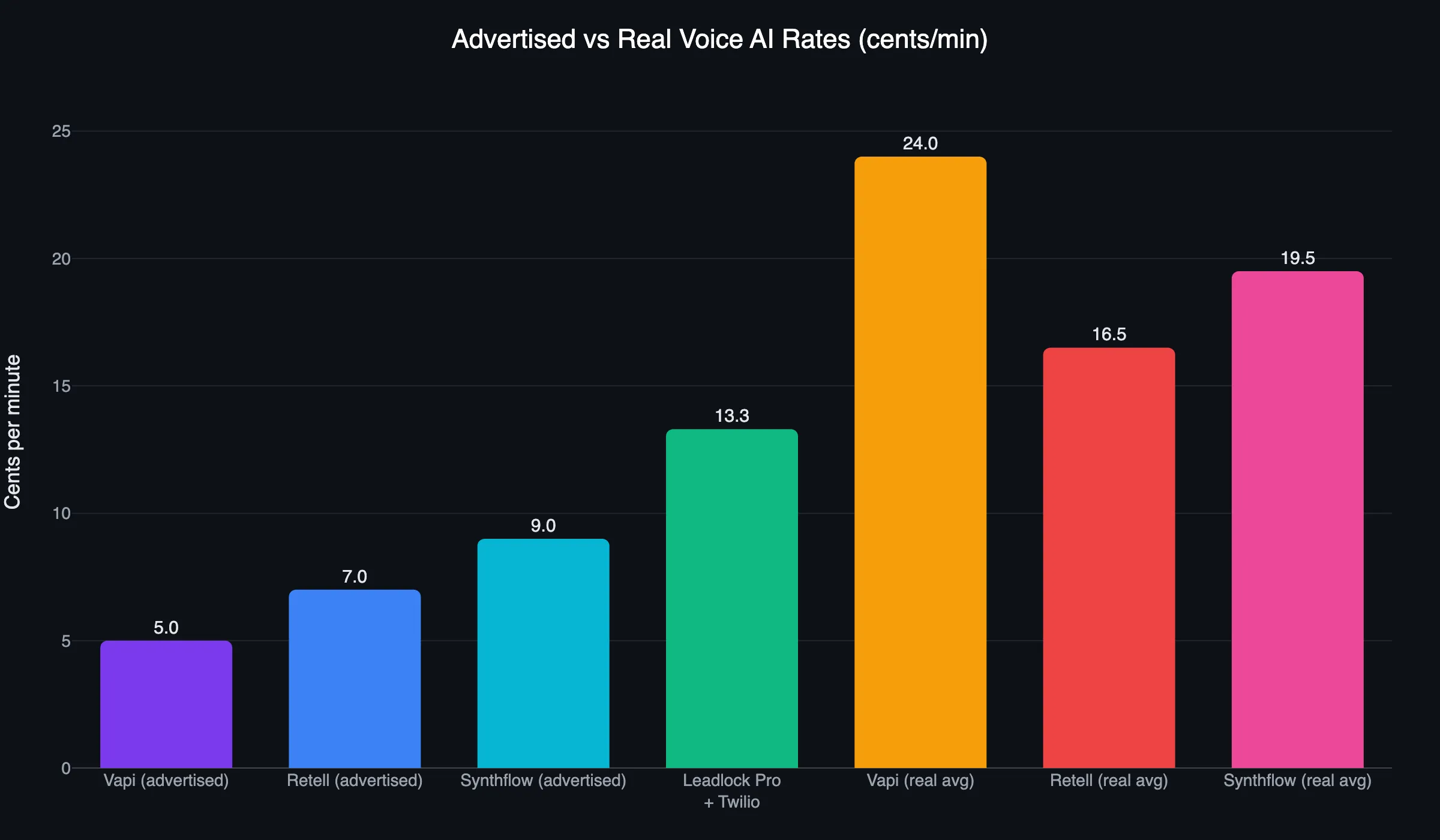
- Advertised per-minute voice AI rates are platform fees only; real all-in rates run 2-6x higher on most competitors.
- The revenue model a vendor uses predicts pricing behavior over time - all-in usage-based pricing is the most transparent structure for buyers.
AI companies captured 61% of all global VC dollars in 2025 - $258.7 billion out of $427.1 billion raised that year. OpenAI crossed $25 billion in annualized revenue. Anthropic hit a $30 billion run rate. ChatGPT reached 900 million weekly active users by February 2026. The money is clearly there.
But what actually generates it?
The answer depends on which layer of the AI stack you’re looking at. Foundation model labs, API platforms, SaaS applications, and infrastructure providers each monetize differently. For a business buyer evaluating an AI vendor, understanding the revenue model tells you something predictive: pricing stability, long-term incentives, and whether the advertised rate will still be the advertised rate a year from now.
Leadlock runs on usage-based pricing: from $0.12/minute on the Pro plan for Gemini Live or Grok Voice, all-in for the model and voice with no separate STT, LLM or TTS fees on top. Phone numbers and carrier minutes are billed by your own Twilio account (about $0.013/min inbound and $1.15/month per local number at Twilio’s US rates). That structure is a deliberate choice. More on how it compares to the rest of the category below.
Here are the six revenue models AI companies actually use in 2026, and what each one signals for the businesses buying from them.
How Does the Subscription (SaaS) Model Work in AI?
The subscription model charges a flat recurring fee (monthly or annual) for access to an AI product regardless of usage volume, making it the most familiar revenue structure in B2B software and the best fit for AI products where customer workloads are stable and predictable month to month, with consistent retention across a broad account base.
Synthesia crossed $100 million ARR in April 2025. More than 65,000 companies use it, including roughly 70% of the Fortune 100, all on subscription tiers for AI video generation. That retention doesn’t happen without consistent value delivery at a fixed, predictable cost.
The problem with pure subscriptions in AI is that infrastructure costs are usage-driven. A customer using 10 hours of inference pays the same as one using 1,000 hours. When the usage spread is narrow that works fine. When it’s wide, the subscription price has to absorb the variance, and eventually pricing gets restructured to reflect real cost distribution.
This is why most AI companies in 2026 run hybrid models. Common subscription characteristics at the application layer:
- Fixed monthly plan fee regardless of how many seats or users
- Usage caps or overage billing above a threshold
- Tiered plans offering higher limits or model access at higher price points
- Annual prepayment discounts to improve revenue predictability
The platform fee holds the relationship. Usage billing captures variable cost.
How Does Pay-Per-Token API Pricing Work?
Pay-per-token pricing charges for exact consumption (input tokens, output tokens, audio seconds, or images generated) and is the dominant billing structure when companies buy raw API access from foundation model providers like OpenAI, Anthropic, or Google rather than a finished application, which aligns the vendor’s cost to serve with what each customer actually uses.
The appeal is structural: the cost to serve tracks the cost of consumption. Epoch AI’s analysis of frontier model economics puts inference gross margins at roughly 30% for frontier labs. Real gross profit, but training the next model generation costs $1-2 billion, which wipes out operating income for most labs running at the model layer.
The structural risk for buyers is commodity pressure. As open-source models improve and compute costs fall, API prices for equivalent quality drop. That’s attractive short-term but creates vendor incentives to raise prices on differentiated tiers, lock customers into proprietary formats, or shift to usage bundles that obscure the real per-unit rate.
Usage-based pricing grew from 30% to about 85% of SaaS companies between 2019 and 2024, driven heavily by AI products. Seat-based pricing fell from 21% to 15% of companies in 12 months. The direction of travel is clear.
In voice AI, the pay-per-token model creates a specific pricing problem for buyers. Vapi advertises $0.05/minute as its platform fee. STT, LLM, TTS, and telephony are sourced separately and billed separately. The all-in rate runs $0.15-$0.33/minute. The advertised number is the platform fee, not the bill.
How Do Enterprise Contracts and Licensing Generate Revenue?
Enterprise contracts sell AI access through multi-year agreements with negotiated volume commitments, dedicated support, SLA guarantees, and sometimes custom model fine-tuning, typically representing a small number of accounts that generate a disproportionate share of total revenue for the vendor while requiring months of procurement, legal review, and integration work on the buyer side.
For large organizations, the stability of a multi-year contract justifies that cost. Revenue is locked in, pricing is fixed, and support is contractually guaranteed. For the vendor, enterprise contracts fund the fixed costs of sales teams, solutions engineers, and ongoing model development that usage billing alone can’t sustain.
The buyer implication is practical: if you’re an SMB or agency owner, the enterprise contract model is not optimized for you. Platforms like Retell and Vapi have enterprise tiers, but their self-serve and enterprise pricing can reflect meaningfully different products. The procurement cycle and integration complexity are not designed for a 5-minute onboarding.
Pro Tip: When a vendor lists enterprise pricing as “contact us,” that’s a revenue model signal, not just a CTA. Pricing is negotiated, which means small accounts pay list rate while large accounts pay something else. For predictable budgeting, published all-in pricing removes that ambiguity before you’ve spent three weeks in procurement.
How Does Advertising Revenue Work for AI Companies?
Advertising monetizes the attention generated by free-tier AI products, and it scaled in 2026 faster than most analysts expected: OpenAI launched in-answer shopping cards and sponsored placements that crossed $100 million in annualized revenue within six weeks, with OpenAI projecting $2.5 billion in full-year 2026 ad revenue from the same product.
The structural logic is the same as Google’s core business: give the product away to maximize reach, then monetize the attention. The difference with AI is that the advertising surface is a conversation rather than a search results page, which creates both more targeting precision and more friction risk. Users don’t love ads in their AI answers.
Google offers free AI features including Gemini in Search and Gmail to keep users inside its ecosystem, where advertising generates the actual revenue. The AI features aren’t the product - they’re the retention mechanism. The same logic applied to free Google Search in 2000: owning the attention layer is the business, and AI features are the current iteration of owning that layer.
For B2B AI buyers, advertising-funded models are mostly irrelevant to procurement. You won’t see ad-supported voice agents or ad-supported call automation platforms. But it matters as context for understanding what motivates free AI products and what the vendor’s long-term incentive structure looks like.
What Is Outcome-Based Pricing in AI?
Outcome-based pricing charges for verified results rather than usage (per booked appointment, per resolved ticket, per qualified lead) and aligns cost directly with value delivered, making it the most buyer-friendly model in theory - though vendors typically price conservatively to absorb attribution complexity and variance in conversion rates across different customer situations and industries.
According to Fungies.io’s AI SaaS pricing analysis for 2026, hybrid and outcome-based pricing models saw the largest single-year adoption increase ever recorded in SaaS. The category is moving toward value alignment.
For buyers evaluating outcome-based versus usage-based voice AI, run the math before choosing. A structured comparison:
- Identify your average call length (typically 5-15 minutes for booking calls)
- Estimate your conversion rate (calls to booked appointments)
- Calculate cost per booked appointment on usage-based pricing: minutes x rate divided by conversion rate
- Compare that to the per-booking fee on outcome-based pricing
- Factor in the plan fee for usage-based platforms
A 10-minute call on Leadlock’s Pro plan at $0.12/minute costs $1.20. The equivalent per-booking charge on an outcome-based voice platform typically runs $15-30. If your voice agent converts calls at even a 15% rate, usage-based pricing costs less per booked appointment.
Leadlock is usage-based. You pay for minutes, not outcomes. The math for AI voice agent ROI is straightforward to run: take your booked-call value, multiply by conversion rate, compare to minute cost. That transparency is the point.
How Do AI Companies Monetize Data and Ecosystem Access?
Data monetization and ecosystem access operate at the infrastructure and platform layers, where the real long-term value accrues: Amazon, Google, and Microsoft don’t primarily make money selling AI - they make money running the compute infrastructure every AI application pays to access, with hyperscaler capex projected at $725 billion in 2026, up 77% year-over-year.
At the application layer, ecosystem monetization works through integration depth and network effects. Perplexity grew from $80 million ARR in late 2024 to roughly $200 million by early 2026, partly on a $42.5 million publisher revenue-share pool that created a two-sided market: Perplexity cites sources, sources optimize their content for AI parsability, and the platform captures value from both sides.
For voice AI specifically, ecosystem monetization shows up in integration depth and retention. A platform natively integrated into GoHighLevel or ServiceTitan is harder to replace than one connected via a generic webhook - not because of technical lock-in alone, but because the switching cost is real. Leadlock’s native GoHighLevel integration means agents update contacts, calendars, tags, and pipelines live with no middleware layer. That integration creates organic retention without requiring a long-term contract.
Are AI Companies Actually Profitable?
Most frontier AI model labs are not profitable at the operating level despite strong inference margins: roughly 30% gross margins translate to about $1.2 billion in gross profit on $4 billion revenue - barely enough to cover a single model training run costing $1-2 billion, leaving operating income near zero for most foundation model companies according to Epoch AI’s analysis.
The most profitable layer is hardware and infrastructure, not models. NVIDIA operates above 70% gross margins. The cloud providers running inference infrastructure make money on every token regardless of who built the model. The infrastructure layer is where AI profitability actually lives today.
95% of enterprise generative AI pilots delivered zero measurable P&L impact through mid-2025, according to research cited by MIT and McKinsey. Yet 78-88% of organizations report using AI in some capacity. The gap between adoption and value capture is the defining challenge of 2026.
The exceptions tend to be narrow, production-deployed, workflow-integrated applications. Voice agents that book appointments into an actual system of record are one of the clearer categories where AI value shows up in the P&L immediately. Missed calls have a dollar cost. Booked appointments have a dollar value. That directness is why ROI is easier to calculate for production voice AI than for most enterprise AI deployments.
What Should Buyers Look For in an AI Vendor’s Revenue Model?
The revenue model a vendor uses predicts their pricing behavior when margins compress, when a model provider raises API rates, and when you need to renegotiate years into production: knowing whether the advertised rate is all-in, whether the vendor monetizes your usage data, and whether integration depth creates switching cost that works in your favor are the three questions worth asking before signing up.
On the advertised rate question, the voice AI category shows the gap most clearly:
| Platform | Advertised Rate | Real All-In Rate |
|---|---|---|
| Vapi | $0.05/min | $0.15-$0.33/min |
| Retell | $0.07/min | $0.13-$0.20/min |
| Synthflow | $0.09/min | $0.15-$0.24/min |
| Bland | $0.11-$0.14/min bundled | Plus transfer, SMS, TTS add-ons |
| Leadlock | From $0.12/min (Pro plan) | $0.12/min on Pro + about $0.013/min Twilio ($497/month plan fee) |
Leadlock’s Gemini Live and Grok Voice run from $0.12/minute on the Pro plan. The monthly total at Pro for 1,000 minutes: $497 plus 1,000 times $0.12 equals $617, plus about $14.15 at Twilio for the number and carrier minutes, so about $631/month. The Leadlock rate covers the model, voice and infrastructure; telephony is the Twilio line. OpenAI Realtime runs from $0.20/minute on Pro; ElevenLabs from $0.15/minute on Pro. Different models, different rates, all published upfront.
The architecture point connects directly to pricing transparency. Leadlock runs true speech-to-speech: Audio In, one model, Audio Out. Competitors running an STT step plus an LLM step plus a TTS step add three separate API calls, each with its own cost. That’s the orchestration layer - three billing events per conversation turn, not one. Replies on Leadlock come in about a third of a second on Grok (median of 461 live turns, measured September 2026). The orchestration-layer alternatives are slower by architecture, and they’re more expensive for the same reason.
Vendor incentives worth tracking:
- A vendor whose revenue depends on your usage has an incentive to deliver value so you keep using the platform
- A vendor whose revenue depends on a component markup has an incentive to keep that markup invisible
- A vendor whose free tier is funded by advertising or data licensing is treating your usage as part of the product
The six revenue models above aren’t mutually exclusive - most AI companies blend them. The point is to identify which model drives the majority of a vendor’s revenue, because that model is where their product decisions will be optimized. A usage-based voice AI platform with published all-in rates optimizes for usage value. A platform with advertised-vs-real rate gaps optimizes for keeping you in the funnel before you notice the real bill.
Frequently Asked Questions
Q: Are AI companies actually profitable?
Most frontier AI model labs are not yet profitable at the operating level. Epoch AI puts gross margins on inference at roughly 30%, but training the next model generation costs $1-2 billion, which absorbs most of that profit. Application-layer AI SaaS companies with strong retention can run on standard SaaS margins. The infrastructure layer (NVIDIA, cloud providers) is the most profitable segment of the AI stack today.
Q: What is the most common revenue model for AI companies?
Usage-based pricing is the dominant model in 2026. Flexprice data shows UBP grew from 30% to about 85% of SaaS companies between 2019 and 2024, driven by AI products. Hybrid models - a subscription base plus usage billing - are the most common structure for AI applications that need both revenue predictability and cost alignment with actual consumption.
Q: How does pay-per-token API pricing work?
Pay-per-token pricing charges for exact consumption: input tokens processed, output tokens generated, audio seconds transcribed, or images generated. You pay for what you use with no subscription floor. Application-layer products like voice agent platforms typically layer a plan fee on top to give buyers more cost predictability while keeping per-unit costs aligned to actual consumption.
Q: Why do companies like Google offer AI features for free?
Google offers AI features in Search and Gmail to keep users inside its ecosystem, where advertising generates the actual revenue. The AI features are a retention mechanism, not the business itself. The same logic applied to free Google Search in 2000: owning the attention layer is the business, and AI features are the current version of owning that layer.
Q: What is outcome-based pricing in AI?
Outcome-based pricing charges for verified results rather than usage - per booked appointment, per resolved ticket, per qualified lead. It aligns cost with value but requires vendors to price conservatively to absorb attribution complexity and conversion variance. For voice AI, usage-based pricing often comes out cheaper: a 10-minute call at $0.12/minute costs $1.20, versus $15-30 for the same booked appointment on an outcome-based platform.
Q: How do AI startups make money before reaching scale?
Early-stage AI startups typically run on VC funding plus early enterprise contracts. A handful of committed large customers can generate enough revenue to fund continued development without requiring broad distribution. Some startups adopt usage-based pricing from day one to keep burn predictable: infrastructure spend tracks customer consumption, which disciplines growth spending before a company reaches sustainable ARR.
Ready to see what all-in pricing looks like in production? Leadlock deploys in 5 minutes, runs Gemini Live, Grok Voice, OpenAI Realtime, and ElevenLabs at published model-and-voice rates from $0.12/minute on the Pro plan, and books directly into GoHighLevel and ServiceTitan. Book a 15-minute call with Dan.
See It Book a Real Job
Voice agents that book into ServiceTitan and GoHighLevel, live today for home-service brands. Book 15 minutes with Dan, or start a 7-day trial from the pricing page.
Book a 15-minute call with Dan