AI phone agents cut loan application drop-off by automating intake, document follow-up, and status calls. Leadlock deploys in 5 minutes from $0.12/min all-in on Pro.
- 40-60% of loan applications are abandoned due to process friction, not borrower disqualification - AI phone agents eliminate the phone gap at the point applicants drop off.
- Leadlock deploys an AI loan intake agent in 5 minutes, all-in from $0.12/minute on Gemini Live or Grok Voice, with no SIP trunking required.
- The three-stage AI loan workflow covers intake and pre-qualification, document collection and status follow-up, and escalation to licensed humans for judgment-required decisions.
- Orchestration-layer competitors add delay at every hop of every response; Leadlock’s speech-to-speech path replies in about 300ms on Grok, which directly reduces borrower drop-off on loan calls.
Mortgage origination cost hit $11,109 per loan in Q3 2025, with personnel expenses consuming 67% of production costs and net margin sitting at just $1,201 per loan, according to PennantTech’s 2026 lending industry analysis. That margin leaves no room for a borrower who calls at 7pm and gets a voicemail.
The bigger problem isn’t margin compression. It’s attrition. Research from GrowwStacks puts loan application abandonment at 40-60%, and the culprit usually isn’t underwriting rejection. It’s friction: unanswered phones, delayed callbacks, and a document collection process that treats borrowers like they have unlimited patience.
AI phone agents close that gap. They answer instantly, walk borrowers through intake, collect qualifying information, and route to a licensed human only when the conversation requires judgment. Leadlock deploys a live AI voice agent in 5 minutes, no SIP trunking required, all-in from $0.12/minute on Gemini Live or Grok Voice. For lenders and lending-focused agencies running high call volumes, the math is worth running.
What Makes Loan Applications So Hard to Complete?
Loan origination loses 40-60% of applicants before they ever submit a completed file, not because borrowers don’t qualify, but because the phone experience is broken: hold times stretch, callbacks arrive late, and document requests arrive as an unguided list with no one on the other end to walk the borrower through it.
The data makes this concrete. According to PennantTech, personnel expenses consume 67% of per-loan production costs at a time when origination margins are near their floor. A significant portion of inquiry calls arrive after standard business hours, when no loan officer is available to answer. The borrower who can’t get through on a Friday evening signs somewhere else by Monday.
Document friction compounds the problem. Kore.ai’s 2026 finance analysis reports that 40% of loan processing time is spent on manual data entry and document verification tasks. That’s not underwriting. It’s overhead that eats into the capacity for actual credit decisions.
The broader industry is moving fast to address it. Stratmor Group data shows 38% of mortgage lenders used AI or ML in underwriting in 2024, up from 15% in 2023. The lenders deploying AI on the phone side are solving the intake problem at the point where applicants actually drop off.
How Do AI Phone Agents Work in Loan Applications?
AI phone agents handle inbound and outbound loan calls across three workflow stages: intake and pre-qualification during the first call, document collection and status follow-up through the application window, and escalation to a licensed human when judgment is required, running on a single-step audio path that replies in about a third of a second on Grok (median of 461 live turns, measured September 2026).
Stage 1: Intake and pre-qualification
The agent answers the call, identifies itself as an AI, and walks the borrower through a structured intake: loan type, requested amount, employment status, income range, and credit tier self-report. This data logs to the CRM in real time. Eligible borrowers schedule a callback with a loan officer. Ineligible borrowers receive a clear explanation and, where applicable, a referral.
Stage 2: Document collection and status updates
After application submission, borrowers stall most often on document requests. An AI agent can follow up proactively, confirm what’s been received, request outstanding items, and provide status updates without consuming a loan officer’s time. GrowwStacks deployment data shows this stage alone reduces processing time by 85%, collapsing a 2-3 week process into hours.
Stage 3: Human escalation
When a borrower asks a rate-specific question, raises an objection, or triggers an exception flag, the agent transfers the call to the assigned loan officer with an AI-generated whisper summary: what was collected, what the borrower said, and what triggered the escalation.
The competitor architecture runs STT to LLM to TTS, three separate API calls per response. Each one adds latency, and spikes get worse under load. On a loan call, where the borrower is already cautious, that pause reads as confusion. Leadlock’s audio-in to audio-out path eliminates the orchestration layer. The conversation moves at human pace from the first second.
Pro Tip: Script your AI agent to read back collected data before ending the call: “I have you down for a $280,000 conventional refinance. Is that right?” This one step catches misheard figures before they reach the underwriter and signals competence to the borrower.
What Does It Really Cost to Deploy an AI Phone Agent for Lending?
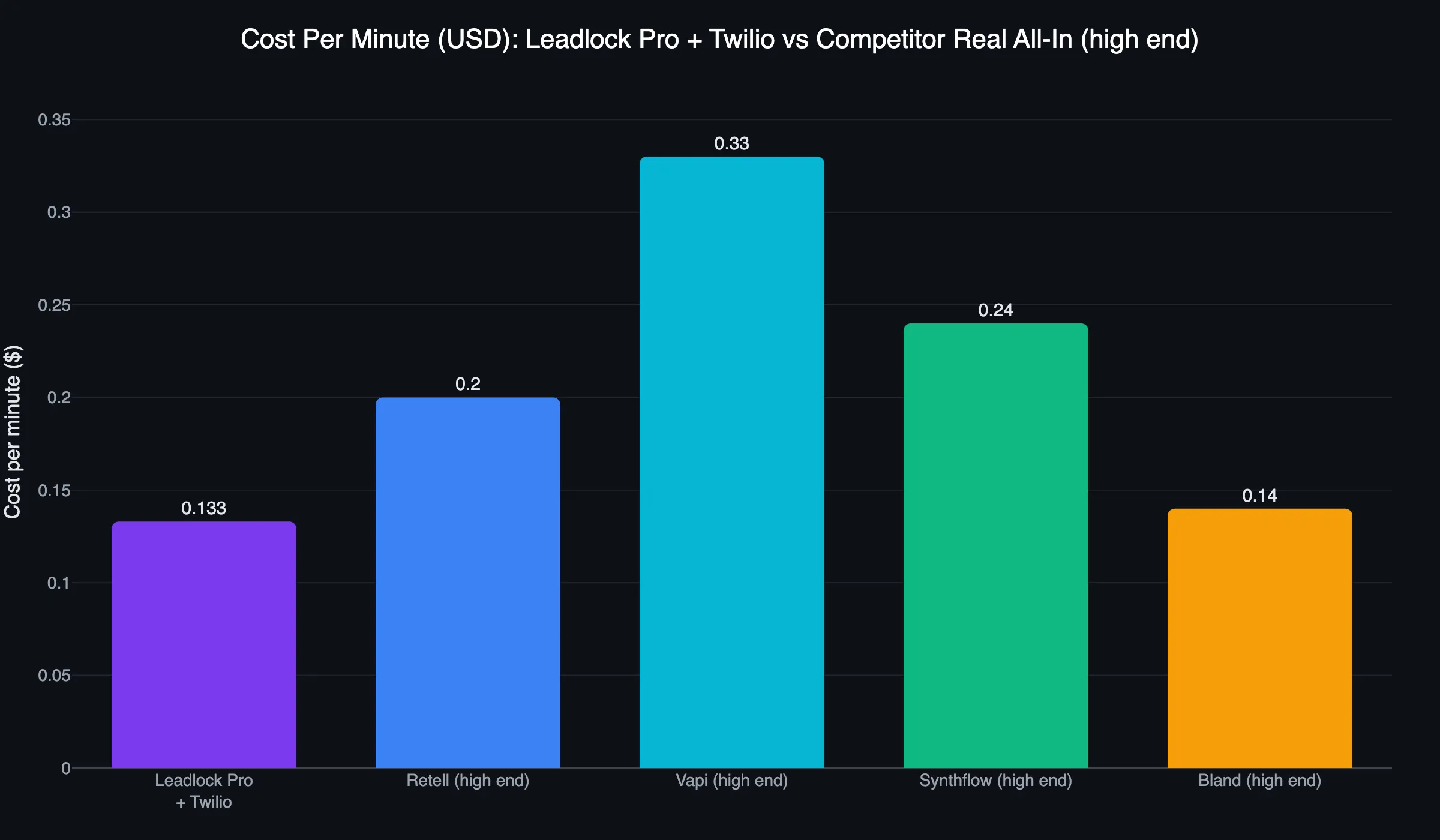
An AI phone agent for lending on Leadlock costs a plan fee ($97/month Starter to $497/month Pro) plus a per-minute rate. On Pro that is $0.12/minute on Gemini Live or Grok Voice, $0.20/minute on OpenAI Realtime, and $0.15/minute on ElevenLabs, with all rates covering the model and voice and no separate STT, LLM or TTS fees. Phone numbers and carrier minutes are billed by your own Twilio account (about $0.013/min inbound and $1.15/month per local number at Twilio’s US rates).
The advertised rate on competing platforms is the platform fee, not the all-in rate. Here’s what the real comparison looks like:
| Platform | Advertised Rate | Real All-In Rate |
|---|---|---|
| Leadlock (Gemini Live / Grok Voice) | $0.12/min on Pro, $0.18 on Starter | $0.12-$0.18/min + plan from $97/mo |
| Leadlock (OpenAI Realtime) | $0.20/min on Pro, $0.25 on Starter | $0.20-$0.25/min + plan from $97/mo |
| Vapi | $0.05/min (platform fee) | $0.15-$0.33/min |
| Retell | $0.07/min | $0.13-$0.20/min |
| Bland | $0.11-$0.14/min (bundled) | $0.11-$0.14/min + transfer/SMS fees |
| Synthflow | $0.09/min | $0.15-$0.24/min |
The advertised number is a marketing number. The all-in number is the bill.
For a lender running 500 call-minutes per day, the monthly difference compounds:
- Leadlock (Gemini Live, Pro plan): $497 + 15,000 min/month x $0.12 = $2,297/month
- Retell at real all-in $0.20/min: same volume = $3,000/month
- Vapi at real all-in $0.33/min: same volume = $4,950/month
On the cost-per-loan side, Freddie Mac’s Loan Product Advisor update released in May 2025 saved mortgage originators up to $1,500 per loan and shortened the production cycle by 5 days through ML-assisted conditions clearing. AI on the phone side stacks on top of that by reducing the labor cost of intake and follow-up calls that currently pull loan officers off pipeline work.
For agencies deploying Leadlock for their mortgage broker clients, the per-agent economics improve further when the same platform covers multiple lender clients under a single account.
How Do AI Loan Agents Handle Compliance Requirements?
AI phone agents for loan origination must comply with TCPA, Fair Lending laws, and state disclosure requirements, and properly configured agents handle this through scripted disclosures at call start, required AI identification to any borrower who asks, call recording, and opt-out mechanisms built into the call flow from the first ring.
The five compliance steps every AI loan agent deployment must cover:
- AI identification at call open. Disclose that the caller is an AI at the start of every call. Script it as the agent’s first sentence. This protects against TCPA misrepresentation liability and sets borrower expectations correctly.
- TCPA consent for outbound calls. Outbound AI calls require prior express written consent. Don’t deploy an AI agent for outbound follow-up without a verified consent record on file for each number dialed.
- Fair Lending-safe scripting. The agent’s qualification questions must be identical across all borrower segments. No variation by geography, name, or any characteristic that correlates with a protected class. Log every call.
- Call recording and retention. Maintain call recordings per state lending record requirements. Most states require a minimum of 3 years for mortgage origination records.
- Escalation logging. Log every transfer with the reason, the data collected during the AI call, and the outcome of the human conversation.
On Leadlock, TCPA and lending compliance stay your responsibility. You write the AI disclosure and opt-out wording into the agent’s prompt and set the escalation triggers, and a “this call may be recorded” notice plays by default. Leadlock does not check DNC lists, store consent records, or apply a retention schedule to recordings, so keep consent and record-retention processes in your own systems and review the setup with counsel. For a full breakdown of current TCPA and FTC requirements for voice AI in lending, the AI voice agents legal compliance guide covers the current federal and state-level landscape.
How Do Borrowers Actually Respond to AI on Loan Calls?
Borrower trust with AI loan agents is higher than most lenders expect: the main drop-off triggers are unnatural pauses caused by processing latency, agents that fail to answer specific questions, and call flows that don’t offer a human option when the borrower asks for one.
Architecture translates directly to conversion here. A voice agent on an orchestration-layer platform pauses at every hop of every response. In a loan call, that pause is not neutral. A borrower who started with some skepticism about the AI process interprets the delay as uncertainty or incompetence and looks for a way off the call. Leadlock’s about 300ms replies on Grok mean the conversation stays at natural pace from the first exchange. Borrowers settle into the conversation in the first 30 seconds.
The tactics that keep borrowers engaged through intake:
- Open with the disclosure and immediately ask a concrete question. “I’m an AI loan intake specialist. Can I get your name and the loan type you’re looking at?” moves the call forward rather than stalling on pleasantries.
- When the borrower asks something outside the agent’s scope, name it and offer the transfer. “That’s a great question for one of our loan officers. Want me to connect you now or schedule a callback?” gives the borrower control over the next step.
- Don’t retry a failed capture more than twice on the same field. On the third failed response, escalate. Borrowers in friction don’t retry with patience.
- End every call with a data confirmation. Repeat the key intake points back and ask for confirmation. This closes the intake cleanly and catches errors before they reach underwriting.
For the escalation logic framework, the how an AI agent knows when to hand off to a human post covers the decision criteria in detail. The short version: escalate on request, on rates questions, on objections, and on exception flags. Handle everything else in the AI layer.
How Do Lenders Get Started With AI Phone Agents in 2026?
A lender can have an AI phone agent live in 5 minutes on Leadlock: create an account, configure the agent prompt with your intake script and escalation rules, connect a phone number, and publish, with no SIP trunking, no developer, and no integration project required at any step.
The deployment sequence:
- Write the intake script. Define the 6-8 fields the agent collects on the first call: loan type, requested amount, employment status, income tier, credit tier self-report, and preferred callback window. Keep it conversational, not form-like.
- Set escalation triggers. Specify which borrower responses route to a human: requests a person, asks a specific rate question, raises an objection, or triggers an exception flag.
- Add the compliance disclosure. Script the AI identification into the call-open: “This is an AI assistant from your lending team. You can ask for a loan officer at any time.”
- Choose your model. Gemini Live or Grok Voice (from $0.12/min all-in on Pro) handles high-volume intake calls. OpenAI Realtime (from $0.20/min on Pro) fits premium customer-facing calls where voice quality affects borrower confidence from the first sentence.
- Connect a phone number. Import a number from your Twilio account or GoHighLevel. No SIP trunking configuration.
- Test the call yourself. Walk through the intake as a borrower would. Adjust anything that sounds robotic or skips a natural conversational beat.
- Publish. The agent answers every inbound call from this point.
Gartner’s 2025 forecast projects that by 2029, agentic AI will autonomously resolve 80% of common customer service issues without human intervention, reducing operational costs by 30%. Loan intake is squarely in that 80%. Lenders who deploy now build the borrower experience infrastructure that others will spend years trying to match.
Frequently Asked Questions
Q: Can AI phone agents handle the entire loan application process?
No, and they shouldn’t be configured to try. AI agents handle intake, pre-qualification, document follow-up, and status updates effectively. Underwriting decisions, rate lock commitments, and borrower-specific exception handling require a licensed human. The right model is AI for volume and repetitive tasks, human for judgment and compliance-sensitive decisions.
Q: Are AI voice agents compliant with TCPA and fair lending laws?
Yes, when configured correctly. Inbound calls are generally TCPA-safe. Outbound AI calls require prior express written consent from the borrower before the call is placed. Fair lending compliance requires identical scripted intake across all borrower segments, with call recordings retained for audit purposes. Those obligations are yours as the lender: on Leadlock, the disclosure wording lives in the prompt you write and a recording notice plays by default, but consent records, DNC checks and record retention are not built in, so handle them in your own systems.
Q: What loan types work best with AI phone agents?
Consumer loans, auto loans, personal loans, and mortgage refinance inquiries are the strongest fit. These have structured intake flows with predictable borrower questions and standard document requirements. Complex commercial loans with custom underwriting structures and significant negotiation components are better handled by a human loan officer from the first call.
Q: How do AI agents collect and verify documents during a call?
The agent verbally requests each document, confirms the borrower understands what’s needed, and provides a secure upload link by text during the call. Verification happens downstream in the underwriting system. The agent’s role is collection and confirmation, not review. Real-time CRM sync means the loan file updates as the borrower responds, so the assigned loan officer sees a complete intake record before their callback.
Q: When should an AI loan agent escalate to a human?
Escalate when the borrower asks for a person, raises a specific question about rates or loan terms, expresses frustration, or provides an answer that triggers an underwriting exception flag. A well-configured escalation setup means the loan officer receives a full intake summary before the first word of the human conversation. The handoff should feel like a warm transfer, not a reset.
Q: How much does an AI phone agent cost for a lending company?
On Leadlock, from $0.12/minute using Gemini Live or Grok Voice on the $497/month Pro plan, covering the model and voice with no separate STT, LLM or TTS fees. At 500 call-minutes per day (15,000 a month), that’s $2,297/month on Pro including the plan fee, plus about $196 to Twilio (15,000 x $0.013 + $1.15 for the number), so about $2,493/month, compared to $3,000-$4,950/month on orchestration-layer competitors when their real all-in component costs are factored in.
Ready to stop losing loan applications to missed calls? Leadlock deploys a live AI voice agent in 5 minutes, all-in from $0.12/minute, with no SIP trunking and no developer required. Book a 15-minute call with Dan.
See It Book a Real Job
Voice agents that book into ServiceTitan and GoHighLevel, live today for home-service brands. Book 15 minutes with Dan, or start a 7-day trial from the pricing page.
Book a 15-minute call with Dan