SIP trunk and VoIP providers for AI phone agents ranked on latency, cost per 10,000 minutes and STIR/SHAKEN: Telnyx, Twilio, Vonage, Plivo, SignalWire and more.
- Telnyx posts the lowest carrier-leg latency (118ms p95 RTT) and lowest cost (~$70/10k min) among VoIP providers tested independently in June 2026.
- Running a BYOC VoIP carrier on an orchestration-layer AI platform (Vapi, Retell, Bland) adds $70-$140 per 10,000 minutes in carrier cost on top of platform, LLM, STT, and TTS fees.
- Leadlock runs on your own Twilio account (or numbers imported from GoHighLevel) at a rate starting at $0.12/min on Gemini Live or Grok Voice, all-in for the model and voice, with no SIP trunk or BYOC setup; Twilio bills the numbers and carrier minutes to your own account.
- STIR/SHAKEN A-level attestation is the most commonly overlooked VoIP requirement for AI phone agents; calls without it face increasing spam filter rates at major US carriers.
The VoIP question comes up the moment someone builds an AI phone agent on Vapi, Retell, Bland, or Synthflow. Those platforms handle the AI layer. The phone call itself runs through a separate carrier you either source yourself (BYOC) or pay through the platform at their markup. Either way, VoIP is a separate bill, a separate setup step, and a separate source of latency stacked on top of an orchestration pipeline where each hop already adds delay, which is why the wider infrastructure for AI phone agents deserves a look before you commit.
The cleaner path is a platform where the telephony connection is already built. Leadlock connects to your own Twilio account (or imports numbers from GoHighLevel) and prices model access and voice as one rate starting at $0.12 per minute, on a single speech-to-speech step. Phone numbers and carrier minutes are billed by your own Twilio account. Leadlock agents reply in about a third of a second on Grok (median of 461 live turns, measured September 2026). No SIP trunk to configure. But if you’re running on Vapi, Retell, or Bland, the VoIP provider you pick matters. This guide covers both angles: the 10 VoIP providers that work best with AI phone agents in 2026, plus the architecture context that explains when the VoIP question stops being relevant entirely.
Why Does VoIP Provider Choice Matter for AI Phone Agents in 2026?
The VoIP carrier layer sets your floor on call quality and carrier-leg latency, which stacks directly on top of whatever your AI pipeline contributes, so a fast AI model on a slow carrier still produces a slow call, and the combined bill from carrier plus platform plus model can push real all-in costs to $0.30 per minute or more.
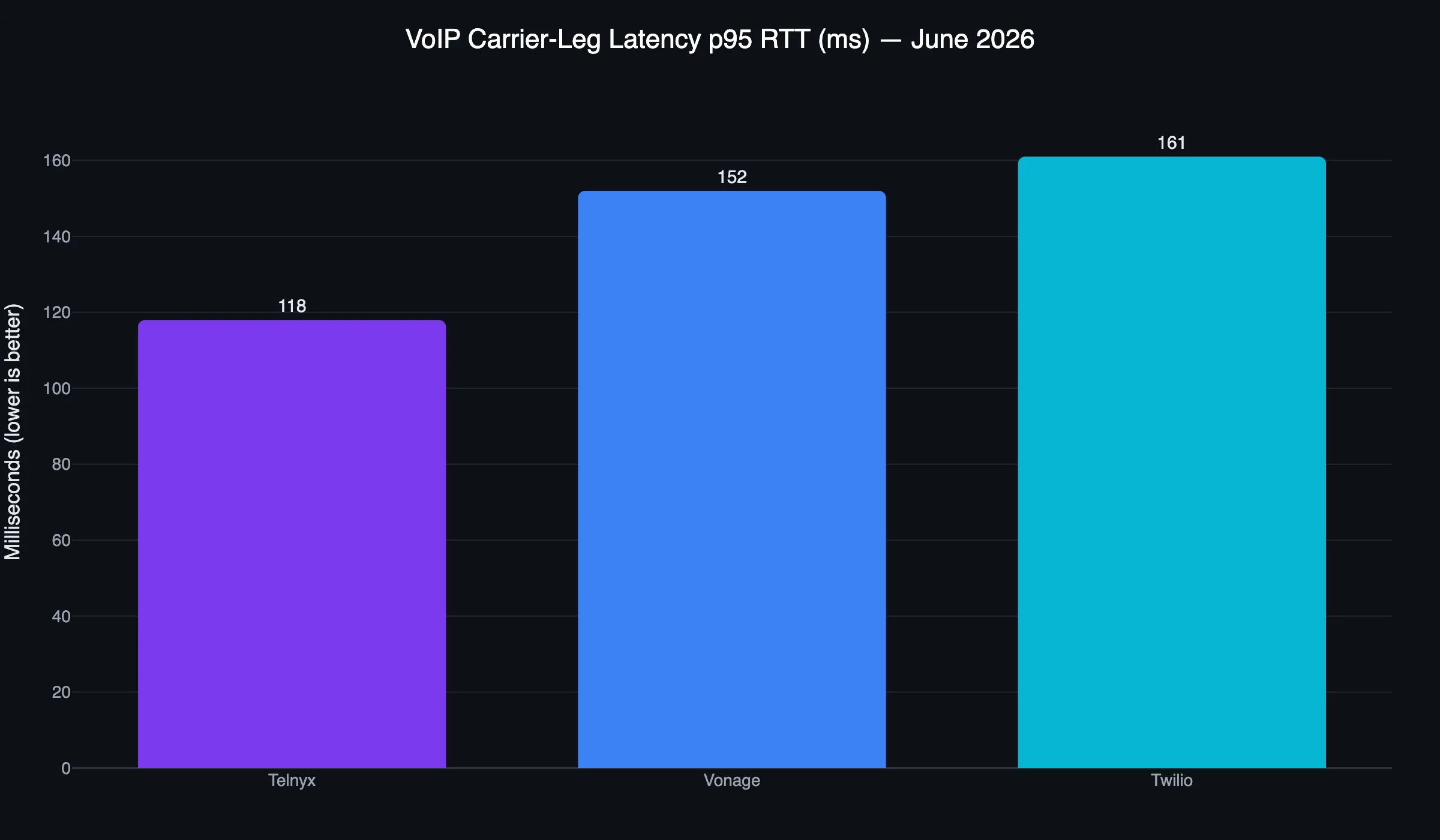
An independent carrier test by TECHSY in June 2026 ran 120 outbound calls per provider through Telnyx, Vonage, and Twilio. Telnyx posted a p95 RTT of 118ms and a 380ms call setup time. Twilio came in at 161ms p95 RTT and 470ms call setup. On a single call the 90ms difference is imperceptible. Across tens of thousands of calls on an orchestration-layer platform that already adds delay at every hop, the numbers accumulate.
Pricing compounds the same way. At 10,000 minutes per month, Telnyx runs roughly $70 in carrier cost versus approximately $140 for Twilio, per the same benchmark. Add the AI platform fee, the LLM, the STT, and the TTS, and the full infrastructure stack turns a $0.05/minute advertised rate into $0.15-$0.33/minute in real billing.
How Do AI Agents Connect to VoIP Carriers: SIP, CPaaS, or WebRTC?
The three connection architectures for AI phone agents, SIP trunking for lowest carrier-leg latency, CPaaS for easier API-driven programmability, and WebRTC for browser-based agents, determine how audio flows between your caller and your AI model, with SIP trunking offering the least media-path overhead and WebRTC adding codec translation costs that compound on high-volume PSTN calls.
For AI phone agents in production:
- SIP trunking (Telnyx, SignalWire, Bandwidth, Viirtue): lowest carrier-leg latency, full BYOC compatibility with most AI platforms, requires STIR/SHAKEN configuration to avoid spam filtering
- CPaaS (Twilio, Vonage, Plivo): easier initial setup, mature call control APIs, slightly more media-path overhead, wider out-of-the-box integrations with AI platforms
- WebRTC (SignalWire, some Dialpad configurations): works for browser-based agents, adds PSTN bridging overhead for traditional phone calls, not ideal for high-volume outbound
The architecture of your AI platform matters here too. Orchestration-layer platforms (STT then LLM then TTS) are sensitive to carrier latency because every millisecond of VoIP delay adds to an already multi-step pipeline. Speech-to-speech architecture handles this differently, because audio goes straight into the model without intermediate transcription steps that each introduce their own delay.
Pro Tip: Before configuring BYOC on any AI platform, confirm your carrier supports STIR/SHAKEN A-level attestation, not B or C. Calls without it face increasing spam filter rates at major carriers, and re-mediating flagged numbers takes weeks.
What Are the Top 10 VoIP Providers for AI Phone Agents in 2026?
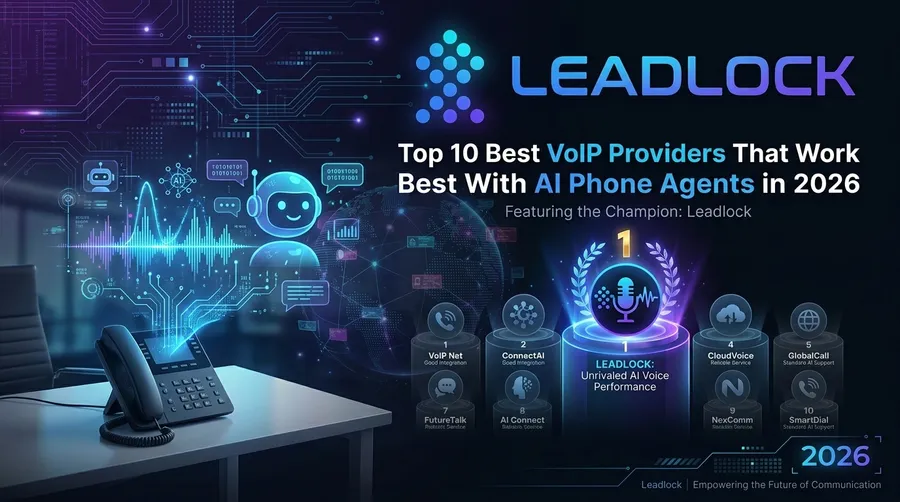
The best VoIP providers for AI phone agents in 2026 combine carrier-leg latency below 150ms p95, full STIR/SHAKEN A-level attestation to prevent spam filtering, SIP trunk compatibility with Vapi, Retell, Bland, and Synthflow, pricing that stays manageable at 10,000-plus minutes per month, and documentation clear enough that BYOC setup takes hours rather than days.
Five criteria drive the ranking for any team evaluating these providers:
- Carrier-leg latency (p95 RTT below 150ms is strong; Telnyx posted 118ms in independent testing)
- STIR/SHAKEN attestation level (A-level is required for reliable caller ID; B or C creates spam filtering risk at scale)
- SIP trunk BYOC compatibility with your AI platform of choice
- Per-minute pricing at volume (carrier cost of $70-$140 per 10,000 minutes varies 2x between providers)
- Business Associate Agreement availability for HIPAA-sensitive use cases in telehealth, insurance, or HR
1. Telnyx
Telnyx posts the lowest carrier-leg latency in independent testing. The TECHSY June 2026 benchmark put Telnyx at 118ms p95 RTT and 380ms call setup time, better than both Vonage and Twilio in the same test. Carrier cost at 10,000 minutes runs roughly $70, about half Twilio’s rate at the same volume. BYOC SIP trunk documentation covers Vapi, Retell, and Bland configuration specifically. Best pick for latency-sensitive AI calling at scale.
2. Twilio
The most widely integrated VoIP provider in the AI voice category. Nearly every orchestration-layer AI platform ships a Twilio integration out of the box, which means faster initial setup and fewer compatibility surprises during configuration. The tradeoff: carrier cost at scale runs approximately $140 per 10,000 minutes, and call setup averaged 470ms in the TECHSY benchmark. You pay for the ecosystem breadth.
3. Vonage (Ericsson)
Vonage posted p95 RTT of 152ms in the TECHSY test, landing between Telnyx and Twilio on latency. Enterprise support, global number inventory, and mature APIs make it a strong pick for operations with international calling requirements or heavy compliance overhead. The Ericsson acquisition has improved carrier backbone reliability for enterprise accounts.
4. Plivo
Developer-friendly CPaaS with competitive per-minute rates and straightforward SIP trunk configuration. Auto Interview AI’s 2026 SIP trunking guide lists Plivo among the strongest options for AI calling pipelines, with solid API documentation and broad number inventory across North America and Europe. Pricing undercuts Twilio at comparable volume levels.
5. SignalWire
Open-source roots (FreeSWITCH-based) with WebRTC-native architecture and SIP trunk support for PSTN bridging. Per-minute pricing is competitive. STIR/SHAKEN compliance is present but self-configured, which gives technically inclined teams more flexibility and gives everyone else a steeper setup curve compared to Twilio or Plivo.
6. Bandwidth
Enterprise carrier infrastructure with direct interconnects to major US carriers. Viirtue’s 2026 SIP provider comparison positions Bandwidth as a top-tier choice for enterprises where carrier-grade SLA terms are non-negotiable. Volume minimums run higher than Telnyx or Plivo, which makes Bandwidth a poor fit for small agencies but a strong fit for high-volume enterprise deployments.
7. Viirtue
White-label-friendly SIP trunking with strong STIR/SHAKEN tooling and a reseller-first model. A good fit for GHL agency owners who want to manage carrier relationships under their own brand and bundle telephony as part of a broader AI voice package. Pricing is volume-dependent with flexibility for agency-level account structures.
8. RingCentral
A full-featured business phone platform with SIP trunking available for AI agent traffic. Works for hybrid environments where some employees need traditional desk phones and some calls route to AI agents. Not the lowest-latency or lowest-cost carrier path, but the unified platform simplifies IT overhead for mid-market companies running mixed human-and-AI call environments.
9. Dialpad
AI-forward business communications with built-in transcription and call coaching. Dialpad’s AI features create redundancy with AI voice agent platforms that already handle transcription, which means overlapping costs. Strong as a standalone business phone system; less clean as a carrier layer underneath a separate AI platform that already processes audio natively.
10. Nextiva
SMB-friendly with competitive support quality and reliable uptime. Easier to configure than Bandwidth or SignalWire for teams without dedicated infrastructure resources. Per-minute costs run higher than Telnyx, but the onboarding is faster. Reasonable pick for agencies running low-to-medium call volumes where setup speed matters more than marginal carrier cost optimization.
How Much Does VoIP Add to Your Monthly AI Agent Bill?
Carrier cost adds $70 to $140 per 10,000 minutes on top of every other line item your orchestration-layer AI platform already charges, and at meaningful call volumes that carrier line item can exceed what you pay for the AI model itself, making VoIP provider selection as financially consequential as platform selection.
| Provider / Setup | VoIP Carrier (10k min) | AI Platform + Model + STT/TTS | Real All-In |
|---|---|---|---|
| Telnyx (via Vapi BYOC) | ~$70 | Vapi platform + LLM + STT + TTS | $1,500-$3,300 |
| Twilio (via Retell BYOC) | ~$140 | Retell platform + components | $1,300-$2,000 |
| Vonage (via Bland BYOC) | Competitive | Bland bundled + transfer fees | $1,100-$1,400 + fees |
| Leadlock (Gemini Live) | Your own Twilio account: ~$131 inbound, ~$181 outbound | Included | about $1,331 inbound on Pro + plan fee |
| Leadlock (OpenAI Realtime) | Your own Twilio account: ~$131 inbound, ~$181 outbound | Included | about $2,131 inbound on Pro + plan fee |
Leadlock’s Twilio figures use Twilio’s published US rates: about $0.013/min inbound or $0.018/min outbound, including Media Streams, plus $1.15/month per local number. With the $497 Pro plan fee added, Leadlock on Gemini Live comes to about $1,828 for 10,000 inbound minutes: inside the Retell range and above the Bland range in this table.
The hidden cost in AI voice agents is rarely the model: it’s everything around it. STT, LLM, TTS and telephony all stack up, so an advertised $0.05 a minute can turn into a much larger bill. Leadlock’s per-minute rate is all-in for the model and voice, from $0.12 on the $497/month Pro plan ($0.18 on the $97/month Starter plan); the other lines are the monthly plan fee and your own Twilio bill.
On Leadlock, Gemini Live runs $0.12/minute, Grok Voice (OpenAI Realtime API spec compatible) also runs $0.12/minute, OpenAI Realtime runs $0.20/minute, and ElevenLabs runs $0.15/minute on Pro. Every rate is all-in for the model and voice: no separate STT, LLM or TTS fees. Numbers and carrier minutes come from your own Twilio account or GoHighLevel, with no SIP trunk to configure. You can see the full real-cost breakdown in the automated phone calling system cost guide.
What Compliance Requirements Apply When AI Is Handling the Call?
When an AI phone agent replaces a human on an inbound or outbound call, TCPA governs whether you can make that call at all, HIPAA governs whether the call is allowed to touch health information, and financial services regulations govern what must be disclosed and recorded, so your VoIP provider plays a direct compliance role on all three fronts before the agent speaks a word.
TCPA covers outbound calling. Automated dialing systems, including AI voice agents making outbound calls, require prior express written consent from the called party. Your VoIP carrier must support STIR/SHAKEN A-level attestation, or your outbound calls will face increasing spam filter rates before the agent ever reaches the intended recipient. Carriers with B or C attestation become a compliance liability as call volume grows.
HIPAA applies the moment your AI agent discusses protected health information: appointment details, prescription status, test results, anything that qualifies as PHI. Your VoIP provider must sign a Business Associate Agreement before you route any HIPAA-sensitive calls through them. Twilio and Telnyx both offer BAA signing. Verify this before connecting patient-facing agents.
Financial services calls in mortgage, insurance, and debt collection carry additional state-level requirements on call recording and disclosure. Most VoIP providers support call recording but don’t manage the consent-capture workflow. That falls to your AI platform configuration. Your VoIP provider’s job is to support call recording with audit logs stored compliantly. The HIPAA and TCPA compliance guide covers what these obligations look like in practice.
Why Does Leadlock Skip SIP Trunking Entirely?
Leadlock connects to your own Twilio account, or imports numbers from GoHighLevel, so there is no SIP trunk or BYOC configuration: calls run at $0.12 per minute on Gemini Live or Grok Voice, or $0.20 per minute on OpenAI Realtime, for the model and voice, with telephony billed by Twilio to your own account.
The practical difference for a team deploying its first AI phone agent:
- No BYOC or SIP trunk configuration
- Connect your Twilio account once, or import numbers from GoHighLevel
- Live in 5 minutes from account signup to a phone number answering calls
Connected telephony does not move compliance off your plate. Calls still pass through the telephony carrier and the model provider, Leadlock does not manage STIR/SHAKEN attestation for you, and TCPA consent stays the customer’s responsibility.
The architecture also changes what latency means. Orchestration-layer platforms run STT, then LLM, then TTS, three separate API calls, and each hop adds delay. Leadlock runs a single speech-to-speech step and replies in about 300ms on Grok. Adding a VoIP carrier latency problem on top of a three-step pipeline is a problem that doesn’t exist when the architecture eliminates the pipeline. The guide to integrating AI voice agents with existing phone systems walks through the technical path for both approaches.
Frequently Asked Questions
Q: Can AI phone agents work with any VoIP provider?
Most AI voice platforms including Vapi, Retell, Bland, and Synthflow support BYOC through SIP trunking, which means they work with most major VoIP providers. Compatibility depends on your platform’s SIP trunk configuration requirements. Leadlock skips SIP trunking: you connect your own Twilio account (or import numbers from GoHighLevel) and the agent runs on those numbers.
Q: Which VoIP providers support SIP trunking for AI agent integrations?
Telnyx, Twilio, Vonage, Plivo, SignalWire, Bandwidth, and Viirtue all support SIP trunking compatible with major AI voice platforms. Telnyx and SignalWire post the best carrier-leg latency in independent testing. Twilio has the broadest out-of-the-box integrations. Your choice depends on whether you’re optimizing for latency, carrier cost, or integration speed.
Q: How much does a business VoIP service cost per month for AI calling?
Carrier cost alone runs $70 to $140 per 10,000 minutes depending on provider, based on TECHSY’s June 2026 benchmark. That number sits on top of AI platform fees, LLM costs, STT, and TTS. Real all-in costs on orchestration-layer platforms typically land at $0.15-$0.33 per minute. Leadlock runs $0.12 per minute on Gemini Live or Grok Voice for the model and voice, plus about $0.013/min inbound on your own Twilio account.
Q: What features should a VoIP provider have for AI phone agents?
The critical features are STIR/SHAKEN A-level attestation to prevent spam filtering, SIP trunk BYOC compatibility with your AI platform, carrier-leg latency under 150ms p95 RTT, call recording with audit logs, and a Business Associate Agreement option for any calls touching health information. STIR/SHAKEN is the most commonly overlooked requirement and the one most likely to break a high-volume outbound campaign.
Q: Is VoIP reliable enough for high-volume AI call centers?
Yes, with the right carrier. Telnyx, Twilio, Vonage, and Bandwidth all support enterprise SLA terms with uptime commitments above 99.9%. The reliability concern at scale is less about carrier uptime and more about concurrent call capacity limits and STIR/SHAKEN attestation quality, both of which determine how many calls clear spam filters and reach actual callers. According to Gartner’s 2025 forecast, agentic AI will autonomously resolve 80% of common customer service issues without human intervention by 2029, which means call volumes routed through AI platforms will increase significantly.
Q: What is the difference between an AI voice agent and AI transcription in a VoIP system?
An AI voice agent handles the entire conversation autonomously: speaking with callers, answering questions, capturing information, and completing tasks like booking appointments or routing calls. AI transcription in a VoIP system converts speech to text for post-call analysis but doesn’t interact with callers. Transcription is a reporting tool. A voice agent replaces or augments the human on the call itself.
Ready to run AI phone agents without BYOC configuration or SIP trunks? Leadlock connects to your Twilio account and prices model access and voice in one rate from $0.12/minute, with telephony on your own Twilio bill. Book a 15-minute call with Dan.
See It Book a Real Job
Voice agents that book into ServiceTitan and GoHighLevel, live today for home-service brands. Book 15 minutes with Dan, or start a 7-day trial from the pricing page.
Book a 15-minute call with Dan