Automated phone calling systems explained: what they are, how they work, 4 main types, real all-in pricing, TCPA compliance rules, and the best option in 2026.
- Automated phone calling systems range from basic dialers to AI voice agents that hold two-way conversations, qualify leads, and book appointments without human agents on the line.
- Leadlock uses speech-to-speech architecture on OpenAI Realtime, Gemini Live, or Grok Voice (about 300ms replies on Grok) from $0.12/min on Pro for the model and voice (Twilio phone charges are separate), compared to $0.15-$0.33/min and extra hops per turn for orchestration-layer platforms.
- Most platforms advertise only the platform fee; real all-in costs for Vapi, Retell, Bland, and Synthflow run 2-7x higher once STT, LLM, TTS, and telephony are added.
- TCPA compliance requires written consent before automated outbound calls to cell phones, calling hours restricted to 8am-9pm local time, and immediate opt-out capability on every campaign.
This guide covers what automated phone calling systems are, how they work, what the different types cost, and when they’re the right choice.
What Is an Automated Phone Calling System?
An automated phone calling system is software that places or receives phone calls without requiring a human agent on the line, using pre-recorded messages, interactive voice response menus, or conversational AI voice agents to handle the full call: qualifying leads, booking appointments, routing emergencies, and updating CRM records in real time.
The category has split into two architectures. Older systems and most platforms still on the market use a three-step orchestration layer: speech-to-text converts audio to a transcript, a language model generates a text response, and text-to-speech converts it back to audio. Each step adds latency, and spikes are common under load. Speech-to-speech platforms skip those conversion layers and process audio natively.
The business case starts with one number. A study by 411 Locals across 85 businesses in 58 industries found that 62% of small business calls go unanswered. Businesses answer only 37.8% of incoming calls; 24.3% get no response at all. Automated calling addresses both the missed-call problem and the cost of routing routine calls through human agents.
How Do Automated Calling Systems Work?
Automated phone calling systems work by receiving or placing calls through telephony infrastructure, then processing the caller’s speech and generating a response in a cycle that takes about 300ms on Grok on a speech-to-speech platform like Leadlock, and longer on an orchestration-layer system using three separate API calls for speech-to-text, an LLM, and text-to-speech.
Orchestration-layer systems (Vapi, Retell, Bland, Synthflow, Assistable):
- Caller audio transcribed by a speech-to-text engine
- Transcript sent to a language model
- Text response sent to a text-to-speech engine
- Synthesized audio played back to the caller
Three API calls per response cycle. Each hop adds delay, and spikes are common under load.
Speech-to-speech systems (Leadlock): Audio In → Native Multimodal Model (OpenAI Realtime, Gemini Live, or Grok Voice) → Audio Out. One step. Leadlock agents reply in about a third of a second on Grok (median of 461 live turns, measured September 2026).
For outbound campaigns, the system dials a contact list, connects answered calls to the AI agent, and runs the configured conversation flow. Transfers to a human, appointment bookings, and CRM updates happen in real time during the call.
What Types of Automated Calling Systems Are Available in 2026?
Automated phone calling systems in 2026 fall into four main categories: power dialers that connect answered calls to human agents, predictive dialers that maximize team talk time using algorithmic call pacing, IVR systems that route callers through menus, and AI voice agents that hold full two-way conversations and complete tasks without a human on the line.
Power dialers call one contact at a time and connect answered calls immediately to a live agent. No AI conversation layer. Good for high-volume outbound teams where humans close every call. According to ViciStack’s 2026 call center report, predictive dialers increase sales rep call capacity by 212% over manual dialing and cut agent idle time from 25-35 minutes per hour to under 5.
Predictive dialers call multiple numbers simultaneously and use algorithms to predict agent availability. They maximize talk time but require a full team of human agents to handle connected calls. The global predictive dialer market is projected at $6.6 billion in 2026.
IVR systems play a phone menu and route callers based on keypad input. They handle simple routing and information delivery but can’t hold a real conversation. Most callers hang up rather than navigate a multi-level menu.
AI voice agents hold a two-way conversation, qualify callers, answer questions, book appointments, and transfer to humans when needed.
What Are the Most Common Use Cases for Automated Phone Calling?
Automated phone calling covers four main categories in 2026: inbound reception and lead capture for businesses that miss 62% of calls according to a 411 Locals study, outbound prospecting and follow-up, appointment reminders that cut no-show rates, and customer support triage that resolves routine inquiries before they reach the hold queue.
Inbound reception and lead capture. 40-60% of business calls arrive outside standard 9-to-5 hours, according to Nextiva. An AI voice agent answers every call, qualifies the lead, and books the appointment even at 11pm. Businesses using 24/7 AI reception report capturing an extra 15-20% of appointments from after-hours callers that would otherwise hit voicemail.
Outbound prospecting and follow-up. AI agents work through contact lists, engage callers who answer, and leave structured voicemails on missed calls. A software company cited by My AI Front Desk reported a 40% increase in qualified sales meetings after deploying AI for initial call screening.
Appointment reminders. Outbound reminder calls before scheduled appointments confirm attendance more reliably than texts for many client types. Phone calls require an active response; an unread text does not.
Customer support triage. Routine inquiries (hours, status checks, refill requests, basic troubleshooting) get resolved without holding the call queue. Matic Insurance automated 50% of low-value insurance workflows with AI, handling 8,000+ calls while dropping average handle time from 12.4 minutes to 5.8 minutes, per a Retell AI case study.
For a deeper look at outbound use cases, see our guide to outbound AI calling.
What Features Should You Look for in an Automated Phone Calling System?
The features that most determine whether an automated calling system performs are call quality and latency (the difference between one-step speech-to-speech on Leadlock and three hops on orchestration-layer platforms), CRM integration depth, concurrent call capacity, TCPA compliance controls, and transparent pricing that spells out every cost layer (model, voice, carrier minutes) before you sign.
Key features to evaluate:
- Latency. Fast replies are what make a conversation feel natural. Long pauses are noticeable, and callers react to them negatively. Ask vendors for their measured TTFA, not marketing copy.
- CRM integration. Native GoHighLevel integration (no webhooks, no SIP trunking) matters for agencies. For other CRMs, check whether the sync is real-time or batched.
- Concurrent call handling. Dialer systems cap concurrent calls at a license tier. AI voice agents on multimodal models (OpenAI Realtime, Gemini Live, Grok Voice) scale concurrently without per-seat costs.
- Compliance controls. TCPA-required opt-out handling, call-time restrictions, do-not-call list management, and opening disclosure scripts are not optional for outbound campaigns.
- All-in pricing. A platform at $0.05/min becomes expensive fast once you add STT, LLM, TTS, and telephony fees on separate lines.
Pro Tip: Before signing up for any automated calling platform, ask for the total all-in cost per minute including model, voice synthesis, and telephony. If the vendor can’t give you a single number, the real cost is higher than the homepage rate.
What Does an Automated Phone Calling System Actually Cost?
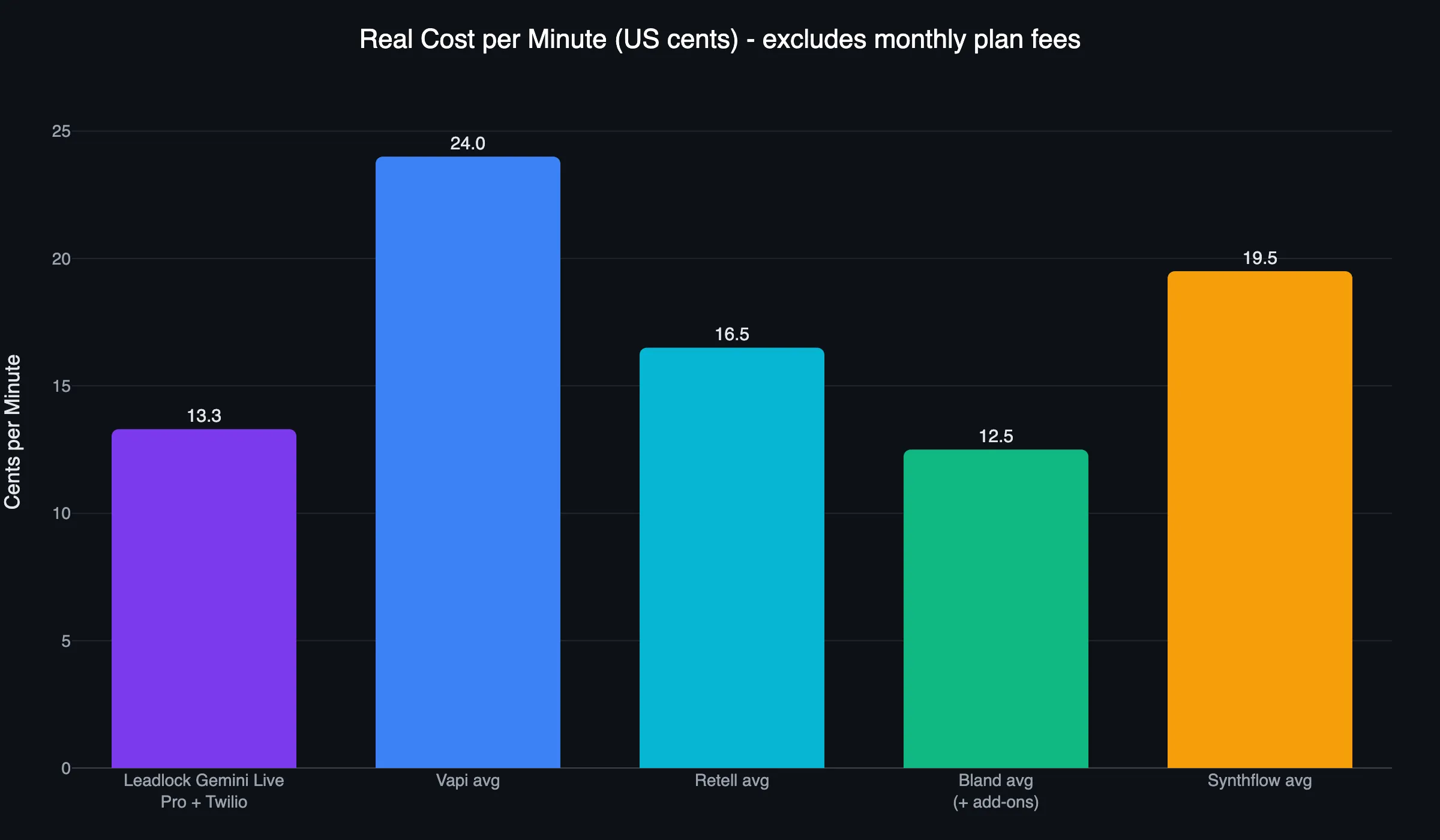
Pricing for automated phone calling systems in 2026 ranges from $0.12/min on Leadlock’s Gemini Live and Grok Voice models (model and voice, plus Twilio phone charges) to $0.33/min or more for orchestration-layer platforms like Vapi once you add speech-to-text, a language model, text-to-speech, and telephony on top of the advertised platform fee, which is the number most vendor homepages show.
| Platform | Advertised Rate | Real All-in Cost |
|---|---|---|
| Leadlock (Gemini Live or Grok Voice) | $0.12/min on Pro | $0.12/min (model + voice) + $497/mo Pro plan + Twilio |
| Leadlock (OpenAI Realtime) | $0.20/min on Pro | $0.20/min (model + voice) + $497/mo Pro plan + Twilio |
| Leadlock (ElevenLabs) | $0.15/min on Pro | $0.15/min (model + voice) + $497/mo Pro plan + Twilio |
| Vapi | $0.05/min | $0.15-$0.33/min |
| Retell | $0.07/min | $0.13-$0.20/min |
| Bland | $0.11-$0.14/min bundled | + transfer, SMS, TTS add-ons |
| Synthflow | $0.09/min | $0.15-$0.24/min |
| Assistable | $0.07/min | + $97-$975/mo subscription |
Leadlock’s rate is all-in for the model and voice: no separate STT, LLM or TTS fees. Phone numbers and carrier minutes are billed by your own Twilio account (about $0.013/min inbound, $0.018/min outbound and $1.15/month per local number at Twilio’s US rates). Competitor advertised rates cover only the platform or voice-engine fee.
The math adds up at volume. At 10,000 minutes per month, Vapi at a real cost of $0.24/min (midpoint of the range) is $2,400 versus Leadlock at about $1,828 on Gemini Live with the Pro plan ($497 + 10,000 x $0.12, plus about $131 in Twilio charges for 10,000 inbound minutes and one number). That’s about a $572/month, or $6,862/year, difference before factoring in setup time: Leadlock is live in 5 minutes; most orchestration-layer platforms take hours to days.
What Legal Requirements Apply to Automated Phone Calls?
TCPA compliance is the primary US legal framework governing automated phone calls, and violations cost $500-$1,500 per call: it requires written consent before calling cell phones with an autodialer or pre-recorded message, restricts calling hours to 8am-9pm local time, mandates opt-out mechanisms, and requires immediate disclosure of who is calling and why.
The key requirements for outbound automated calling campaigns:
- Written consent is required before calling cell phones with an autodialer or pre-recorded message
- Residential landline calls with pre-recorded messages require prior express consent
- Calling hours are restricted to 8am-9pm in the recipient’s local time zone
- Every call must disclose who is calling and the reason for the call
- An opt-out mechanism must be offered and honored immediately
- Do-not-call list scrubbing is required before each campaign run
State laws add further restrictions. California and Florida have stricter consent requirements than federal minimums. For multi-state campaigns, the most restrictive applicable state law governs.
Inbound calls face significantly fewer restrictions. If a caller contacts your business first, AI can handle the call without the outbound consent requirements. The compliance exposure is primarily on the outbound side.
For a full legal walkthrough, see AI voice agents and TCPA compliance in 2026.
What Are the Best Practices for Running Automated Calling Campaigns?
Automated calling campaigns perform best when launched with a scrubbed, compliant contact list, an AI agent configured with a TCPA disclosure in the opening line, calling hours locked to 8am-9pm local time, a live human transfer path, and a 10-20 call test run before full deployment to catch issues in the conversation flow.
Follow this sequence for any new outbound campaign:
- Scrub your contact list against the National Do Not Call Registry and remove cell numbers without written consent if using an autodialer
- Configure calling hours within the TCPA window: 8am-9pm in the caller’s local time zone
- Write a clear opening disclosure for the AI agent: who is calling and why, stated in the first sentence
- Set up a live human transfer trigger for calls the AI cannot resolve
- Run 10-20 test calls before full deployment; listen to recordings and adjust pacing and tone
- Monitor connect rate, transfer rate, and opt-out rate in the first 48 hours after launch
The metrics that matter: connect rate (answered calls as a percentage of dials), cost per qualified conversation, transfer rate to humans, and first-call resolution rate for inbound.
When Is Automated Calling the Wrong Choice?
Automated calling is the wrong choice in three scenarios: when the call requires nuanced human judgment that AI cannot replicate reliably, when the contact list lacks the written consent documentation required by TCPA for outbound cell-phone campaigns, and when conversation complexity will produce a poor caller experience that damages the client relationship more than a missed call.
High-stakes or complex conversations. Debt disputes, legal consultations, healthcare triage beyond basic scheduling, and high-dollar sales closings are calls where a bad AI response has real consequences. Use AI for first-pass qualification and configure a low transfer threshold. See how AI agents know when to hand off to a human for how to set those triggers.
Undocumented contact lists. If you purchased a list without individual written consent records for cell-phone calling, you cannot legally run an automated outbound campaign under TCPA. Clean the list or collect consent before dialing.
Very-high-touch client relationships. Some clients expect a human caller and interpret an AI call as a signal they’re low priority. A law firm’s top clients probably shouldn’t get an automated appointment reminder. A human assistant is worth the five minutes on those accounts.
Everything else is a candidate for automation. Gartner projects that by 2029, agentic AI will autonomously resolve 80% of common customer service issues without human intervention. The businesses automating routine calls now free their human staff for the conversations that actually need them.
Frequently Asked Questions
Q: Are automated phone calls legal?
Yes, automated phone calls are legal in the US, but TCPA regulations govern when and how you can use them. Outbound calls to cell phones with an autodialer or pre-recorded message require prior written consent, must be placed between 8am and 9pm local time, and must include a caller disclosure and opt-out option. Inbound AI calls face far fewer restrictions.
Q: What is the difference between a predictive dialer and a power dialer?
A power dialer calls one contact at a time and connects answered calls to a live human agent. A predictive dialer calls multiple numbers simultaneously and uses algorithms to predict when an agent will be available, reducing idle time from 25-35 minutes per hour to under 5. AI voice agents replace both for businesses that want to automate the conversation itself, not just the dialing.
Q: How much does an automated phone calling system cost?
Costs range from $0.12/min on Leadlock’s Gemini Live and Grok Voice models (model and voice, plus Twilio phone charges) to $0.33/min or more for platforms like Vapi after all component fees are included. Most platforms advertise only their platform fee, which understates true cost by 2-7x. Always ask for the total all-in rate before comparing.
Q: What is the best automated calling system for small businesses?
Leadlock is the strongest option for small businesses in 2026. It’s live in 5 minutes with no SIP trunking or developer setup, costs $0.12/min for the model and voice on Gemini Live or Grok Voice (Twilio phone charges are separate), handles both inbound and outbound calls, and connects natively to GoHighLevel. Plans start at $97/month, and the $0.12/min rate is on the $497/month Pro plan. Small businesses don’t have a procurement cycle; the 5-minute setup is the deciding spec.
Q: How do I set up an automated phone calling system?
With Leadlock: sign up, connect your Twilio account (or GoHighLevel) and import a phone number, configure the AI agent’s conversation logic, and go live in under 5 minutes with no SIP trunking. With orchestration-layer platforms, setup involves connecting a speech-to-text provider, an LLM, a text-to-speech engine, and telephony separately, which typically takes hours to days and requires technical resources.
Q: What is TCPA compliance and how does it apply to automated calls?
TCPA (Telephone Consumer Protection Act) is US federal law governing automated phone calls. It requires written consent before calling cell phones with an autodialer, restricts calling hours to 8am-9pm local time, mandates opt-out mechanisms, and requires caller disclosure on every call. Violations cost $500-$1,500 per call. The requirements apply primarily to outbound campaigns; inbound AI calls face significantly fewer restrictions.
Ready to automate your phone calls without hidden component fees? Leadlock handles inbound and outbound calls with about 300ms replies on Grok, from $0.12/min for the model and voice, live in 5 minutes. Book a 15-minute call with Dan.
See It Book a Real Job
Voice agents that book into ServiceTitan and GoHighLevel, live today for home-service brands. Book 15 minutes with Dan, or start a 7-day trial from the pricing page.
Book a 15-minute call with Dan