AI voice agents reduce no-shows by 50–80% with peer-reviewed evidence. See real case studies, ROI data, and what reminder calls cost on Leadlock from $0.12/min.
- Peer-reviewed research confirms AI voice agents reduce no-show rates by 50.7% (odds ratio 0.43) across 135,393 appointments in healthcare settings.
- El Rio Health recovered $100K/month in revenue with a 32% no-show reduction - staff time on manual outreach dropped 40%.
- Traditional STT→LLM→TTS pipelines add delay at every hop; Leadlock’s true speech-to-speech architecture replies in about 300ms on Grok, so reminder calls flow like a normal conversation.
- 1,000 reminder minutes on Leadlock Gemini costs about $296 a month on Starter ($97 plan + $180 in minutes + about $19 to Twilio on your own account), so a handful of recovered $200 appointments covers it.
No-show appointments drain more revenue than most business owners realize. Across healthcare, dental, legal, fitness, and service industries, missed appointments cost the U.S. economy over $150 billion per year - with the average single missed appointment costing $200 in lost revenue, according to Dialog Health and Solutionreach data cited by SCIMUS.
AI voice agents have changed the equation. Clinics and service businesses deploying AI-powered appointment reminders are reporting no-show reductions of 50–80%, with peer-reviewed research from the UAE confirming a 50.7% reduction in missed appointments across 135,393 appointments after AI implementation. The industry headline - 60% fewer no-shows - is not marketing spin. It’s the midpoint of what’s actually happening on the ground.
Leadlock AI runs reminder and rescheduling calls. With true speech-to-speech architecture, Leadlock agents reply in about a third of a second on Grok (median of 461 live turns, measured September 2026), so reminder calls feel like a real human reached out - not a robocall. And at rates starting from $0.12/minute on Gemini, the math makes sense for any business that books appointments. One limit for medical practices: Leadlock is not HIPAA compliant and does not sign a BAA, so it fits only calls that carry no patient health information.
Why Are No-Show Rates So High?
No-show rates range from 6% to 50% depending on the industry, with outpatient healthcare averaging 23–33% missed appointments, according to Gnani.ai’s 2026 Voice AI in Healthcare guide. In physiotherapy and ophthalmology, the rate climbs as high as 20% in France alone - representing 28 million missed medical appointments annually, as documented by CallRounded.
The root causes are predictable: patients forget, life intervenes, and the friction of rescheduling feels higher than simply not showing up. Traditional reminder systems - manual phone calls, static SMS blasts - only partially close the gap. Staff at El Rio Health in Tucson, Arizona were spending 20 hours per week making manual reminder calls before deploying an automated system.
The problem isn’t just volume. It’s timing, personalization, and two-way communication. A reminder that arrives but can’t respond to “can I reschedule?” is a missed opportunity.
What Does a 60% No-Show Reduction Actually Mean in Revenue?
A 60% reduction in no-shows translates directly into recoverable revenue. For a business with 100 appointments per week at a 25% no-show rate, that’s 25 missed slots. At $200 average revenue per appointment, that’s $5,000 per week in lost income - $260,000 annually. Cutting no-shows by 60% recovers $156,000 per year.
El Rio Health (FQHC, Tucson, AZ) documented exactly this kind of return. After deploying automated AI appointment reminders, the clinic saw:
- 32% reduction in overall no-show rate over 9 months
- $100,000/month increase in recovered revenue
- 45% increase in appointment confirmations
- 40% reduction in staff manual outreach hours
The 22% same-day fill-in increase during their pilot phase alone justified the deployment, according to the Emerging Global case study.
UPMC demonstrated similar results at scale - adding $2.6 million annually through automated reminder systems. These are not edge cases. They’re the expected outcome when reminders are done right.
How Do AI Voice Agents Reduce No-Shows? (The Mechanism)
AI voice agents reduce no-shows by combining proactive outreach, two-way conversation, and real-time rescheduling - all without human staff involvement. Unlike static SMS, a voice agent can handle objections, confirm attendance, and immediately fill the slot with another patient if the original books out.
Here’s the sequence that drives the reduction:
- Automated outreach at optimal intervals - Research from SCIMUS shows that weekly reminders improve confirmation rates by 126%, and 3-week advance confirmations yield a 79% response rate. AI agents execute this cadence automatically.
- Two-way voice confirmation - The patient receives a call, confirms attendance or requests a reschedule, and the system updates the calendar in real-time. No hold music. No callbacks.
- Same-day gap-filling - When a cancellation comes in, the AI immediately contacts waitlisted patients and fills the slot. El Rio Health saw a 22% increase in same-day fill-ins during their pilot.
- Multi-language support - Bilingual outreach (Spanish/English in the El Rio case) dramatically improves response rates among populations that traditional English-only reminder systems miss entirely.
- Response rate that beats SMS - Voice AI contact rates sit at 30–60% (SCIMUS), but AI-powered voice with natural conversation outperforms static robocalls significantly. SMS achieves 97–99% delivery but lower engagement in appointment contexts.
Pro Tip: The optimal reminder sequence is 3 touchpoints: one 72 hours out, one 24 hours out, and one 2 hours before the appointment. An AI voice agent can execute all three automatically, escalating from SMS to voice call if the patient hasn’t confirmed. This sequence alone can recover 15–20% of would-be no-shows.
What the Research Says: Peer-Reviewed Evidence for AI Reminder Systems
The strongest evidence comes from a peer-reviewed study published on PubMed Central analyzing the UAE Primary Health Care Network. Across 135,393 total appointments:
- No-show rate dropped from 20.82% to 10.25% - a 50.7% reduction
- The odds ratio of 0.43 means patients were 57% less likely to miss appointments after AI implementation
- Total time saved: approximately 387,000 minutes (6,456 hours) in just 3 months
- AI model prediction accuracy: 86%
A mid-sized clinic documented by NayaAI saw a 48% reduction in no-shows and 15% increase in booking accuracy within 3 months of deploying an AI scheduling agent. Northwell Health achieved a 25% increase in appointments kept while simultaneously reducing call center volume by 30% - a dual efficiency win.
The voice AI healthcare market reflects this demand. It was valued at $650.65 million in 2026 and is projected to reach $11.7 billion by 2035, representing a CAGR of 37.85%, according to Gnani.ai’s market analysis.
Why Most AI Reminder Systems Still Underperform
Not every AI voice solution delivers these results. The gap usually comes down to architecture.
Most “AI voice agents” on the market use a three-step orchestration pipeline:
Speech-to-Text → LLM → Text-to-Speech
This means every patient utterance goes through three separate API calls before the system responds. The result: delay stacks up at every hop before the patient hears anything back. In a real phone conversation, that pause signals “robot” - and patients either hang up or give one-word answers.
Leadlock uses a fundamentally different architecture: Audio In → Native Multimodal Model → Audio Out. One step. About 300ms replies on Grok. The conversation flows naturally because the AI is responding in real time, not waiting for three APIs to complete.
This matters enormously for appointment reminders. A patient who hears a natural-sounding voice that responds instantly will engage differently than one who hears a stilted robocall. Engagement quality directly drives confirmation rates.
Leadlock vs. Competitors: No-Show Reduction Capability Comparison
| Platform | Architecture | Latency | Starting Price | GHL Native | Real-Time Reschedule |
|---|---|---|---|---|---|
| Leadlock | True speech-to-speech | ~300ms reply (Grok, median) | $0.12/min | Yes | Yes |
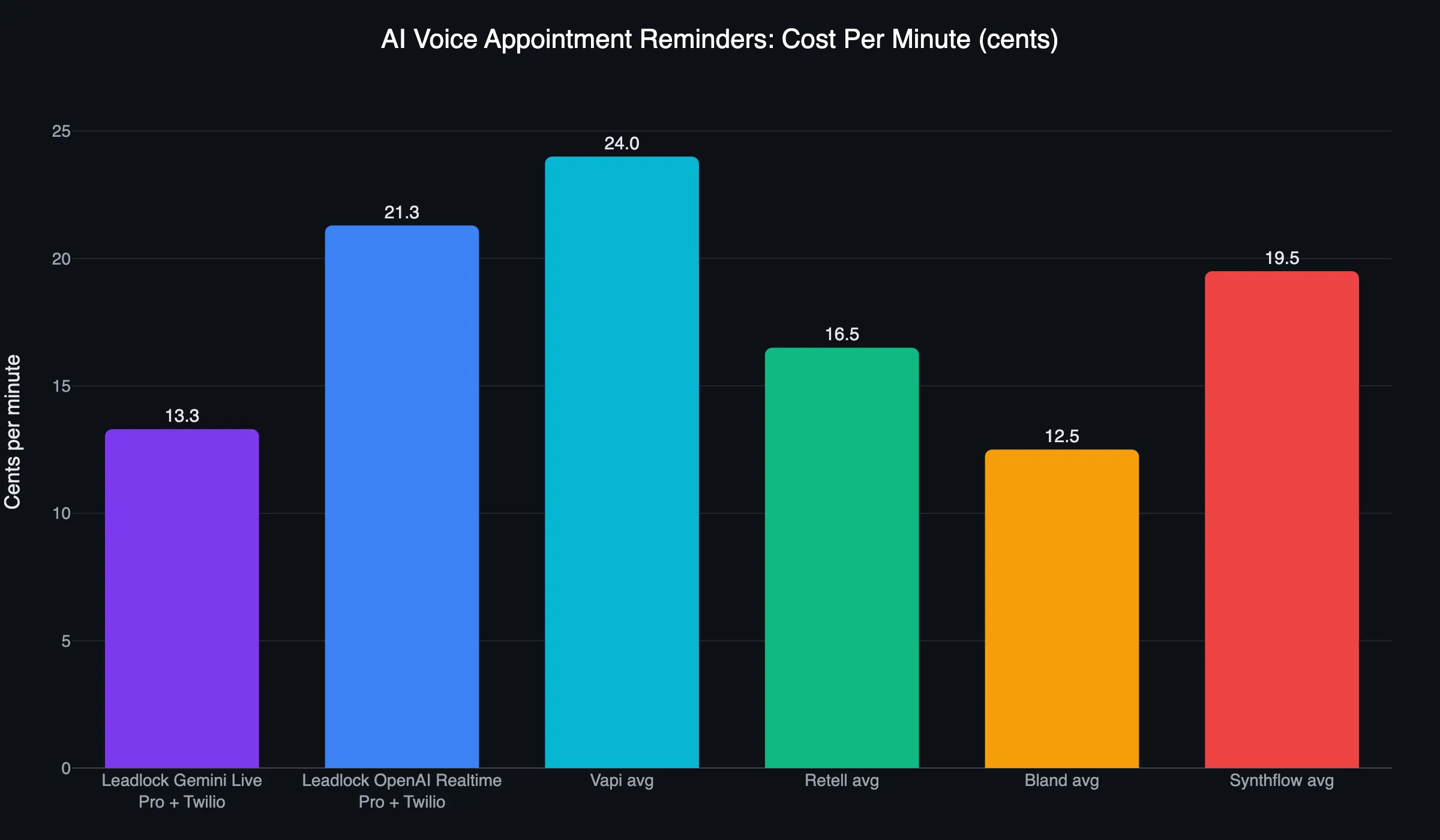
| Vapi | STT → LLM → TTS | Varies by stack | $0.05/min* | No | Partial |
| Retell AI | STT → LLM → TTS | Varies by stack | $0.07/min* | No | Partial |
| Bland AI | STT → LLM → TTS | Varies by stack | $0.11–0.14/min* | No | Limited |
| Synthflow | STT → LLM → TTS | Varies by stack | $0.09/min* | No | Limited |
*Competitor rates are advertised prices. Vapi, Retell and Synthflow exclude STT, LLM, and telephony costs; Bland adds transfer, SMS and TTS fees. Real all-in costs typically range $0.13–$0.33/min.
Vapi’s appointment booking agent does support 24/7 scheduling and real-time calendar integration. But the latency gap is real - and so is the pricing gap once you account for the full stack. Retell AI reports impressive scheduling NPS improvements at Pine Park Health (+38%) but doesn’t publish specific no-show reduction data.
At 1,000 reminder minutes a month, Leadlock Gemini costs about $296 on Starter: $97 plan fee, $180 in minutes at $0.18, and about $19 to Twilio on your own account (outbound calls at about $0.018/min plus $1.15 for the number, at Twilio’s US rates). Retell or Vapi with full STT, LLM, TTS and telephony costs run roughly $130-$330 for the same minutes, so at this volume they can cost less. Leadlock’s case at low volume is the speech-to-speech latency, not price.
Industries Seeing the Biggest No-Show Reductions
AI voice agents aren’t limited to healthcare. The no-show problem is universal, and the ROI follows the same pattern across industries.
Healthcare and Medical Practices
- 23–33% average no-show rate across outpatient settings
- $200 average revenue lost per missed appointment
- 88% of providers now use some form of automated reminder system
- Peer-reviewed results: 50–57% reduction with AI
Dental Offices Dental practices face high no-show rates with expensive chair-time costs. A single missed hygiene appointment can cost $150–300. AI reminder agents can confirm, reschedule, and fill cancellations without front desk involvement. For more on dental-specific workflows, see AI Voice Agents for Dental Offices in 2026.
Beauty, Fitness, and Service Industries No-show rates in service industries reach 30–50% in automotive, beauty, and restaurant settings, according to CallRounded’s 2025 analysis. A single hair salon chair running at 30% no-show loses roughly 2-3 appointments per stylist per day. At $80/appointment, that’s $160–240/day in recoverable revenue per chair.
Legal and Financial Services Consultation no-shows in legal and financial advisory practices are particularly costly because attorney time is non-recoverable and high-value. For practices booking $300–600 consultations, even a 20% improvement in show rates drives significant monthly revenue. See AI Voice Agents for Law Firms in 2026 for a breakdown of the intake workflow.
Physiotherapy and Allied Health Physiotherapy clinics and chiropractic practices have among the highest no-show rates - up to 20% - with French clinics reporting 25% fewer missed appointments after deploying AI voice reminders, according to CallRounded’s 2025 analysis.
What the Best-Performing AI Reminder Deployments Have in Common
Across the case studies and peer-reviewed research, the highest-performing deployments share a consistent set of features:
- EHR/CRM integration - The AI pulls appointment data directly from the practice management system, not a separate database. El Rio Health’s EHR integration eliminated manual data entry entirely.
- Two-way rescheduling - Patients can say “I need to reschedule” and the AI handles it in real time, including finding an available slot and confirming it.
- Bilingual or multilingual support - Serves patient populations that English-only systems miss.
- Multi-channel escalation - SMS confirmation first, voice call if unconfirmed, escalation to staff only for complex cases.
- Confirmation response rates above 70% - El Rio Health achieved >70% response rates, which the Emerging Global case study identifies as the threshold for meaningful no-show reduction.
- Same-day waitlist management - Automatically contacts waitlisted patients when cancellations occur, filling gaps before they become lost revenue.
For practices using GoHighLevel, Leadlock’s native GHL integration means reminder campaigns can be triggered directly from CRM pipeline stages - no Zapier bridges, no custom webhooks. Learn more about GHL-native voice automation in Best GoHighLevel AI Voice Agent Integrations for Agencies in 2026.
How Much Does AI Appointment Reminder Software Cost?
The cost question depends on volume and which voice quality tier fits your use case.
Leadlock Gemini - for high-volume reminder campaigns:
Monthly totals include the plan fee and Twilio on your own account (outbound reminder calls at about $0.018/min plus $1.15 for one number, at Twilio’s US rates).
| Plan | Rate | 1,000 min/month | 5,000 min/month |
|---|---|---|---|
| Starter ($97) | $0.18/min | $296 | $1,088 |
| Agency ($297) | $0.15/min | $466 | $1,138 |
| Pro ($497) | $0.12/min | $636 | $1,188 |
Leadlock OpenAI - for complex or stability-critical calls:
| Plan | Rate | 1,000 min/month |
|---|---|---|
| Starter ($97) | $0.25/min | $366 |
| Agency ($297) | $0.22/min | $536 |
| Pro ($497) | $0.20/min | $716 |
For context: if AI reminders recover one additional $200 appointment per day, that’s $6,000/month in recovered revenue. At 5,000 minutes of outreach on Gemini, you’re spending about $1,088 a month on Starter (plan fee and Twilio included) to recover $6,000, roughly 5.5:1 before accounting for staff time savings.
The AI Voice Agent ROI Calculator covers the full cost-per-call analysis if you want to model your specific volume.
Related how-to guide: Add reschedule, cancel and update contact tools to your voice agent.
Frequently Asked Questions
Q: How much can AI voice agents really reduce no-show rates?
Peer-reviewed research from the UAE shows a 50.7% reduction (odds ratio 0.43) across 135,393 appointments. Practitioner data ranges from 25% to 80% depending on implementation quality. The commonly cited 60% reduction figure sits at the midpoint of documented real-world results. The strongest results come from deployments with EHR integration, two-way rescheduling, and bilingual support.
Q: How does an AI voice agent handle rescheduling requests during a reminder call?
A properly implemented AI voice agent connects to your calendar system in real time. When a patient says they need to reschedule, the agent checks available slots, presents options, and confirms the new appointment - all within the same call. No human staff required. Leadlock books into GoHighLevel calendars out of the box, and ServiceTitan or anything else with an API can be connected. For medical practices, keep in mind that Leadlock is not HIPAA compliant and does not sign a BAA.
Q: What industries have the highest no-show rates?
Outpatient healthcare averages 23–33% no-show rates. Physiotherapy, chiropractic practices, and ophthalmology see rates up to 20% in European markets. Service industries including automotive, beauty, and restaurants experience 30–50% no-show rates. Legal, dental, and financial advisory practices typically see 15–25% depending on appointment type and lead time.
Q: How does AI voice agent latency affect appointment confirmation rates?
Response latency directly impacts whether patients perceive the call as natural or robotic. Traditional STT→LLM→TTS pipelines add silence at every hop, which signals “automated system” and drives hang-up rates. True speech-to-speech systems like Leadlock reply in about 300ms on Grok, with no separate transcription and text-to-speech chain, resulting in higher engagement and confirmation rates.
Q: What’s the ROI on AI appointment reminder systems?
El Rio Health documented $100,000/month in recovered revenue from a 32% reduction in no-shows. UPMC added $2.6 million annually. A mid-sized clinic with 100 weekly appointments and a 25% no-show rate recovers roughly $156,000/year from a 60% reduction. On Leadlock, 1,000 minutes of reminder calls costs about $296 a month on Starter, plan fee and Twilio included - a fraction of the revenue recovered.
Q: Can AI voice agents send reminders in multiple languages?
Yes. Bilingual and multilingual reminder campaigns significantly improve response rates in mixed-language patient populations. El Rio Health’s bilingual English/Spanish reminders achieved 70%+ response rates. On Leadlock, the ElevenLabs provider offers 15 selectable languages.
Q: How quickly can a business deploy AI appointment reminders?
Leadlock can be live in under 5 minutes with no SIP trunking required. Connecting a practice-management system or a CRM other than GoHighLevel runs through custom functions and that system’s API, so timing depends on API access and workflow configuration. Agencies using GoHighLevel can deploy directly through the native GHL integration with no additional technical setup.
Q: Do patients prefer AI or human reminder calls?
Research shows mixed preferences by channel: 67.3% of healthcare patients prefer text reminders overall (Gnani.ai), but voice reminders outperform SMS for complex scheduling situations where rescheduling is needed. The key finding is that response quality - not channel - drives confirmation rates. A natural-sounding AI voice that responds in real time outperforms a scripted robocall in every measured metric.
Ready to cut no-shows and recover lost revenue on autopilot? Leadlock delivers true speech-to-speech AI voice agents at rates starting from $0.12/minute - live in under 5 minutes, with native GoHighLevel integration and four voice providers to match any use case. Book a 15-minute call with Dan.
See It Book a Real Job
Voice agents that book into ServiceTitan and GoHighLevel, live today for home-service brands. Book 15 minutes with Dan, or start a 7-day trial from the pricing page.
Book a 15-minute call with Dan